Published in France in 1965, Le Tour de Gaule d’Astérix (known in English as Asterix and the Banquet) is the fifth album in the iconic series by writer René Goscinny and artist Albert Uderzo. This adventure represents a definitive turning point for the series, consolidating the narrative structure, comedic rhythm, and sociological satire that would define the “indomitable Gauls” for decades.

The story is built around a defiant wager. In response to the Roman Inspector General Overload’s attempt to isolate the village with a palisade, Asterix and Obelix set out to traverse Gaul. Their mission: to collect regional culinary specialties from across the country to prove that the Roman occupation cannot cut them off from their land.
A Satire of Modern France
Although set in 50 BC, the album is firmly anchored in the France of the early 1960s. Its structure is a masterful parody of the Tour de France, which in 1964 was a national obsession followed by 59% of the French population.
The journey unfolds like a multi-stage cycling race. The heroes move from region to region, pursued by Roman patrols (acting as the “peloton”) and welcomed by enthusiastic locals. The album plays with visual and verbal references to cycling culture, such as the “infernal pavements” mentioned by the legionary Milexcus—a nod to the grueling Paris-Roubaix race—and crowds cheering on the heroes as if they were legends like Jacques Anquetil or Raymond Poulidor.
The Evolution of the Itinerary
Before the final script was settled, René Goscinny went through several iterations of the journey. Early sketches and handwritten notes reveal a creative process of trial and error:
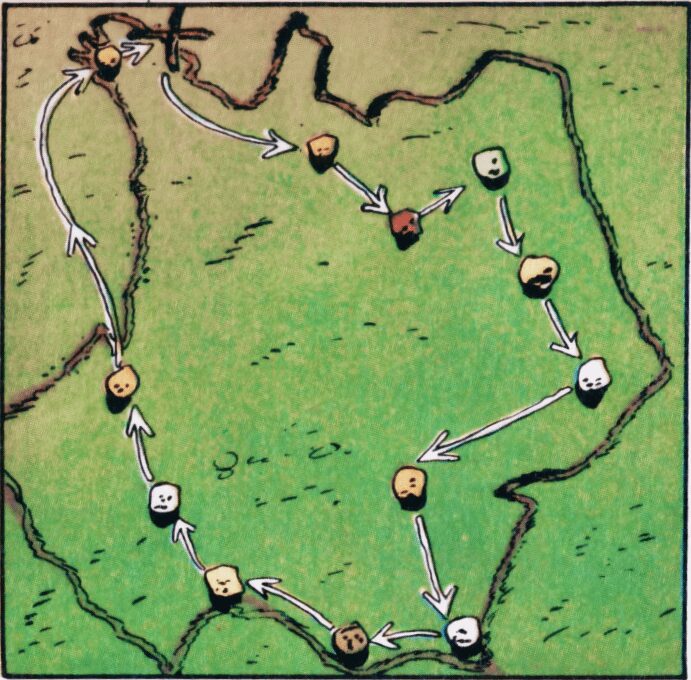
- The Direction: Original drafts show the duo traveling in a counter-clockwise direction. The final version famously follows a clockwise loop.
- The Specialties: Some early ideas were replaced to better fit the “greatest hits” of French cuisine. For instance, “chestnuts” from Brest and “sun-dials” from Besançon appeared in early sketches but were swapped for more iconic items like Crêpes from Gesocribate (Le Conquet) and Oysters and Wine from Burdigala (Bordeaux).
- The Cast: Goscinny’s preparatory notes show a massive list of potential character names, many of which were cut to maintain the 44-page limit, including names like Souletropix, Suffix, and Caius Cactus.
The Meaning Behind the Title
The original French title is a rich pun. It evokes both a “tour of Gaul” and the “Tour de France” bicycle race. While most European translations kept this connection (e.g., German: Tour de France; Spanish: La vuelta a la Galia), the English edition was titled Asterix and the Banquet.
English publishers opted for a title that highlighted the goal—the feast—rather than the journey. This was likely because the Tour de France was considered less central to Anglophone cultural identity in the 1970s. However, this shift inevitably downplays the central satirical device of the book.

The Birth of Dogmatix (Idéfix)
One of the most lasting contributions of this album is the introduction of Dogmatix (Idéfix). Remarkably, he was not in the original synopsis.
During the drawing phase, Uderzo felt certain panels looked “empty” and suggested adding a small dog. Goscinny turned this into a running visual gag: the dog follows the heroes throughout the entire journey, yet no one notices him until the final banquet when Obelix finally offers him a bone. His popularity was so immediate that a naming contest was held in Pilote magazine, resulting in the name Idéfix (a pun on idée fixe), translated into English as Dogmatix to preserve the punning tradition.
Four people came up with this name. They all received the album signed by Goscinny and Uderzo. Other suggestions that were made were: “Patarocur,” “Papadépif,” “Trépiéx,” “Pidépix,” “Toutoufix,” “Médorix,” “Caninix,” and many others.
Another first

On page 11 it is for the first time that Obelix wonders who they mean when he gets called a fat man. The joke gets repeated a few times and we know it is one that will stay.
Translation Challenges and Publication History
Le Tour de Gaule is regarded as one of the most difficult albums to translate due to its heavy reliance on French regional stereotypes and geography. This led to significant publication delays internationally:
- Delayed Release: The English edition didn’t appear until 1974, nearly a decade after the French original.
- Out of Sequence: Because of the translation difficulties, many countries published the albums out of order. In Germany and the UK, readers often encountered Dogmatix in later adventures (like Asterix and Cleopatra) before ever reading his “first” appearance in this album.
The Cities
We look at every stop along the tour in separate articles.
- The Ham of Lutetia
- The Treasures of Camaracum
- Asterix, Reims, and a Champagne Anachronism
- Betrayal in Divodurum
- The Labyrinth of Lugdunum
- A Taste of the Riviera
- A Visit to a Cinematic and Cultural Landmark
- Tolosa: A Stop We Never See
- Prunes, Poison, and Perfect Irony
- Burdigala: Why No Red Wine?
- The Final Stretch: Gésocribate and the Last “Specialty”

Legacy
Le Tour de Gaule d’Astérix was a milestone that turned the entire map of Gaul into a narrative stage. It proved that the series could sustain a long-form journey while balancing historical parody with 20th-century sociological observation. By introducing Dogmatix and refining the “travelogue” format, Goscinny and Uderzo created a template that would allow Asterix to conquer the world.


Published in France in 1965, Le Tour de Gaule d’Astérix (known in English as Asterix and the Banquet) is the fifth album in the iconic series by writer René Goscinny and artist Albert Uderzo. This adventure represents a definitive turning point for the series, consolidating the narrative structure, comedic rhythm, and sociological satire that would define the “indomitable Gauls” for decades.
The story is built around a defiant wager. In response to the Roman Inspector General Overload’s attempt to isolate the village with a palisade, Asterix and Obelix set out to traverse Gaul. Their mission: to collect regional culinary specialties from across the country to prove that the Roman occupation cannot cut them off from their land.
A Satire of Modern France
Although set in 50 BC, the album is firmly anchored in the France of the early 1960s. Its structure is a masterful parody of the Tour de France, which in 1964 was a national obsession followed by 59% of the French population.
The journey unfolds like a multi-stage cycling race. The heroes move from region to region, pursued by Roman patrols (acting as the “peloton”) and welcomed by enthusiastic locals. The album plays with visual and verbal references to cycling culture, such as the “infernal pavements” mentioned by the legionary Milexcus—a nod to the grueling Paris-Roubaix race—and crowds cheering on the heroes as if they were legends like Jacques Anquetil or Raymond Poulidor.
The Evolution of the Itinerary
Before the final script was settled, René Goscinny went through several iterations of the journey. Early sketches and handwritten notes reveal a creative process of trial and error:
- The Direction: Original drafts show the duo traveling in a counter-clockwise direction. The final version famously follows a clockwise loop.
- The Specialties: Some early ideas were replaced to better fit the “greatest hits” of French cuisine. For instance, “chestnuts” from Brest and “sun-dials” from Besançon appeared in early sketches but were swapped for more iconic items like Crêpes from Gesocribate (Le Conquet) and Oysters and Wine from Burdigala (Bordeaux).
- The Cast: Goscinny’s preparatory notes show a massive list of potential character names, many of which were cut to maintain the 44-page limit, including names like Souletropix, Suffix, and Caius Cactus.
The Meaning Behind the Title
The original French title is a rich pun. It evokes both a “tour of Gaul” and the “Tour de France” bicycle race. While most European translations kept this connection (e.g., German: Tour de France; Spanish: La vuelta a la Galia), the English edition was titled Asterix and the Banquet.
English publishers opted for a title that highlighted the goal—the feast—rather than the journey. This was likely because the Tour de France was considered less central to Anglophone cultural identity in the 1970s. However, this shift inevitably downplays the central satirical device of the book.
The Birth of Dogmatix (Idéfix)
One of the most lasting contributions of this album is the introduction of Dogmatix (Idéfix). Remarkably, he was not in the original synopsis.
During the drawing phase, Uderzo felt certain panels looked “empty” and suggested adding a small dog. Goscinny turned this into a running visual gag: the dog follows the heroes throughout the entire journey, yet no one notices him until the final banquet when Obelix finally offers him a bone. His popularity was so immediate that a naming contest was held in Pilote magazine, resulting in the name Idéfix (a pun on idée fixe), translated into English as Dogmatix to preserve the punning tradition.
Four people came up with this name. They all received the album signed by Goscinny and Uderzo. Other suggestions that were made were: “Patarocur,” “Papadépif,” “Trépiéx,” “Pidépix,” “Toutoufix,” “Médorix,” “Caninix,” and many others.
Another first
On page 11 it is for the first time that Obelix wonders who they mean when he gets called a fat man. The joke gets repeated a few times and we know it is one that will stay.
Translation Challenges and Publication History
Le Tour de Gaule is regarded as one of the most difficult albums to translate due to its heavy reliance on French regional stereotypes and geography. This led to significant publication delays internationally:
- Delayed Release: The English edition didn’t appear until 1974, nearly a decade after the French original.
- Out of Sequence: Because of the translation difficulties, many countries published the albums out of order. In Germany and the UK, readers often encountered Dogmatix in later adventures (like Asterix and Cleopatra) before ever reading his “first” appearance in this album.
The Cities
We look at every stop along the tour in separate articles.
- The Ham of Lutetia
- The Treasures of Camaracum
- Asterix, Reims, and a Champagne Anachronism
- Betrayal in Divodurum
- The Labyrinth of Lugdunum
- A Taste of the Riviera
- A Visit to a Cinematic and Cultural Landmark
- Tolosa: A Stop We Never See
- Prunes, Poison, and Perfect Irony
- Burdigala: Why No Red Wine?
- The Final Stretch: Gésocribate and the Last “Specialty”
Legacy
Le Tour de Gaule d’Astérix was a milestone that turned the entire map of Gaul into a narrative stage. It proved that the series could sustain a long-form journey while balancing historical parody with 20th-century sociological observation. By introducing Dogmatix and refining the “travelogue” format, Goscinny and Uderzo created a template that would allow Asterix to conquer the world.