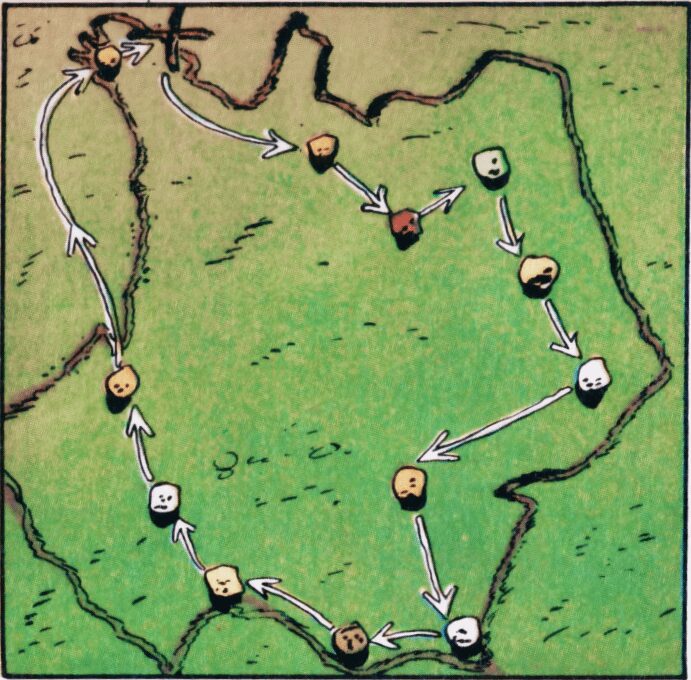
In this series of articles, we take a closer look at the places Asterix and Obelix visit during their journey across Gaul in Le Tour de Gaule d’Astérix, known in English as Asterix and the Banquet. The focus is on the original French version of the story and the regional context behind each stop. The album is widely regarded as one of the most difficult in the series to translate, as much of its humour depends on regional cuisine, cultural references, and wordplay. By exploring the historical background of each location, this series helps clarify the jokes and narrative details that make the journey so memorable.
One of the more unusual stops on the Gauls’ journey is Tolosa (Toulouse). Unlike the previous cities visited in the story, Toulouse never actually appears on panel. Instead, the episode focuses on Asterix and Obelix being captured by Roman soldiers who intend to transport them there.
Captured by the Romans
After leaving Marseille, Asterix and Obelix spend the night in what they believe is an open field. When they wake up the next morning, they quickly discover that they have unknowingly fallen asleep inside a Roman camp. Their presence is soon noticed, and a fight breaks out.

During the skirmish, the Romans mention that their prisoners will be taken to Toulouse. Hearing this, Asterix immediately recognizes an opportunity. Instead of continuing the fight, he and Obelix suddenly surrender to the centurion. If the Romans insist on taking them to Toulouse, they might as well enjoy the journey.
Before the patrol even sets out, however, the album introduces one of its recurring gags. While waiting to be transported, Asterix and Obelix repeatedly break out of their chains with ease. Each time, the unfortunate Roman soldier responsible for guarding them must put the chains back on again. The situation repeats several times, gradually driving the guard to distraction.

Eventually the patrol finally departs, placing the two Gauls on a cart while the Roman soldiers march alongside on foot. Asterix dryly remarks that although they are technically prisoners, they are the ones traveling comfortably while their captors must walk.
At one point the centurion rides ahead to inform the prefect of Toulouse that the famous Gauls have been captured. When he later returns to meet the patrol, he discovers that the inevitable has happened: Asterix and Obelix have escaped once again. In the final panel of the sequence, the two heroes are already on their way to the next stop, Agen, having taken the Roman cart—along with a supply of Toulouse sausages.
What’s in a name?
The prefect of Toulouse is named Yenapus, a typical example of the phonetic wordplay found throughout Le Tour de Gaule d’Astérix. Spoken aloud, the name sounds like the French phrase “Y en a plus!”, meaning “There are none left”—a fitting joke in a story where the Romans repeatedly fail to keep hold of their prisoners.

The Historical City of Tolosa
The Roman city of Tolosa stood on the site of modern Toulouse and was one of the most important settlements in southern Gaul. Before the Roman conquest, it served as the principal centre of the Volcae Tectosages, a Celtic tribe that dominated much of the region.
In 106 BCE the city was captured by Roman forces under Quintus Servilius Caepio. From that point onward, Tolosa became an important administrative and commercial centre within Roman Gaul. Its location along major trade routes connecting the Mediterranean to the Atlantic made it strategically valuable, while the fertile plains of the Garonne River supported agriculture and livestock.
Toulouse sausages

Although the comic never shows the city itself, the reference to Toulouse sausages reflects a well-known regional specialty. The saucisse de Toulouse is traditionally made from coarsely ground pork and simple seasoning and remains one of the culinary symbols of the region today.
Saucisse de Toulouse is the heavyweight champion of French sausages—famed for its simplicity, its meaty texture, and its starring role in a traditional Cassoulet. Unlike many other sausages that rely on heavy smoking or complex spice blends, this one is all about the quality of the pork.
In a true Label Rouge (the high-quality French certification) Saucisse de Toulouse, there are strictly no preservatives, water, or fillers like breadcrumbs.
While some modern or regional variations might sneak in a hint of garlic, nutmeg, or sugar, purists argue that the only “aromatics” allowed are salt and pepper.
Why Toulouse Never Appears in the Story
Because Toulouse never appears on panel, this part of the story stands out from the other stops in Le Tour de Gaule d’Astérix. Earlier cities in the album—such as Nice, Lyon, and Marseille—are filled with local jokes, regional stereotypes, and culinary references.

For Toulouse, the authors instead relied on the repeated gag of Asterix and Obelix breaking out of their chains. Some readers have noted that this sequence feels more repetitive than the richly detailed city visits elsewhere in the album.
At the same time, the decision may have been intentional. By this point in the story, the narrative pattern of the journey had already been firmly established: the Gauls arrive in a city, encounter local colour, collect a regional specialty, and evade the pursuing Romans. Repeating the same formula too often might have made the story predictable. By briefly skipping Toulouse itself, the authors changed the rhythm of the journey before sending Asterix and Obelix on to the next stop.


In this series of articles, we take a closer look at the places Asterix and Obelix visit during their journey across Gaul in Le Tour de Gaule d’Astérix, known in English as Asterix and the Banquet. The focus is on the original French version of the story and the regional context behind each stop. The album is widely regarded as one of the most difficult in the series to translate, as much of its humour depends on regional cuisine, cultural references, and wordplay. By exploring the historical background of each location, this series helps clarify the jokes and narrative details that make the journey so memorable.
One of the more unusual stops on the Gauls’ journey is Tolosa (Toulouse). Unlike the previous cities visited in the story, Toulouse never actually appears on panel. Instead, the episode focuses on Asterix and Obelix being captured by Roman soldiers who intend to transport them there.
Captured by the Romans
After leaving Marseille, Asterix and Obelix spend the night in what they believe is an open field. When they wake up the next morning, they quickly discover that they have unknowingly fallen asleep inside a Roman camp. Their presence is soon noticed, and a fight breaks out.
During the skirmish, the Romans mention that their prisoners will be taken to Toulouse. Hearing this, Asterix immediately recognizes an opportunity. Instead of continuing the fight, he and Obelix suddenly surrender to the centurion. If the Romans insist on taking them to Toulouse, they might as well enjoy the journey.
Before the patrol even sets out, however, the album introduces one of its recurring gags. While waiting to be transported, Asterix and Obelix repeatedly break out of their chains with ease. Each time, the unfortunate Roman soldier responsible for guarding them must put the chains back on again. The situation repeats several times, gradually driving the guard to distraction.
Eventually the patrol finally departs, placing the two Gauls on a cart while the Roman soldiers march alongside on foot. Asterix dryly remarks that although they are technically prisoners, they are the ones traveling comfortably while their captors must walk.
At one point the centurion rides ahead to inform the prefect of Toulouse that the famous Gauls have been captured. When he later returns to meet the patrol, he discovers that the inevitable has happened: Asterix and Obelix have escaped once again. In the final panel of the sequence, the two heroes are already on their way to the next stop, Agen, having taken the Roman cart—along with a supply of Toulouse sausages.
What’s in a name?
The prefect of Toulouse is named Yenapus, a typical example of the phonetic wordplay found throughout Le Tour de Gaule d’Astérix. Spoken aloud, the name sounds like the French phrase “Y en a plus!”, meaning “There are none left”—a fitting joke in a story where the Romans repeatedly fail to keep hold of their prisoners.
The Historical City of Tolosa
The Roman city of Tolosa stood on the site of modern Toulouse and was one of the most important settlements in southern Gaul. Before the Roman conquest, it served as the principal centre of the Volcae Tectosages, a Celtic tribe that dominated much of the region.
In 106 BCE the city was captured by Roman forces under Quintus Servilius Caepio. From that point onward, Tolosa became an important administrative and commercial centre within Roman Gaul. Its location along major trade routes connecting the Mediterranean to the Atlantic made it strategically valuable, while the fertile plains of the Garonne River supported agriculture and livestock.
Toulouse sausages
Although the comic never shows the city itself, the reference to Toulouse sausages reflects a well-known regional specialty. The saucisse de Toulouse is traditionally made from coarsely ground pork and simple seasoning and remains one of the culinary symbols of the region today.
Saucisse de Toulouse is the heavyweight champion of French sausages—famed for its simplicity, its meaty texture, and its starring role in a traditional Cassoulet. Unlike many other sausages that rely on heavy smoking or complex spice blends, this one is all about the quality of the pork.
In a true Label Rouge (the high-quality French certification) Saucisse de Toulouse, there are strictly no preservatives, water, or fillers like breadcrumbs.
While some modern or regional variations might sneak in a hint of garlic, nutmeg, or sugar, purists argue that the only “aromatics” allowed are salt and pepper.
Why Toulouse Never Appears in the Story
Because Toulouse never appears on panel, this part of the story stands out from the other stops in Le Tour de Gaule d’Astérix. Earlier cities in the album—such as Nice, Lyon, and Marseille—are filled with local jokes, regional stereotypes, and culinary references.
For Toulouse, the authors instead relied on the repeated gag of Asterix and Obelix breaking out of their chains. Some readers have noted that this sequence feels more repetitive than the richly detailed city visits elsewhere in the album.
At the same time, the decision may have been intentional. By this point in the story, the narrative pattern of the journey had already been firmly established: the Gauls arrive in a city, encounter local colour, collect a regional specialty, and evade the pursuing Romans. Repeating the same formula too often might have made the story predictable. By briefly skipping Toulouse itself, the authors changed the rhythm of the journey before sending Asterix and Obelix on to the next stop.