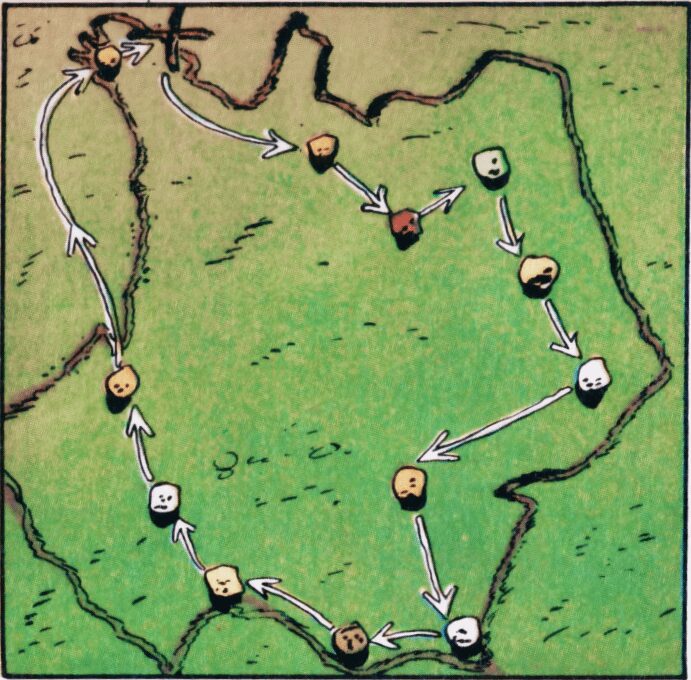
In this series of articles, we take a closer look at the places Asterix and Obelix visit during their journey around Gaul, focusing on the original French version of the story and the specific regional delicacies mentioned there. Le Tour de Gaule d’Astérix is widely regarded as one of the most difficult albums to translate, as much of its humor relies on cultural references, wordplay, and regional food traditions. By providing historical and culinary context, this series aims to clarify the puns that make this journey so distinctive.
In Asterix and the Banquet (Le Tour de Gaule d’Astérix), Asterix and Obelix travel across Roman-occupied Gaul to collect regional food specialties. On their second stop they visit Camaracum (modern-day Cambrai). Their goal is to get one specific product: its famous bêtises.
What’s in a Name?
The joke works only if you understand French. A bêtise literally means a blunder, mistake, or piece of nonsense. When Asterix enters a shop and asks for bêtises, he is not being absurd—he is ordering Cambrai’s most celebrated confection. The name itself directly refers to the candy’s supposed accidental origin and has become inseparable from the city’s identity.
The Stronghold of the North
Long before it became associated with sweets, Camaracum was an important Roman settlement. Located at a strategic crossroads of Roman roads, it connected Nemetacum (Arras) with Bagacum (Bavay), at the time the principal city of the Nervii. By the late fourth century, Camaracum replaced Bavay as the regional administrative capital. Its growing importance led the Romans to surround the city with substantial stone walls, confirming its role as a defensive and commercial stronghold in northern Gaul.
Bêtises de Cambrai: The “Mistake” That Conquered Gaul

Cambrai’s most famous export remains the Bêtises de Cambrai, hard rectangular mint candies distinguished by a characteristic stripe of caramelized sugar. Their origin is traditionally traced to the nineteenth century and is preserved mainly through local legend rather than documented history.
According to this story, a young apprentice working at the Afchain confectionery made a serious mistake while preparing a batch of mint sweets, either by misjudging the proportions or by working the sugar mass for too long. His mother is said to have scolded him with the words “Tu ne fais que des bêtises !” The supposedly failed candies were nonetheless sold to avoid waste and proved unexpectedly popular, valued for their refreshing flavor and reputed digestive qualities.
A Recognized Culinary Heritage
Today, Bêtises de Cambrai are officially listed in the Inventaire du patrimoine culinaire de la France, an inventory established in 1996 by the French Ministry of Culture and the Ministry of Agriculture to document and preserve regional food traditions. This designation acknowledges their historical importance and traditional method of production, without granting protected status such as AOP or IGP.

The candies are still produced using a traditional process in which the sugar mass is repeatedly stretched to incorporate air, creating a white center without artificial coloring. A long-running legal dispute once opposed the Afchain and Despinoy families over the authorship of the original recipe, but both houses continue to manufacture bêtises today, selling them in their distinctive decorative metal tins.
Lutetia : Previous stop | Next stop : Reims


In this series of articles, we take a closer look at the places Asterix and Obelix visit during their journey around Gaul, focusing on the original French version of the story and the specific regional delicacies mentioned there. Le Tour de Gaule d’Astérix is widely regarded as one of the most difficult albums to translate, as much of its humor relies on cultural references, wordplay, and regional food traditions. By providing historical and culinary context, this series aims to clarify the puns that make this journey so distinctive.
In Asterix and the Banquet (Le Tour de Gaule d’Astérix), Asterix and Obelix travel across Roman-occupied Gaul to collect regional food specialties. On their second stop they visit Camaracum (modern-day Cambrai). Their goal is to get one specific product: its famous bêtises.
What’s in a Name?
The joke works only if you understand French. A bêtise literally means a blunder, mistake, or piece of nonsense. When Asterix enters a shop and asks for bêtises, he is not being absurd—he is ordering Cambrai’s most celebrated confection. The name itself directly refers to the candy’s supposed accidental origin and has become inseparable from the city’s identity.
The Stronghold of the North
Long before it became associated with sweets, Camaracum was an important Roman settlement. Located at a strategic crossroads of Roman roads, it connected Nemetacum (Arras) with Bagacum (Bavay), at the time the principal city of the Nervii. By the late fourth century, Camaracum replaced Bavay as the regional administrative capital. Its growing importance led the Romans to surround the city with substantial stone walls, confirming its role as a defensive and commercial stronghold in northern Gaul.
Bêtises de Cambrai: The “Mistake” That Conquered Gaul
Cambrai’s most famous export remains the Bêtises de Cambrai, hard rectangular mint candies distinguished by a characteristic stripe of caramelized sugar. Their origin is traditionally traced to the nineteenth century and is preserved mainly through local legend rather than documented history.
According to this story, a young apprentice working at the Afchain confectionery made a serious mistake while preparing a batch of mint sweets, either by misjudging the proportions or by working the sugar mass for too long. His mother is said to have scolded him with the words “Tu ne fais que des bêtises !” The supposedly failed candies were nonetheless sold to avoid waste and proved unexpectedly popular, valued for their refreshing flavor and reputed digestive qualities.
A Recognized Culinary Heritage
Today, Bêtises de Cambrai are officially listed in the Inventaire du patrimoine culinaire de la France, an inventory established in 1996 by the French Ministry of Culture and the Ministry of Agriculture to document and preserve regional food traditions. This designation acknowledges their historical importance and traditional method of production, without granting protected status such as AOP or IGP.
The candies are still produced using a traditional process in which the sugar mass is repeatedly stretched to incorporate air, creating a white center without artificial coloring. A long-running legal dispute once opposed the Afchain and Despinoy families over the authorship of the original recipe, but both houses continue to manufacture bêtises today, selling them in their distinctive decorative metal tins.
Lutetia : Previous stop | Next stop : Reims