Released in 1970, Asterix in Switzerland (Astérix chez les Helvètes) marks a fascinating turning point in the adventures of our indomitable Gauls. Coming right after the societal satire of The Roman Agent, this sixteenth album pushed the series into even more mature territory. It features genuine political corruption, attempted murder, direct cinematic parodies, and a script so densely packed with 1970s French cultural references that even the legendary translators Anthea Bell and Derek Hockridge couldn’t bring them all across the channel.
For English-speaking fans looking to uncover the secrets of the original French release, here is a deep dive into the background, the story, and the hidden wordplay of this Alpine masterpiece.
A Presidential Pitch

When fans ask where René Goscinny and Albert Uderzo got their ideas, the answer for this album is surprisingly high-profile. During the 1960s, the duo had a tradition of sending their new albums to the French Prime Minister, Georges Pompidou. (They never dared send them to President Charles de Gaulle, who famously considered Tintin to be his only international rival).
Pompidou sent them a congratulatory note back, adding a little suggestion: “Why don’t you do Asterix in Helvetia?” The authors were stunned. As Uderzo later recalled, they thought, “No way… now he’s giving us ideas!” To protect their artistic dignity and prove they weren’t simply taking orders from the government, they intentionally delayed the project. They waited until 1970—shortly after Pompidou had actually become President of France—to finally send Asterix and Obelix to the land of chocolate, cheese, and secret bank accounts.
A Darker Tone: Orgies, Poison, and Satyricon
Goscinny explicitly stated on French television that the comic book audience was growing up, meaning the authors could now tackle harsher themes without fear of shocking readers.
This album deals with actual corruption, greed, and assassination. Enter Garovirus, the spectacularly vile Roman governor of Condate. Unlike the usual bumbling Romans, Garovirus is genuinely malevolent. He’s a compulsive poisoner with toxic rings on every finger, hoarding wealth stolen from Rome.
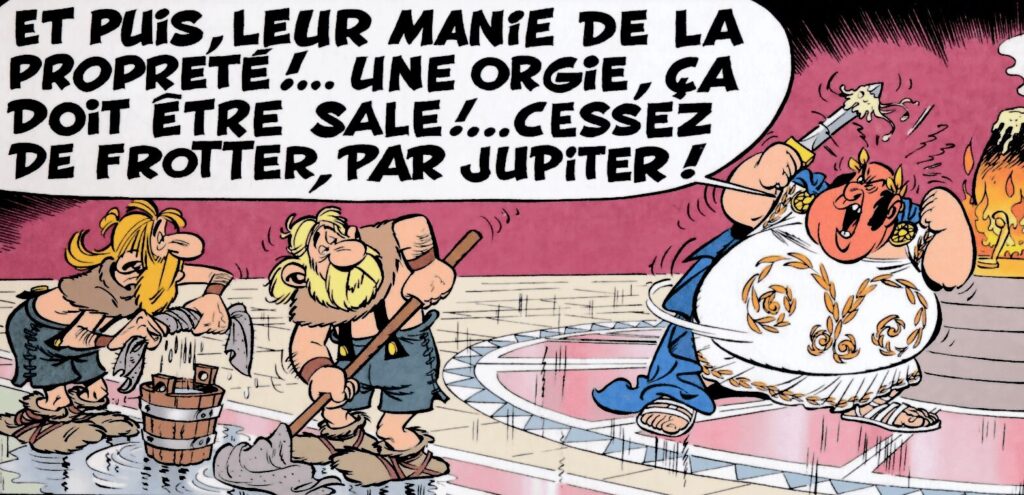
His decadent lifestyle was directly inspired by Federico Fellini’s film Satyricon, which had hit theaters the year prior in 1969. Uderzo and Goscinny went all-in on this parody, creating orgies filled with grotesque, heavily made-up guests gorging themselves in a dark, claustrophobic atmosphere. The original French script even explicitly name-drops the film as a reference for Uderzo to draw from. While Uderzo’s depictions were incredibly mild compared to Fellini’s film, it still caused a “mini-scandal” in France among parents and politicians who were shocked to see such debauchery in a comic strip.
The MacGuffin and the Masterclass in Stereotypes
When Garovirus poisons the upright Roman quaestor Malosinus, Getafix realizes he needs a rare flower to cure him: the “Silver Star,” or Edelweiss.

Goscinny framed this quest around a classic cinematic trope coined by director Alfred Hitchcock: the MacGuffin. A MacGuffin is an object that drives the plot and the characters’ motivations, even if it isn’t intrinsically important. The Edelweiss perfectly serves this role, standing as a pristine, fragile symbol of purity against the filth of Roman corruption.
Along the way, the authors deliver a masterclass in poking fun at national stereotypes. Goscinny actually made a checklist of Swiss clichés to pace throughout the story:
- Extreme Cleanliness: The moment the Gauls cross the border, the difference is stark. The Roman Empire sign on the Gallic side is covered in moss; on the Helvetian side, it is gleaming and spotless. The Swiss innkeeper Petisuix even has to force himself to dirty his own inn to hide our messy heroes.
- Bank Secrecy: The character Zurix embodies the legendary discretion of Swiss banks. When he has to admit his bank might not be 100% secure to save the Gauls, it causes him a near-existential crisis.
- The Red Cross: When a Helvetian knocks out a Roman soldier, he immediately starts bandaging the poor guy’s face. When the Roman asks why he’s treating him after hitting him, the Helvetian replies that it’s a calling to help all belligerents.
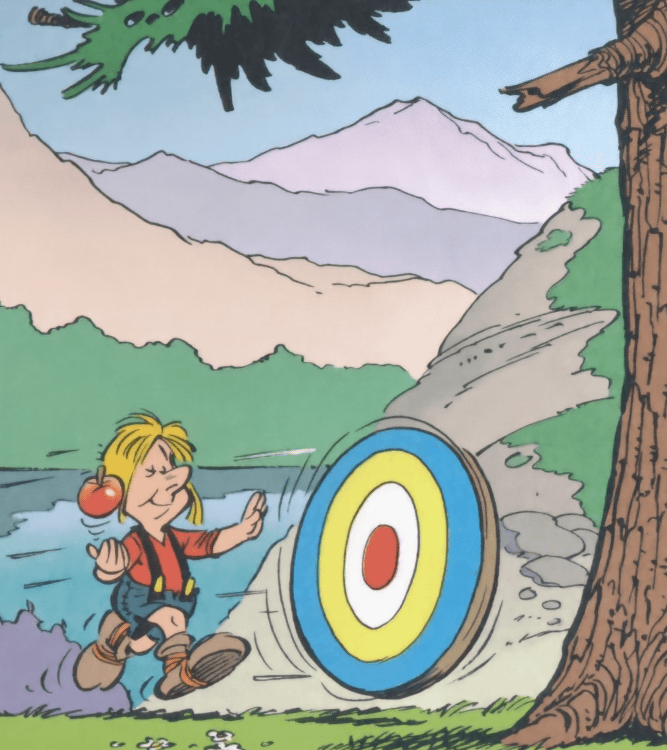
- William Tell: Asterix partakes in an archery contest and hits the bullseye perfectly—but entirely misses the apple placed on a boy’s head. The crowd is disappointed, though they don’t quite know why. A brilliant historical premonition!
- The “Cuckoo” Clocks: Since mechanical clocks didn’t exist in 50 BC, the Swiss rely on hourglasses. But to keep their famous punctuality, people are employed to pop out of windows and yell “Cuckoo!” so citizens remember to flip them.
Lost in Translation: The Hidden French Wordplay
While the story itself translates beautifully, Goscinny’s hyper-specific French cultural puns are incredibly difficult to adapt. Here are some of the best Easter eggs hiding in the original French text:
The Unionized Shield Bearers
At the very beginning of the album, Chief Vitalstatistix falls off his shield because his porters are distracted. He complains that a chief is wrong to displease his “base” and deprive himself of its “soutien”. In French, base means the physical base (the shield-bearers) but is also the common term for the working-class union base. Soutien means physical support, but also political backing. Goscinny turned a simple slapstick gag into a brilliant satire of a 1970s French labor union dispute!
Serving a “Half”
Because of the height difference between Asterix and Obelix, Obelix ends up carrying the Chief’s shield all by himself with one hand, draping a cleaning rag over his other arm. The Chief complains that this makes him feel like a “demi-chef” (a half-chief). When Getafix asks what Obelix is doing, Asterix replies: “Il est en train de servir un demi.” In French, un demi translates to “a half,” but it is also the standard order for a half-pint of draft beer. Obelix looks exactly like a Parisian café waiter serving a drink.
Ancient Autoroutes and the Michelin Man

The 1970s saw a massive boom in French highway (autoroute) construction. Goscinny pokes fun at this by having the Gauls travel on a “charovoie” (chariot-way/autoroute), eat at a “restovoie” (restoroute/highway diner), and sleep in a “charotel” (motel). The Roman road signs even feature two crossed, dirty hands, mocking the crossed knife-and-fork signs of modern highway rest stops. When they pull into a service station to fix a chariot wheel, Obelix notices a “drôle de bonhomme” (funny little man) made of white rings. In the original it was the mascotte for Antar, but in the early English releases of the album this was an ancient Roman cameo of Bibendum, the famous Michelin Man!
Satire and Bureaucracy
While counting his corrupt wealth, Garovirus mentions collecting a tax for the right to listen to public criers. This is a direct jab at the redevance audiovisuelle—the mandatory tax French citizens had to pay to fund public television and radio stations. Later, when Garovirus needs a snack for his journey, he asks for a “panier-orgie.” This is a clever play on panier-repas, the standard French term for a packed lunch. Because he’s so decadent, his packed lunch is a packed orgy.
Deep into Swiss Waters

Once the Gauls cross the border, Goscinny takes famous Swiss tropes and turns them into a rapid-fire series of literal idioms:
- Declaring Hunger: At the border, the customs officer asks if they have anything to “déclarer” (declare goods). Obelix simply answers, “I’m hungry” (declaring a statement).
- Fed Up: When the Roman soldiers are drowning in cheese fondue, one yells, “J’en ai ras la marmite !” The common French expression for “I’m fed up” is j’en ai ras-le-bol (my bowl is full). Here, the bowl is replaced by the national fondue pot (marmite).
- Lake Puns: The presence of Lake Geneva allows for aquatic puns. The Gauls are warned not to “se mouiller” (get wet / take a political risk), and when they are rescued from the water, they thank the Swiss for “tirer du lac”—a pun on nous tirer de là (getting us out of a bad situation).
- The Empty Stomach: Obelix complains that eating Gruyère cheese with so many holes hasn’t fixed his “creux”. In French, creux means a hole or hollow, but avoir un creux means to have an empty stomach. Eating holes didn’t fix his hole!
Ultimately, Asterix in Switzerland is a masterpiece of its era. It brilliantly balanced the slapstick humor of a cheese fondue gone wrong with a sharp, satirical look at 1970s political paranoia, making it a timeless classic that rewards readers no matter what language they read it in.


Released in 1970, Asterix in Switzerland (Astérix chez les Helvètes) marks a fascinating turning point in the adventures of our indomitable Gauls. Coming right after the societal satire of The Roman Agent, this sixteenth album pushed the series into even more mature territory. It features genuine political corruption, attempted murder, direct cinematic parodies, and a script so densely packed with 1970s French cultural references that even the legendary translators Anthea Bell and Derek Hockridge couldn’t bring them all across the channel.
For English-speaking fans looking to uncover the secrets of the original French release, here is a deep dive into the background, the story, and the hidden wordplay of this Alpine masterpiece.
A Presidential Pitch
When fans ask where René Goscinny and Albert Uderzo got their ideas, the answer for this album is surprisingly high-profile. During the 1960s, the duo had a tradition of sending their new albums to the French Prime Minister, Georges Pompidou. (They never dared send them to President Charles de Gaulle, who famously considered Tintin to be his only international rival).
Pompidou sent them a congratulatory note back, adding a little suggestion: “Why don’t you do Asterix in Helvetia?” The authors were stunned. As Uderzo later recalled, they thought, “No way… now he’s giving us ideas!” To protect their artistic dignity and prove they weren’t simply taking orders from the government, they intentionally delayed the project. They waited until 1970—shortly after Pompidou had actually become President of France—to finally send Asterix and Obelix to the land of chocolate, cheese, and secret bank accounts.
A Darker Tone: Orgies, Poison, and Satyricon
Goscinny explicitly stated on French television that the comic book audience was growing up, meaning the authors could now tackle harsher themes without fear of shocking readers.
This album deals with actual corruption, greed, and assassination. Enter Garovirus, the spectacularly vile Roman governor of Condate. Unlike the usual bumbling Romans, Garovirus is genuinely malevolent. He’s a compulsive poisoner with toxic rings on every finger, hoarding wealth stolen from Rome.
His decadent lifestyle was directly inspired by Federico Fellini’s film Satyricon, which had hit theaters the year prior in 1969. Uderzo and Goscinny went all-in on this parody, creating orgies filled with grotesque, heavily made-up guests gorging themselves in a dark, claustrophobic atmosphere. The original French script even explicitly name-drops the film as a reference for Uderzo to draw from. While Uderzo’s depictions were incredibly mild compared to Fellini’s film, it still caused a “mini-scandal” in France among parents and politicians who were shocked to see such debauchery in a comic strip.
The MacGuffin and the Masterclass in Stereotypes
When Garovirus poisons the upright Roman quaestor Malosinus, Getafix realizes he needs a rare flower to cure him: the “Silver Star,” or Edelweiss.
Goscinny framed this quest around a classic cinematic trope coined by director Alfred Hitchcock: the MacGuffin. A MacGuffin is an object that drives the plot and the characters’ motivations, even if it isn’t intrinsically important. The Edelweiss perfectly serves this role, standing as a pristine, fragile symbol of purity against the filth of Roman corruption.
Along the way, the authors deliver a masterclass in poking fun at national stereotypes. Goscinny actually made a checklist of Swiss clichés to pace throughout the story:
- Extreme Cleanliness: The moment the Gauls cross the border, the difference is stark. The Roman Empire sign on the Gallic side is covered in moss; on the Helvetian side, it is gleaming and spotless. The Swiss innkeeper Petisuix even has to force himself to dirty his own inn to hide our messy heroes.
- Bank Secrecy: The character Zurix embodies the legendary discretion of Swiss banks. When he has to admit his bank might not be 100% secure to save the Gauls, it causes him a near-existential crisis.
- The Red Cross: When a Helvetian knocks out a Roman soldier, he immediately starts bandaging the poor guy’s face. When the Roman asks why he’s treating him after hitting him, the Helvetian replies that it’s a calling to help all belligerents.
- William Tell: Asterix partakes in an archery contest and hits the bullseye perfectly—but entirely misses the apple placed on a boy’s head. The crowd is disappointed, though they don’t quite know why. A brilliant historical premonition!
- The “Cuckoo” Clocks: Since mechanical clocks didn’t exist in 50 BC, the Swiss rely on hourglasses. But to keep their famous punctuality, people are employed to pop out of windows and yell “Cuckoo!” so citizens remember to flip them.
Lost in Translation: The Hidden French Wordplay
While the story itself translates beautifully, Goscinny’s hyper-specific French cultural puns are incredibly difficult to adapt. Here are some of the best Easter eggs hiding in the original French text:
The Unionized Shield Bearers
At the very beginning of the album, Chief Vitalstatistix falls off his shield because his porters are distracted. He complains that a chief is wrong to displease his “base” and deprive himself of its “soutien”. In French, base means the physical base (the shield-bearers) but is also the common term for the working-class union base. Soutien means physical support, but also political backing. Goscinny turned a simple slapstick gag into a brilliant satire of a 1970s French labor union dispute!
Serving a “Half”
Because of the height difference between Asterix and Obelix, Obelix ends up carrying the Chief’s shield all by himself with one hand, draping a cleaning rag over his other arm. The Chief complains that this makes him feel like a “demi-chef” (a half-chief). When Getafix asks what Obelix is doing, Asterix replies: “Il est en train de servir un demi.” In French, un demi translates to “a half,” but it is also the standard order for a half-pint of draft beer. Obelix looks exactly like a Parisian café waiter serving a drink.
Ancient Autoroutes and the Michelin Man
The 1970s saw a massive boom in French highway (autoroute) construction. Goscinny pokes fun at this by having the Gauls travel on a “charovoie” (chariot-way/autoroute), eat at a “restovoie” (restoroute/highway diner), and sleep in a “charotel” (motel). The Roman road signs even feature two crossed, dirty hands, mocking the crossed knife-and-fork signs of modern highway rest stops. When they pull into a service station to fix a chariot wheel, Obelix notices a “drôle de bonhomme” (funny little man) made of white rings. In the original it was the mascotte for Antar, but in the early English releases of the album this was an ancient Roman cameo of Bibendum, the famous Michelin Man!
Satire and Bureaucracy
While counting his corrupt wealth, Garovirus mentions collecting a tax for the right to listen to public criers. This is a direct jab at the redevance audiovisuelle—the mandatory tax French citizens had to pay to fund public television and radio stations. Later, when Garovirus needs a snack for his journey, he asks for a “panier-orgie.” This is a clever play on panier-repas, the standard French term for a packed lunch. Because he’s so decadent, his packed lunch is a packed orgy.
Deep into Swiss Waters
Once the Gauls cross the border, Goscinny takes famous Swiss tropes and turns them into a rapid-fire series of literal idioms:
- Declaring Hunger: At the border, the customs officer asks if they have anything to “déclarer” (declare goods). Obelix simply answers, “I’m hungry” (declaring a statement).
- Fed Up: When the Roman soldiers are drowning in cheese fondue, one yells, “J’en ai ras la marmite !” The common French expression for “I’m fed up” is j’en ai ras-le-bol (my bowl is full). Here, the bowl is replaced by the national fondue pot (marmite).
- Lake Puns: The presence of Lake Geneva allows for aquatic puns. The Gauls are warned not to “se mouiller” (get wet / take a political risk), and when they are rescued from the water, they thank the Swiss for “tirer du lac”—a pun on nous tirer de là (getting us out of a bad situation).
- The Empty Stomach: Obelix complains that eating Gruyère cheese with so many holes hasn’t fixed his “creux”. In French, creux means a hole or hollow, but avoir un creux means to have an empty stomach. Eating holes didn’t fix his hole!
Ultimately, Asterix in Switzerland is a masterpiece of its era. It brilliantly balanced the slapstick humor of a cheese fondue gone wrong with a sharp, satirical look at 1970s political paranoia, making it a timeless classic that rewards readers no matter what language they read it in.