While René Goscinny and Albert Uderzo are famous for peppering the Asterix series with mock-Latin and Roman satire, their albums are equally rich in references to world literature, philosophy, and history. Beneath the slapstick fights and boar feasts lies a sophisticated layer of intertextual humor.
For this article, we have carefully consulted the original French editions of the albums to verify the wording and context of the quotations discussed below. Many of these jokes are sharper—and sometimes slightly different—than in translation. These “Gallicized” quotations reward attentive readers who recognize the source material. Here is a closer look at some of the most memorable examples.
Shakespeare in Gaul
The works of William Shakespeare are frequent targets for playful parody.

In Asterix in Spain, the village smith Cétautomatix erupts in frustration over the smell of fish and cries out: “Un poisson ! Un poisson ! Mon royaume pour un poisson !” This is a direct parody of the famous line from Richard III: “A horse! A horse! My kingdom for a horse!”
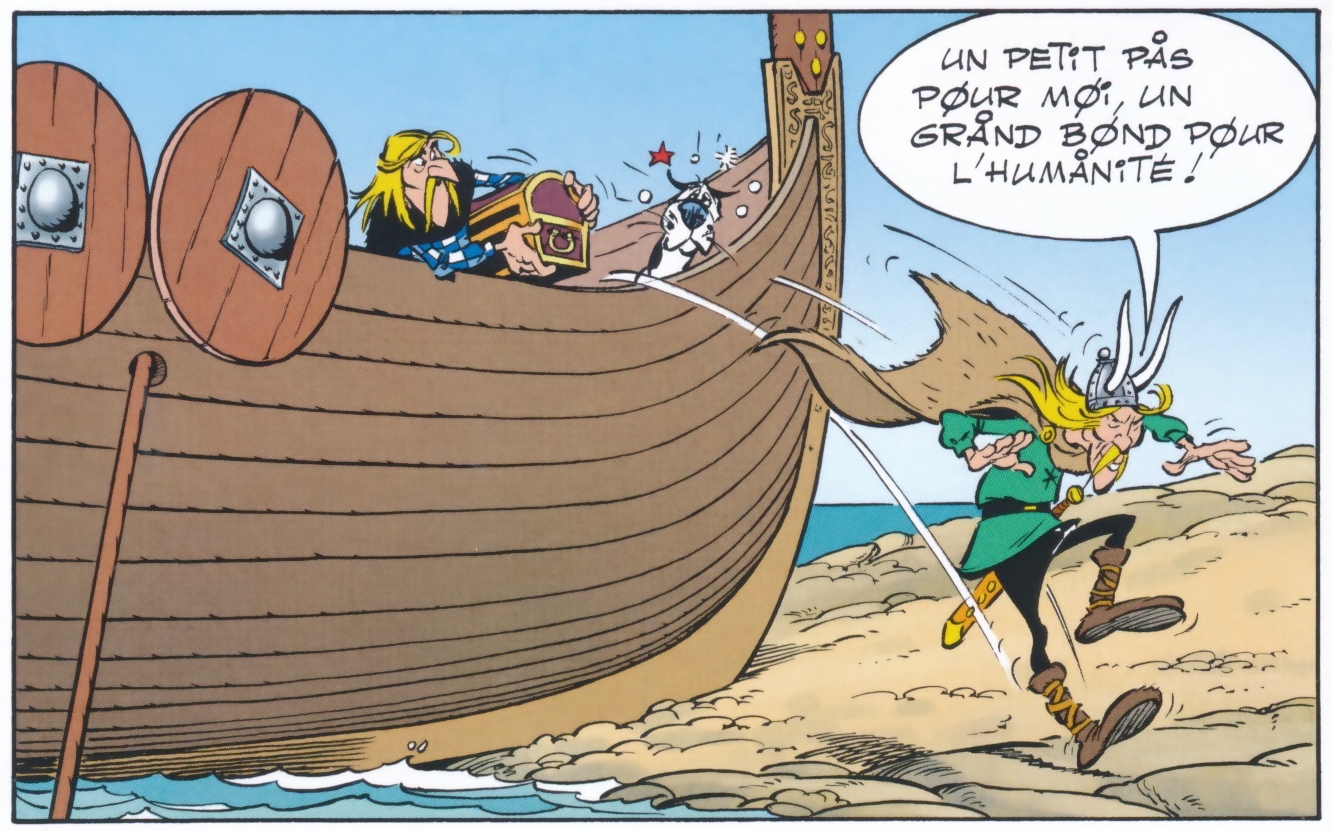
Shakespeare appears again in Asterix and the Great Crossing. The Viking Kerøsen solemnly declares: “Tø be ør nøt tø be, thåt is the questiøn,” unmistakably echoing Hamlet’s soliloquy. In the same album, the Viking’s dramatic landing on new shores recalls the words of Neil Armstrong during the 1969 moon landing: “One small step for man, one giant leap for mankind.” The juxtaposition of Shakespearean existentialism and twentieth-century space exploration in a supposedly ancient setting is classic Asterix absurdity.
French Drama and Fables Reimagined
French literary heritage provides equally fertile ground.
In Asterix in Britain, a Roman legionnaire attempts reassurance with the line: “Vaincre sans péril, c’est éviter les ennuis !” This twists the celebrated verse from Le Cid (1637) by Pierre Corneille: “À vaincre sans péril, on triomphe sans gloire.” The original speaks of glory; the comic version reduces it to merely “avoiding trouble.”
The fables of Jean de La Fontaine also receive affectionate parody. In The Great Divide, Acidenitrix solemnly recites the moral from “The Lion and the Rat”: “Patience et longueur de temps font plus que force ni que rage,” only to break the fourth wall by wondering how he comes up with such elevated phrasing.
In The Roman Agent, the manipulative Tortuous Convolvulus adapts a proverb popularized by La Fontaine’s “The Bear and the Two Companions”: warning others not to “sell the boar’s skin before you’ve killed it,” a rustic Gaulish variation of “don’t sell the bear’s skin before you have killed the bear.”
Philosophy and Historical Grandeur

Philosophy is not spared the comic treatment.
In Asterix the Legionary, the password for a Roman camp plays on the philosophical axiom of René Descartes from Principia Philosophiae (1644): “Cogito, ergo sum” (“I think, therefore I am”). The album humorously fragments the logic into an absurd exchange—turning a foundational statement of Western philosophy into a throwaway gag.
Historical rhetoric fares no better. In Asterix and Cleopatra, Getafix gazes at the pyramids and declares: “Du haut de ces pyramides, vingt siècles vous contemplent.” The line deliberately echoes the speech attributed to Napoleon Bonaparte before the Battle of the Pyramids in 1798—although Napoleon’s version famously invoked “quarante siècles” (forty centuries). The reduction to twenty centuries fits the comic chronology of the Asterix universe.
Proverbs, Maxims, and Everyday Wisdom
Beyond high literature, Goscinny and Uderzo delighted in reshaping proverbs and idioms.
In The Mansions of the Gods, a Roman senator solemnly quotes the Delphic maxim “Gnôthi seauton” (“Know thyself”), only to confess that he has no idea what it means—because “it’s Greek.” The joke works on multiple levels: Roman disdain for Greek culture, classical erudition, and everyday ignorance.
In Asterix and the Chieftain’s Shield, the English phrase “Time is money” becomes “Le temps, c’est des sesterces,” perfectly adapting modern capitalist logic to ancient Roman currency.
And of course, the proverb “All roads lead to Rome” surfaces repeatedly throughout the series, usually uttered by weary travelers or lost legionnaires—only for events to prove the opposite.
A Sophisticated Comic Tradition
These examples illustrate how deeply rooted the Asterix series is in European cultural tradition. Far from being simple children’s comics, the albums operate on multiple levels. Younger readers enjoy the physical comedy and caricatures; older readers recognize Shakespearean tragedy, seventeenth-century French drama, Enlightenment philosophy, and Napoleonic legend hidden in plain sight.
By consulting the original French albums, it becomes clear that many of these literary allusions are even more precise—and more playful—than translations sometimes suggest. This layered humor is part of what has made Asterix a lasting classic: a series where Gauls, Romans, philosophers, and playwrights all share the same battlefield—and everyone, sooner or later, ends up in a punchline.


While René Goscinny and Albert Uderzo are famous for peppering the Asterix series with mock-Latin and Roman satire, their albums are equally rich in references to world literature, philosophy, and history. Beneath the slapstick fights and boar feasts lies a sophisticated layer of intertextual humor.
For this article, we have carefully consulted the original French editions of the albums to verify the wording and context of the quotations discussed below. Many of these jokes are sharper—and sometimes slightly different—than in translation. These “Gallicized” quotations reward attentive readers who recognize the source material. Here is a closer look at some of the most memorable examples.
Shakespeare in Gaul
The works of William Shakespeare are frequent targets for playful parody.
In Asterix in Spain, the village smith Cétautomatix erupts in frustration over the smell of fish and cries out: “Un poisson ! Un poisson ! Mon royaume pour un poisson !” This is a direct parody of the famous line from Richard III: “A horse! A horse! My kingdom for a horse!”
Shakespeare appears again in Asterix and the Great Crossing. The Viking Kerøsen solemnly declares: “Tø be ør nøt tø be, thåt is the questiøn,” unmistakably echoing Hamlet’s soliloquy. In the same album, the Viking’s dramatic landing on new shores recalls the words of Neil Armstrong during the 1969 moon landing: “One small step for man, one giant leap for mankind.” The juxtaposition of Shakespearean existentialism and twentieth-century space exploration in a supposedly ancient setting is classic Asterix absurdity.
French Drama and Fables Reimagined
French literary heritage provides equally fertile ground.
In Asterix in Britain, a Roman legionnaire attempts reassurance with the line: “Vaincre sans péril, c’est éviter les ennuis !” This twists the celebrated verse from Le Cid (1637) by Pierre Corneille: “À vaincre sans péril, on triomphe sans gloire.” The original speaks of glory; the comic version reduces it to merely “avoiding trouble.”
The fables of Jean de La Fontaine also receive affectionate parody. In The Great Divide, Acidenitrix solemnly recites the moral from “The Lion and the Rat”: “Patience et longueur de temps font plus que force ni que rage,” only to break the fourth wall by wondering how he comes up with such elevated phrasing.
In The Roman Agent, the manipulative Tortuous Convolvulus adapts a proverb popularized by La Fontaine’s “The Bear and the Two Companions”: warning others not to “sell the boar’s skin before you’ve killed it,” a rustic Gaulish variation of “don’t sell the bear’s skin before you have killed the bear.”
Philosophy and Historical Grandeur
Philosophy is not spared the comic treatment.
In Asterix the Legionary, the password for a Roman camp plays on the philosophical axiom of René Descartes from Principia Philosophiae (1644): “Cogito, ergo sum” (“I think, therefore I am”). The album humorously fragments the logic into an absurd exchange—turning a foundational statement of Western philosophy into a throwaway gag.
Historical rhetoric fares no better. In Asterix and Cleopatra, Getafix gazes at the pyramids and declares: “Du haut de ces pyramides, vingt siècles vous contemplent.” The line deliberately echoes the speech attributed to Napoleon Bonaparte before the Battle of the Pyramids in 1798—although Napoleon’s version famously invoked “quarante siècles” (forty centuries). The reduction to twenty centuries fits the comic chronology of the Asterix universe.
Proverbs, Maxims, and Everyday Wisdom
Beyond high literature, Goscinny and Uderzo delighted in reshaping proverbs and idioms.
In The Mansions of the Gods, a Roman senator solemnly quotes the Delphic maxim “Gnôthi seauton” (“Know thyself”), only to confess that he has no idea what it means—because “it’s Greek.” The joke works on multiple levels: Roman disdain for Greek culture, classical erudition, and everyday ignorance.
In Asterix and the Chieftain’s Shield, the English phrase “Time is money” becomes “Le temps, c’est des sesterces,” perfectly adapting modern capitalist logic to ancient Roman currency.
And of course, the proverb “All roads lead to Rome” surfaces repeatedly throughout the series, usually uttered by weary travelers or lost legionnaires—only for events to prove the opposite.
A Sophisticated Comic Tradition
These examples illustrate how deeply rooted the Asterix series is in European cultural tradition. Far from being simple children’s comics, the albums operate on multiple levels. Younger readers enjoy the physical comedy and caricatures; older readers recognize Shakespearean tragedy, seventeenth-century French drama, Enlightenment philosophy, and Napoleonic legend hidden in plain sight.
By consulting the original French albums, it becomes clear that many of these literary allusions are even more precise—and more playful—than translations sometimes suggest. This layered humor is part of what has made Asterix a lasting classic: a series where Gauls, Romans, philosophers, and playwrights all share the same battlefield—and everyone, sooner or later, ends up in a punchline.