Recently, I shared a few panels from the Latin edition of L’Odyssée d’Astérix (Asterix and the Black Gold) in a dedicated Asterix fan group. The panels featured the druid Panoramix, thoroughly intoxicated after drinking a strong grain spirit from Caledonia, singing in fluent Latin. The post prompted an interesting question: how was this scene handled in other languages?
That question sent me back to the French original and then through several editions in my collection. I used an AI chatbot as a translation aid for some of the regional slang and unfamiliar expressions, but the albums themselves provided the essential evidence. What I found was more interesting than a series of different translations. The French, Latin, English, German, Dutch, and Spanish editions all solve the same problem in different ways: how do you preserve a joke whose humor depends on a song, a cultural reference, and the ancient Gaulish setting all at once?
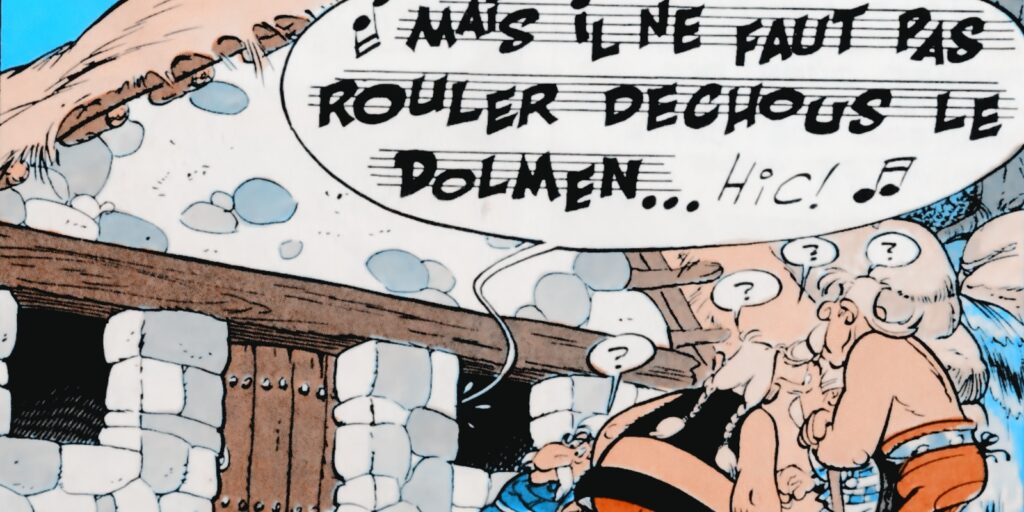
The French version is built around a familiar drinking song and a dolmen replacing a table. The translations don’t simply reproduce that joke in another language. Instead, they find new cultural material that can perform the same function—from Scottish folk song and German dialect to Spanish zarzuela, medieval Latin, and Dutch rhyme.
The French Foundation and Latin Catalyst
To understand what the translations accomplish, we must first establish the original joke. The French page sets a clear analytical model.
The intoxicated druid begins singing, “Boire un petit coup c’est une aubaine… hip,” and follows it with “Boire un petit coup c’est doux… Hic!”. This is an allusion to the traditional French drinking song Boire un petit coup. The comic connection to the Gaulish setting happens in the final panel, where the traditional lyric “Mais il ne faut pas rouler sous la table” (But one must not roll under the table) is altered. The druid instead sings, “Mais il ne faut pas rouler dechous le dolmen… Hic!”.
The mechanism is straightforward: take a recognizable song, modify a lyric, and create a comic connection to the ancient Gaulish setting.
The Latin edition takes an entirely different intertextual route. The character begins by singing, “In taberna quando sumus, non curamus, quid sit humus… Icc!”. These are the opening lines of In taberna quando sumus, one of the best-known drinking poems preserved in the medieval Carmina Burana manuscript.
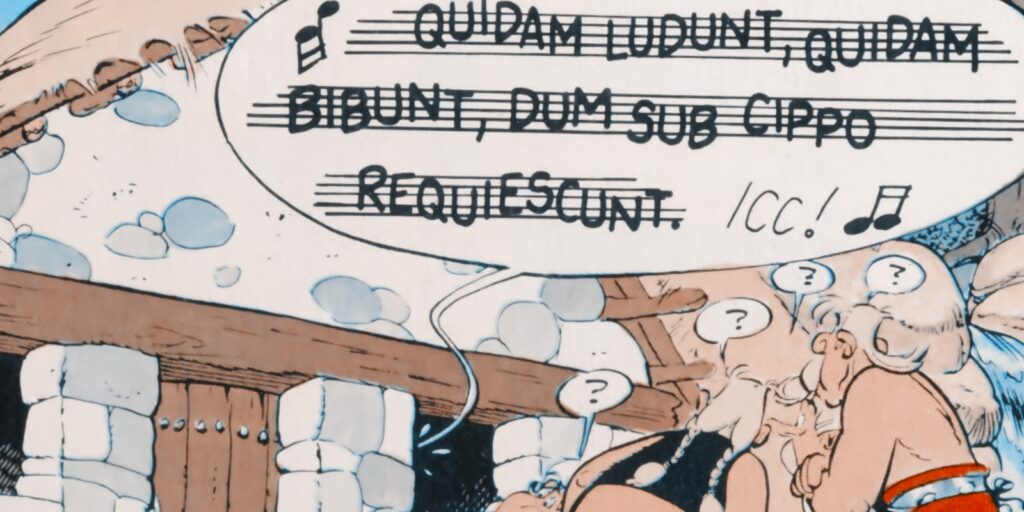
The joke becomes more elaborate in the following panel. The Latin edition keeps the recognizable rhythm and vocabulary of the medieval poem, but then departs from the text: “Quidam ludunt, quidam bibunt, dum sub cippo requiescunt. Icc!”. The original Carmina Burana instead continues with quidam indiscrete vivunt. Here, cippus, a Latin term for a stone marker or monument, provides a suitably antiquarian substitute for the French dolmen. The result is not a literal translation of either the French or the medieval Latin text, but a new joke constructed from both.
Different Ways to Recreate the Joke
When looking at the English, German, Dutch, and Spanish editions, we see that they find culturally recognizable musical or linguistic equivalents for the French joke, but their methods differ considerably.
The English Edition
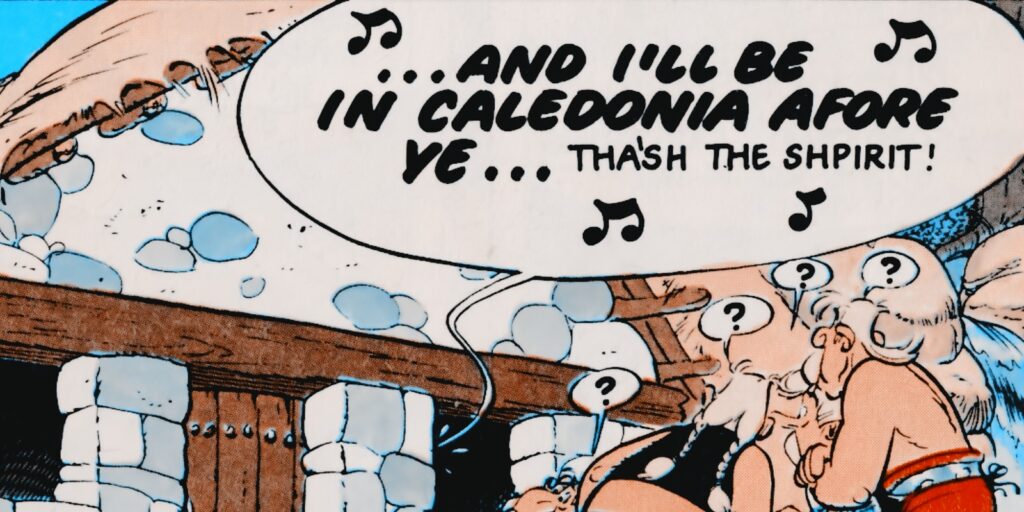
The English edition keeps the Scottish identity of the joke rather than replacing it with a generic drinking song. Prompted by the Caledonian grain spirit, Panoramix sings lines from “The Bonnie Banks o’ Loch Lomond,” a particularly recognizable Scottish song, slurring, “O, ye’ll tak’ the… Hic! … High road…”. The localization then replaces the song’s modern geographical reference with its Roman-era equivalent, resulting in the line, “…And I’ll be in Caledonia afore ye…”. The result preserves two elements simultaneously: the reader’s recognition of a Scottish song and the comic’s deliberately ancient setting.
The German Edition
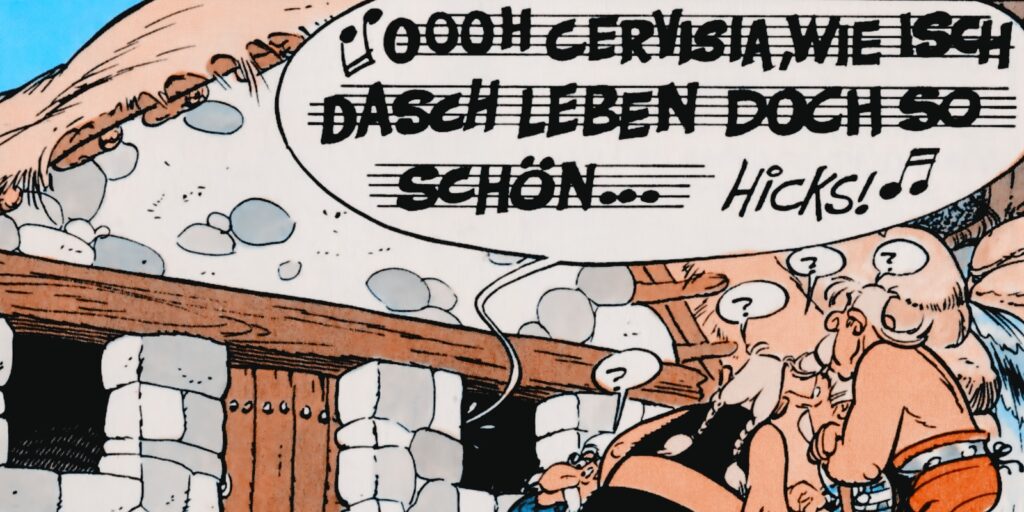
The German edition is a remarkable example of localization because it creates an entirely new linguistic bridge between a familiar cultural text and the terminology of Astérix. Miraculix (Panoramix) begins by singing, “Trink mer noch ä tröpfsche…”, drawing on a German regional drinking song. The brilliance lies in the next line: “Aus dem aaale Hinkelstöpsche… Hicks!”. The original song uses Henkeltöpfchen, literally a small handled jug. The Astérix translation turns this into Hinkelstöpsche, creating a new word that evokes Hinkelstein, the German term for the menhirs associated with Obelix.
The Dutch Edition
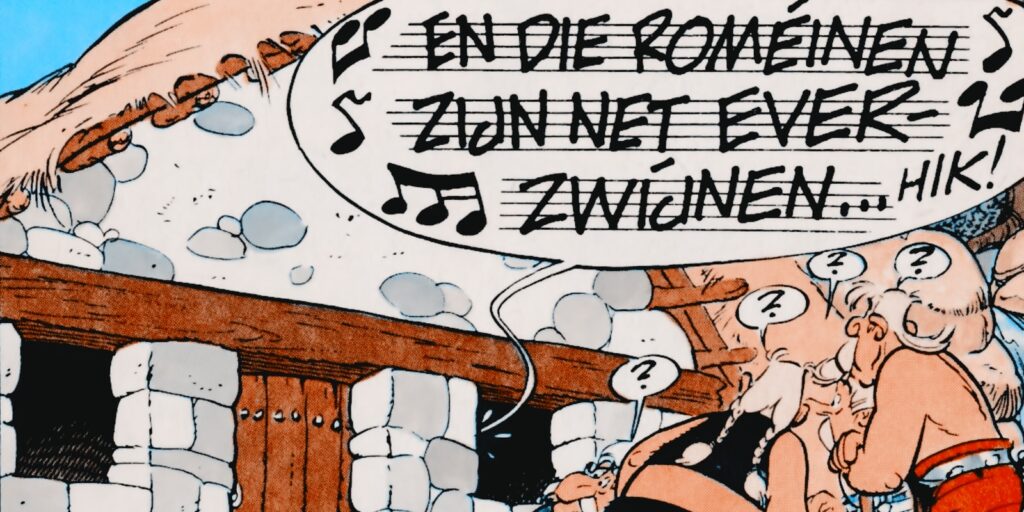
The Dutch edition takes a different approach. Rather than reproducing an identifiable existing song, it builds a new rhyming drinking song around colloquial vocabulary. Panoramix sings, “Geef me nog een neut… Hips! Daarmee krijg ik zoveel leut…”. The rhyme between neut (a colloquialism for a shot of strong liquor) and leut (fun or conviviality) immediately establishes the drinking-song register. The later reference, “En die Romeinen zijn net everzwijnen… Hik!” (And those Romans are just like wild boars), seamlessly brings the song back into the world of Astérix.
The Spanish Edition
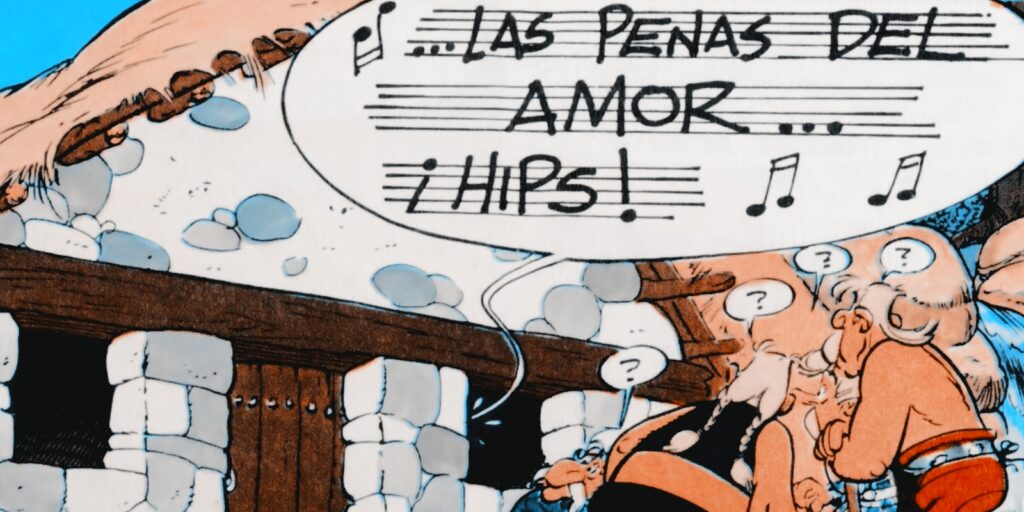
The Spanish edition takes yet another route, borrowing from the theatrical tradition. Panorámix sings “¡A beber, a beber y a apurar las copas de licor… hip!”. This is the opening of the famous drinking chorus from Emilio Arrieta’s Marina, originally premiered as a zarzuela in 1855. In the original work, the number occurs in Act III specifically as a drinking scene, making it an unusually close functional equivalent to the French source. The lyrics continue with “Que el vino nos hará olvidar… hips!” and “…las penas del amor… hips!”. The reference therefore works on two levels: readers familiar with Marina can recognize the drinking chorus, while the subject matter itself fits Panoramix’s drunken performance remarkably well.
Conclusion
What makes this small scene so revealing is that none of these translations needs to reproduce the French wording exactly. The French version depends on recognition of a familiar drinking song and then breaks that song by replacing the table with a dolmen. Other editions reproduce the same comic function through completely different cultural references. The English edition turns to Scottish folk song, the German edition builds an Astérix pun into a German drinking song, the Spanish edition borrows from Marina, and the Latin edition combines medieval Latin quotation with newly constructed wordplay. The Dutch version goes further still by creating its own rhyme-driven drinking song rather than relying on a single identifiable source.
In each case, the translator is solving the same problem: how do you make a reader laugh at a song that was never originally written for them? For this kind of culturally embedded joke, the answer is not literal translation alone. It is recognition, substitution, rhythm, and cultural association. This tiny sequence in Asterix and the Black Gold therefore offers an unusually clear example of what comic translation can accomplish when the translator treats a joke not as a string of words, but as a cultural reference that has to be rebuilt for another audience.


Recently, I shared a few panels from the Latin edition of L’Odyssée d’Astérix (Asterix and the Black Gold) in a dedicated Asterix fan group. The panels featured the druid Panoramix, thoroughly intoxicated after drinking a strong grain spirit from Caledonia, singing in fluent Latin. The post prompted an interesting question: how was this scene handled in other languages?
That question sent me back to the French original and then through several editions in my collection. I used an AI chatbot as a translation aid for some of the regional slang and unfamiliar expressions, but the albums themselves provided the essential evidence. What I found was more interesting than a series of different translations. The French, Latin, English, German, Dutch, and Spanish editions all solve the same problem in different ways: how do you preserve a joke whose humor depends on a song, a cultural reference, and the ancient Gaulish setting all at once?
The French version is built around a familiar drinking song and a dolmen replacing a table. The translations don’t simply reproduce that joke in another language. Instead, they find new cultural material that can perform the same function—from Scottish folk song and German dialect to Spanish zarzuela, medieval Latin, and Dutch rhyme.
The French Foundation and Latin Catalyst
To understand what the translations accomplish, we must first establish the original joke. The French page sets a clear analytical model.
The intoxicated druid begins singing, “Boire un petit coup c’est une aubaine… hip,” and follows it with “Boire un petit coup c’est doux… Hic!”. This is an allusion to the traditional French drinking song Boire un petit coup. The comic connection to the Gaulish setting happens in the final panel, where the traditional lyric “Mais il ne faut pas rouler sous la table” (But one must not roll under the table) is altered. The druid instead sings, “Mais il ne faut pas rouler dechous le dolmen… Hic!”.
The mechanism is straightforward: take a recognizable song, modify a lyric, and create a comic connection to the ancient Gaulish setting.
The Latin edition takes an entirely different intertextual route. The character begins by singing, “In taberna quando sumus, non curamus, quid sit humus… Icc!”. These are the opening lines of In taberna quando sumus, one of the best-known drinking poems preserved in the medieval Carmina Burana manuscript.
The joke becomes more elaborate in the following panel. The Latin edition keeps the recognizable rhythm and vocabulary of the medieval poem, but then departs from the text: “Quidam ludunt, quidam bibunt, dum sub cippo requiescunt. Icc!”. The original Carmina Burana instead continues with quidam indiscrete vivunt. Here, cippus, a Latin term for a stone marker or monument, provides a suitably antiquarian substitute for the French dolmen. The result is not a literal translation of either the French or the medieval Latin text, but a new joke constructed from both.
Different Ways to Recreate the Joke
When looking at the English, German, Dutch, and Spanish editions, we see that they find culturally recognizable musical or linguistic equivalents for the French joke, but their methods differ considerably.
The English Edition
The English edition keeps the Scottish identity of the joke rather than replacing it with a generic drinking song. Prompted by the Caledonian grain spirit, Panoramix sings lines from “The Bonnie Banks o’ Loch Lomond,” a particularly recognizable Scottish song, slurring, “O, ye’ll tak’ the… Hic! … High road…”. The localization then replaces the song’s modern geographical reference with its Roman-era equivalent, resulting in the line, “…And I’ll be in Caledonia afore ye…”. The result preserves two elements simultaneously: the reader’s recognition of a Scottish song and the comic’s deliberately ancient setting.
The German Edition
The German edition is a remarkable example of localization because it creates an entirely new linguistic bridge between a familiar cultural text and the terminology of Astérix. Miraculix (Panoramix) begins by singing, “Trink mer noch ä tröpfsche…”, drawing on a German regional drinking song. The brilliance lies in the next line: “Aus dem aaale Hinkelstöpsche… Hicks!”. The original song uses Henkeltöpfchen, literally a small handled jug. The Astérix translation turns this into Hinkelstöpsche, creating a new word that evokes Hinkelstein, the German term for the menhirs associated with Obelix.
The Dutch Edition
The Dutch edition takes a different approach. Rather than reproducing an identifiable existing song, it builds a new rhyming drinking song around colloquial vocabulary. Panoramix sings, “Geef me nog een neut… Hips! Daarmee krijg ik zoveel leut…”. The rhyme between neut (a colloquialism for a shot of strong liquor) and leut (fun or conviviality) immediately establishes the drinking-song register. The later reference, “En die Romeinen zijn net everzwijnen… Hik!” (And those Romans are just like wild boars), seamlessly brings the song back into the world of Astérix.
The Spanish Edition
The Spanish edition takes yet another route, borrowing from the theatrical tradition. Panorámix sings “¡A beber, a beber y a apurar las copas de licor… hip!”. This is the opening of the famous drinking chorus from Emilio Arrieta’s Marina, originally premiered as a zarzuela in 1855. In the original work, the number occurs in Act III specifically as a drinking scene, making it an unusually close functional equivalent to the French source. The lyrics continue with “Que el vino nos hará olvidar… hips!” and “…las penas del amor… hips!”. The reference therefore works on two levels: readers familiar with Marina can recognize the drinking chorus, while the subject matter itself fits Panoramix’s drunken performance remarkably well.
Conclusion
What makes this small scene so revealing is that none of these translations needs to reproduce the French wording exactly. The French version depends on recognition of a familiar drinking song and then breaks that song by replacing the table with a dolmen. Other editions reproduce the same comic function through completely different cultural references. The English edition turns to Scottish folk song, the German edition builds an Astérix pun into a German drinking song, the Spanish edition borrows from Marina, and the Latin edition combines medieval Latin quotation with newly constructed wordplay. The Dutch version goes further still by creating its own rhyme-driven drinking song rather than relying on a single identifiable source.
In each case, the translator is solving the same problem: how do you make a reader laugh at a song that was never originally written for them? For this kind of culturally embedded joke, the answer is not literal translation alone. It is recognition, substitution, rhythm, and cultural association. This tiny sequence in Asterix and the Black Gold therefore offers an unusually clear example of what comic translation can accomplish when the translator treats a joke not as a string of words, but as a cultural reference that has to be rebuilt for another audience.