For collectors of Astérix memorabilia, some of the most interesting objects are also among the most ordinary. Astérix mustard glasses, or verres à moutarde, were not originally intended to be treasured pieces of comic-book merchandise. They were everyday French household objects: small glasses in which mustard was sold, designed to be washed and reused once the mustard had been eaten. Over several decades, however, French condiment companies decorated these glasses with Astérix and his companions, turning a familiar piece of food packaging into an unexpectedly extensive part of Astérix collecting.

The history is more complicated than it might first appear. Collectors and dealers often refer to these objects collectively as “Amora Astérix glasses,” but not all Astérix mustard glasses were made for Amora. Some were associated with Maille, others carry Éditions Albert René or Dargaud copyright information without an obvious mustard-brand marking, and later examples can be identified quite clearly as Amora products. There are also differences in size, manufacturer, decoration, language and printing. What looks like one long-running promotional series is actually a collection of different productions spanning more than forty years.
And there is an amusing reason why Amora deserves a special place in the story.
Amora, the Goddess of Mustard
In Le Devin (The Soothsayer), Goscinny makes a particularly clever reference to contemporary French consumer culture. During the villagers’ discussion of the gods, a fictional deity named Amora, goddess of mustard, is mentioned. The joke depends on the familiar French expression la moutarde lui monte au nez, literally “the mustard rises to his nose,” meaning that someone is becoming angry or losing their temper.
Goscinny takes the expression literally and turns it into mythology. Amora, the goddess of mustard, has “risen to the noses” of the other gods. He then plays further with the verb monter, meaning “to rise” or “to go up,” allowing the conversation to develop another joke about people trying to get higher. The humour is particularly French because it combines a well-known condiment brand with an everyday idiom. A reader unfamiliar with Amora or the expression can understand the dialogue without necessarily recognizing why it is funny. The reference is therefore a good example of the small details that can make Astérix particularly difficult to translate.
Le Devin first appeared in Pilote in 1972 and was published as an album the same year. By that time, Amora was already a familiar name in French households. The fictional goddess is therefore not simply a random pun invented around a convenient name. Goscinny was taking a recognizable piece of contemporary French life and placing it inside the supposedly ancient world of the Gauls.
There is a wonderful irony in what happened afterwards. Goscinny turned Amora into a fictional goddess of mustard, while Amora would later put Astérix himself on mustard glasses. The character became part of the packaging for the very kind of product that had inspired the joke.
What Is a Verre à Moutarde?
To understand why these objects became collectibles, it helps to understand the verre à moutarde itself. Selling mustard in a reusable glass was a long-established French practice. Instead of throwing away a conventional container, consumers could finish the mustard, wash the glass and use it for drinking. The result was an unusual form of packaging in which the advertising object had a practical second life.
This made the format particularly suitable for licensed characters. A colourful character printed on a disposable wrapper has little value once the product is gone, but a decorated glass can remain in the kitchen for years. Children could collect different characters, while adults could simply use the glasses at the table. The distinction between packaging, advertising and merchandise was therefore unusually blurred.
Astérix proved to be an excellent subject for this format. The characters were instantly recognizable, their colourful artwork worked well on glass, and there were enough scenes and characters to create large collections. The surviving examples also show how the glasses evolved alongside the Astérix franchise itself.
1968: The Earliest Astérix Mustard Glasses
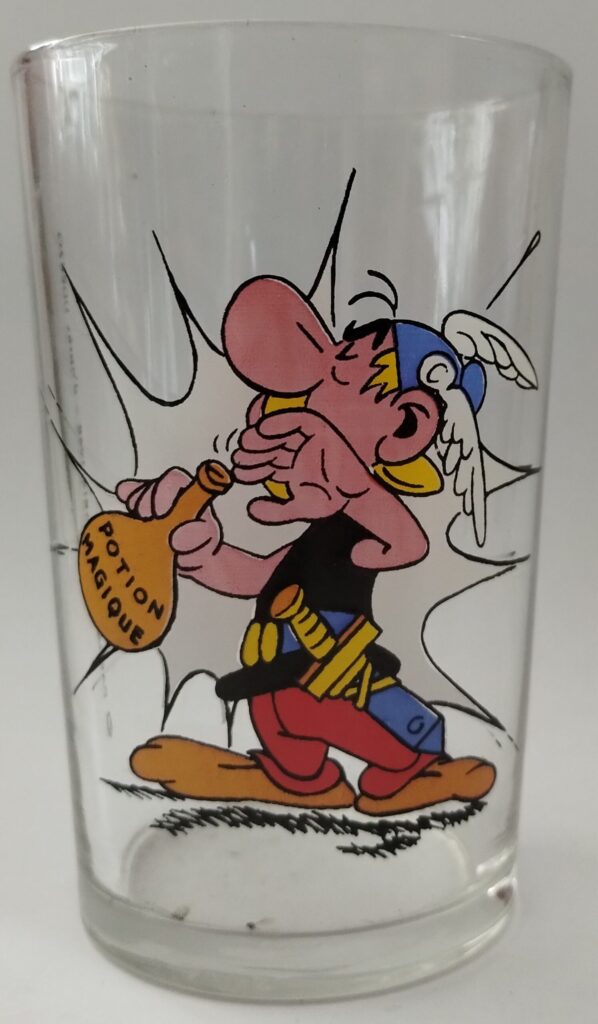
The earliest major group of Astérix mustard glasses known to collectors dates from 1968, only a few years after Astérix’s debut. These glasses carry the important copyright marking “© DARGAUD S.A. PARIS 1968 – d’après UDERZO”, establishing a direct connection with the original publisher and Albert Uderzo’s artwork. Many surviving examples are approximately 98 millimetres high with a capacity of around 20.5 cl, and specialist collector records identify the Verrerie Mécanique Champenoise (VMC) as the manufacturer for several of the principal groups.
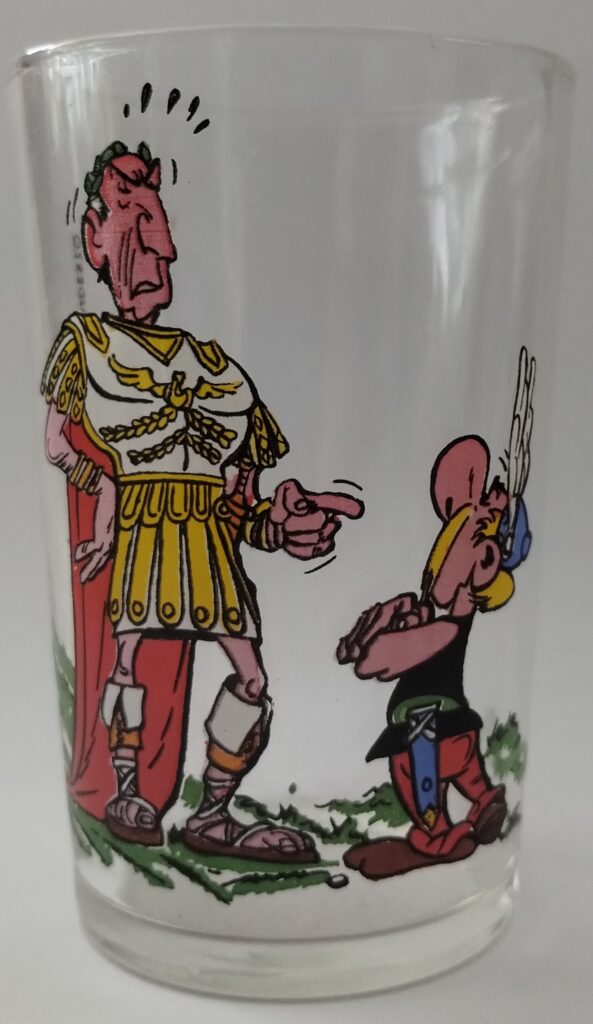
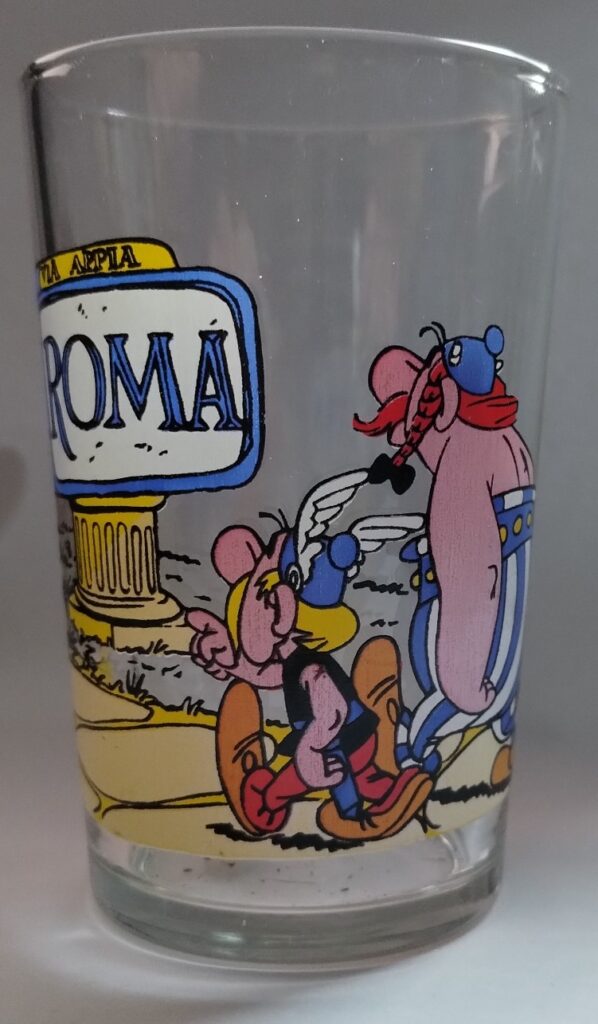
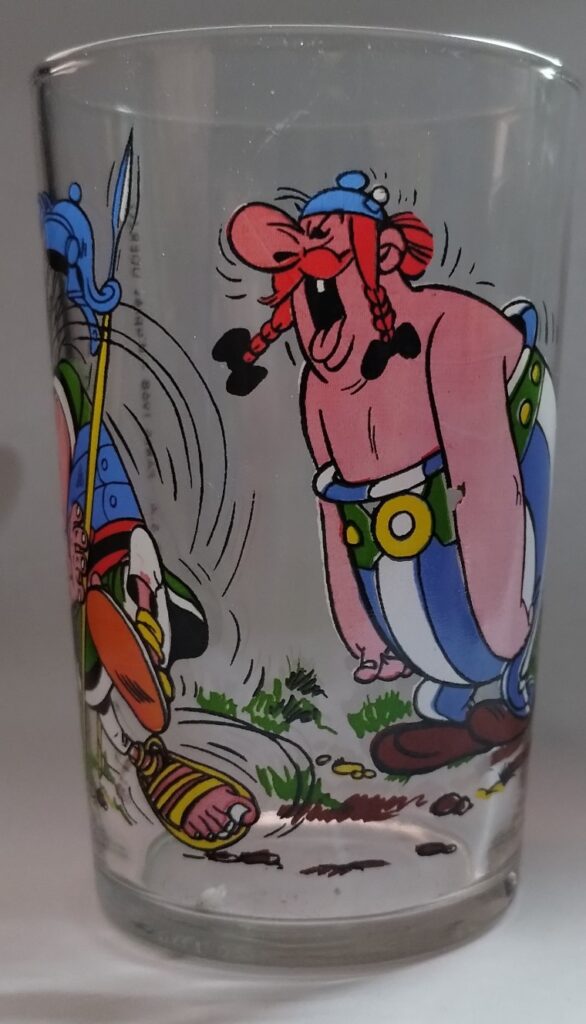
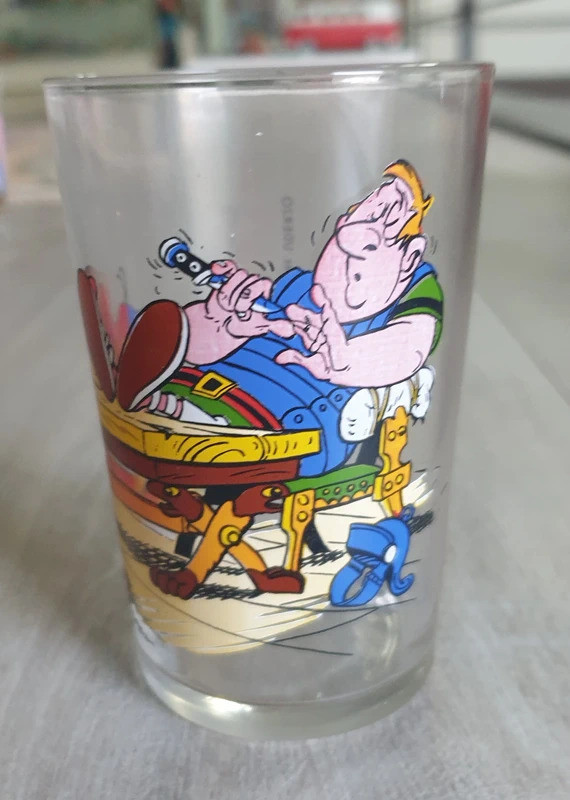
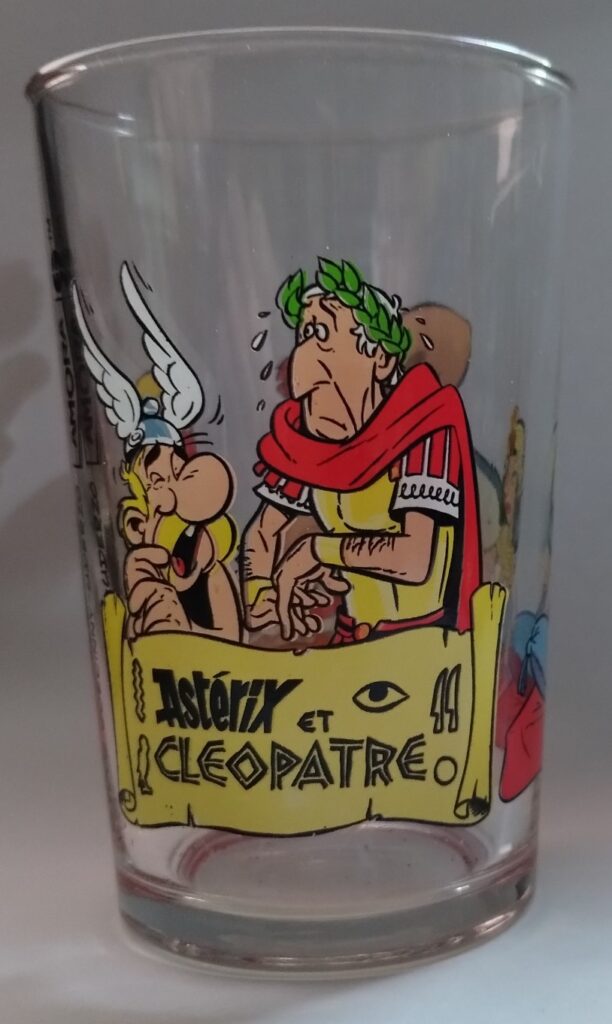
The 1968 production is considerably more complicated than the existence of a single four-glass set might suggest. Collector records divide the surviving material into several production groups, with numerous different decorations and printing variations. Astérix and Obélix appear in scenes involving Romans, Cleopatra, Panoramix, Idéfix and other familiar characters. Among the surviving motifs are Astérix confronting Caesar, Astérix and Obélix approaching Rome, Panoramix preparing the magic potion, Obélix fighting Romans, Obélix carrying his menhir and scenes involving Cleopatra. Some designs survive in different colour combinations or printing variants, making the identification of individual glasses considerably more complicated than simply counting the different pictures.
There are even unusual variations in the early material. One documented 1968 group contains German-language dialogue, demonstrating that at least some decorated glasses were adapted for markets outside the French-language edition. The specialist collector database also records a larger format from the same general period.
This is why the safest way to describe the 1968 material is not as “the four 1968 Amora glasses,” but as a broader family of early Astérix mustard-glass productions. Modern dealers frequently use the term “Amora” when selling individual examples, but the physical evidence on the glasses themselves is more securely tied to Dargaud, Uderzo and the 1968 copyright. The exact commercial relationship between the individual glass productions and Amora is therefore something collectors should distinguish from the copyright information printed on the object.
Astérix and the Mustard Glass in the 1980s
Astérix did not disappear from mustard glasses after the 1968 productions. Collector documentation records further groups dated 1980, 1984, 1986 and 1987, generally using the familiar 98 mm, approximately 20.5 cl format. By this point, the copyright markings had changed from Dargaud to the newer Éditions Albert René and Goscinny-Uderzo attribution, reflecting the changing corporate history of the Astérix property.
The 1984 production is particularly extensive, with numerous different decorations featuring Astérix, Obélix, Panoramix and other characters. The 1986 production includes, among other designs, Falbala kissing Obélix and Obélix shaking a tree while a Roman falls out. The 1987 glasses draw on imagery from Astérix chez Rahàzade, including Astérix, Obélix and Idéfix on the flying carpet. These examples demonstrate another characteristic of Astérix merchandise: the artwork was frequently drawn from existing album scenes rather than created as entirely new material.
The branding of these intermediate productions is less straightforward than the later Amora glasses. For that reason, a serious catalogue should record the copyright and manufacturer separately from the presumed mustard brand. It is tempting to place every Astérix mustard glass into an Amora timeline, but the surviving evidence supports a more cautious classification.

Maille: A Rival Mustard Brand Joins the Collection
By the end of the 1980s, the branding becomes much clearer. Maille, another famous French mustard and condiment brand, produced explicitly collectible Astérix glasses. A documented 1989 campaign carries the wording “COLLECTIONNEZ LES VERRES ASTERIX”, accompanied by a number and the title of the decoration. The glasses are again approximately 98 mm high and 20.5 cl in capacity, with VMC identified as manufacturer for the documented series.
The numbered designs make these glasses particularly attractive to collectors because they were clearly marketed as a collection rather than simply as unrelated pieces of packaging. The surviving examples include decorations entitled La potion magique, Le coup du menhir, La chasse aux sangliers, Obélix amoureux, La bataille de poissons, La chute du chef, Un sacré marathon and Une belle bagarre !. Further numbered designs appear in the following year’s production.
The Maille connection also demonstrates why searching for “Amora Astérix glasses” alone will miss a significant part of the story. During the late 1980s and 1990s, Maille was responsible for some of the most clearly organized Astérix mustard-glass collections.
1991: Astérix Goes to the Olympic Games
One of the most distinctive Maille campaigns appeared in 1991, when the glasses adopted the theme of Astérix aux Jeux olympiques. The collection was explicitly promoted as “Collectionnez les verres Astérix aux Jeux Olympiques” and consisted of six numbered designs. Each represented a different sporting event: ski jumping, speed skating, luge, boxing, equestrian sport and swimming. The glasses were approximately 98 mm high and 20.5 cl, and documented examples were manufactured by VMC.
The Olympic theme was particularly appropriate because Astérix aux Jeux olympiques was one of the earliest Astérix albums and had originally appeared in album form in 1968. The Maille glasses therefore transformed a classic Astérix story into a miniature collectible series, with each glass representing a different sporting scene.
Other Maille glasses from around the same period concentrated on individual characters such as Astérix, Obélix and Falbala, while some were produced in a larger 25 cl format. The existence of different sizes is another reason that counting Astérix mustard glasses by decoration alone can produce misleading totals.
1999: Twelve Albums in Glass
By 1999, Maille was using the Astérix collection to celebrate the breadth of the comic’s catalogue. The surviving collector documentation records at least twelve numbered glasses associated with individual Astérix albums. Among the documented titles are Astérix chez Rahàzade, Astérix chez les Helvètes, Astérix en Hispanie, Astérix et Cléopâtre, Astérix aux Jeux olympiques, Astérix et les Normands, L’Odyssée d’Astérix, Astérix légionnaire, Le Fils d’Astérix, Le Grand Fossé and La Grande Traversée.
This is an interesting development in the history of Astérix collectibles. Instead of simply showing popular characters, the glasses had become a miniature visual catalogue of the albums themselves. Someone collecting the entire series was effectively collecting a small history of Astérix through mustard packaging.
It also illustrates how the reusable verre à moutarde had evolved. What began as functional food packaging had become a deliberately collectible object, with numbered designs encouraging consumers to buy additional jars of mustard in order to complete their glass collection.
2000: The Amora Astérix Collection
Then comes the series that most clearly deserves the name Amora Astérix glasses.
In 2000, Amora produced a collection explicitly advertised with the words “Collectionnez les 6 verres ASTERIX”. The glasses carry the Amora website address, www.amora.com, and the copyright © 2000 Goscinny-Uderzo. Unlike some of the earlier productions, there is therefore little ambiguity about the relationship between the mustard brand and the Astérix glasses.
The advertised collection consisted of six decorations featuring Astérix alongside different characters. Surviving examples include designs featuring Obélix, Falbala, Panoramix, Idéfix, Assurancetourix and Abraracourcix. The familiar small format is approximately 98 mm high and 20.5 cl, while collector documentation also records larger examples measuring around 116 mm and holding approximately 25 cl. VMC is identified as manufacturer for the documented production.
The individual decorations can be identified by their numbers. Décor n°4, for example, features Obélix and Idéfix and carries the “Collectionnez les 6 verres Astérix” wording. Other surviving examples identify decorations 2, 3, 5 and 6. There are also physical variations, including differences in colour and size, which means that even the apparently straightforward six-glass collection can become more complicated once variants are taken into account.
For collectors, this is perhaps the most satisfying Amora Astérix set because the intention is so explicit. The consumer was not merely receiving an attractive mustard container. The packaging itself says what to do: collect the six glasses.
2002 and 2012: The Tradition Continues
Amora’s use of Astérix did not end with the 2000 collection. Collector records document further Amora Astérix glasses from 2002, including a design featuring Astérix, Caesar and Cleopatra. Other surviving examples from the same period show Panoramix and Obélix around the magic potion. The documented glasses are again approximately 98 mm high and 20.5 cl, although different manufacturers appear in the surviving records.
Another generation of Amora Astérix glasses appeared in 2012. Surviving examples include a glass decorated with imagery from Astérix chez les Bretons, while another shows Astérix, Obélix and Idéfix laughing together. These later glasses demonstrate how durable the French mustard-glass tradition was. Even more than forty years after the first documented Astérix examples, the basic concept remained recognizable: buy the mustard, finish the jar, wash the glass and keep using it.
How Many Astérix Mustard Glasses Are There?
That question sounds simple but does not have a simple answer.
Specialist collector databases currently divide the Astérix material into numerous production groups rather than treating it as one continuous collection. The number of individual decorations is considerably higher than the number of campaigns, while individual decorations can themselves exist in different colours, sizes, manufacturers or language versions. The 1968 material alone contains a large number of documented variants.
For this reason, collectors should be careful when encountering claims about a fixed number of “Amora Astérix glasses.” A seller offering four 1968 glasses may genuinely have a particular four-glass group, but that does not mean that only four Astérix designs existed in 1968. Likewise, the six glasses advertised by Amora in 2000 represent the core collection, but surviving examples reveal additional physical variants.
The best way to identify an Astérix mustard glass is therefore to record several pieces of information: the date or copyright, the mustard brand if present, the manufacturer, the height and capacity, the decoration number, the artwork and any language or printing variation. This approach is much more useful than relying on the seller’s description alone.
Why These Glasses Matter
At first glance, an Astérix mustard glass might seem like a minor piece of advertising memorabilia. In reality, these objects occupy an interesting place between comic art, French consumer culture, advertising and everyday material history.
They also show how deeply Astérix became embedded in French popular culture. The character was not confined to comic albums, toys and cinema. He appeared on objects that people encountered while shopping for groceries and then continued using at home. A child might recognize Astérix on the breakfast table without ever having deliberately bought a piece of Astérix merchandise.
The glasses also preserve something that is easily lost when Astérix is translated into other languages. Goscinny’s Amora joke in Le Devin depends on a French brand and a French idiom. The later mustard glasses belong to exactly the same cultural environment. They are physical reminders of the contemporary French world that existed behind the comic’s supposedly ancient setting.
And that makes the connection between Le Devin and the glasses particularly charming. Goscinny took Amora, a familiar mustard brand, and transformed it into a goddess. The goddess of mustard then “rose to the noses” of the other gods, turning an ordinary French expression into an absurd piece of ancient mythology. Years later, Amora put Astérix himself on mustard glasses and encouraged French consumers to collect them.
The joke and the merchandise are therefore connected in a way that is almost too perfect for Astérix: Amora became part of the mythology of the Gauls, while the Gauls became part of Amora’s packaging.
A Small Piece of Astérix History
The story of the Astérix verres à moutarde is ultimately a story about how comics enter everyday life. The glasses were inexpensive, practical objects rather than prestigious collectibles, which is precisely why so many survived. They were used at kitchen tables, placed in cupboards, given to children and eventually forgotten. Decades later, collectors began searching for the missing decoration or the elusive colour variant.
For the Astérix collector, this creates a fascinating field of research. The 1968 Dargaud glasses represent the earliest known period; the 1980s brought further Albert René-era productions; Maille developed substantial numbered collections in the late 1980s and 1990s; and Amora produced the clearly identifiable six-glass collection in 2000 before returning to Astérix again in later years.
They are small objects, but they tell a surprisingly large story — about French mustard, advertising, translation, licensing, Uderzo’s artwork, Goscinny’s wordplay and the extraordinary ability of Astérix to move from the pages of a comic book into almost every corner of French popular culture.
Thanks
I’d like to thank fellow Asterix-collector Orm for giving me the idea for this article and providing the photo’s of the glasses in his collection for this article. Visit his website when you are interested in seeing more Amora glasses.


For collectors of Astérix memorabilia, some of the most interesting objects are also among the most ordinary. Astérix mustard glasses, or verres à moutarde, were not originally intended to be treasured pieces of comic-book merchandise. They were everyday French household objects: small glasses in which mustard was sold, designed to be washed and reused once the mustard had been eaten. Over several decades, however, French condiment companies decorated these glasses with Astérix and his companions, turning a familiar piece of food packaging into an unexpectedly extensive part of Astérix collecting.
The history is more complicated than it might first appear. Collectors and dealers often refer to these objects collectively as “Amora Astérix glasses,” but not all Astérix mustard glasses were made for Amora. Some were associated with Maille, others carry Éditions Albert René or Dargaud copyright information without an obvious mustard-brand marking, and later examples can be identified quite clearly as Amora products. There are also differences in size, manufacturer, decoration, language and printing. What looks like one long-running promotional series is actually a collection of different productions spanning more than forty years.
And there is an amusing reason why Amora deserves a special place in the story.
Amora, the Goddess of Mustard
In Le Devin (The Soothsayer), Goscinny makes a particularly clever reference to contemporary French consumer culture. During the villagers’ discussion of the gods, a fictional deity named Amora, goddess of mustard, is mentioned. The joke depends on the familiar French expression la moutarde lui monte au nez, literally “the mustard rises to his nose,” meaning that someone is becoming angry or losing their temper.
Goscinny takes the expression literally and turns it into mythology. Amora, the goddess of mustard, has “risen to the noses” of the other gods. He then plays further with the verb monter, meaning “to rise” or “to go up,” allowing the conversation to develop another joke about people trying to get higher. The humour is particularly French because it combines a well-known condiment brand with an everyday idiom. A reader unfamiliar with Amora or the expression can understand the dialogue without necessarily recognizing why it is funny. The reference is therefore a good example of the small details that can make Astérix particularly difficult to translate.
Le Devin first appeared in Pilote in 1972 and was published as an album the same year. By that time, Amora was already a familiar name in French households. The fictional goddess is therefore not simply a random pun invented around a convenient name. Goscinny was taking a recognizable piece of contemporary French life and placing it inside the supposedly ancient world of the Gauls.
There is a wonderful irony in what happened afterwards. Goscinny turned Amora into a fictional goddess of mustard, while Amora would later put Astérix himself on mustard glasses. The character became part of the packaging for the very kind of product that had inspired the joke.
What Is a Verre à Moutarde?
To understand why these objects became collectibles, it helps to understand the verre à moutarde itself. Selling mustard in a reusable glass was a long-established French practice. Instead of throwing away a conventional container, consumers could finish the mustard, wash the glass and use it for drinking. The result was an unusual form of packaging in which the advertising object had a practical second life.
This made the format particularly suitable for licensed characters. A colourful character printed on a disposable wrapper has little value once the product is gone, but a decorated glass can remain in the kitchen for years. Children could collect different characters, while adults could simply use the glasses at the table. The distinction between packaging, advertising and merchandise was therefore unusually blurred.
Astérix proved to be an excellent subject for this format. The characters were instantly recognizable, their colourful artwork worked well on glass, and there were enough scenes and characters to create large collections. The surviving examples also show how the glasses evolved alongside the Astérix franchise itself.
1968: The Earliest Astérix Mustard Glasses
The earliest major group of Astérix mustard glasses known to collectors dates from 1968, only a few years after Astérix’s debut. These glasses carry the important copyright marking “© DARGAUD S.A. PARIS 1968 – d’après UDERZO”, establishing a direct connection with the original publisher and Albert Uderzo’s artwork. Many surviving examples are approximately 98 millimetres high with a capacity of around 20.5 cl, and specialist collector records identify the Verrerie Mécanique Champenoise (VMC) as the manufacturer for several of the principal groups.
The 1968 production is considerably more complicated than the existence of a single four-glass set might suggest. Collector records divide the surviving material into several production groups, with numerous different decorations and printing variations. Astérix and Obélix appear in scenes involving Romans, Cleopatra, Panoramix, Idéfix and other familiar characters. Among the surviving motifs are Astérix confronting Caesar, Astérix and Obélix approaching Rome, Panoramix preparing the magic potion, Obélix fighting Romans, Obélix carrying his menhir and scenes involving Cleopatra. Some designs survive in different colour combinations or printing variants, making the identification of individual glasses considerably more complicated than simply counting the different pictures.
There are even unusual variations in the early material. One documented 1968 group contains German-language dialogue, demonstrating that at least some decorated glasses were adapted for markets outside the French-language edition. The specialist collector database also records a larger format from the same general period.
This is why the safest way to describe the 1968 material is not as “the four 1968 Amora glasses,” but as a broader family of early Astérix mustard-glass productions. Modern dealers frequently use the term “Amora” when selling individual examples, but the physical evidence on the glasses themselves is more securely tied to Dargaud, Uderzo and the 1968 copyright. The exact commercial relationship between the individual glass productions and Amora is therefore something collectors should distinguish from the copyright information printed on the object.
Astérix and the Mustard Glass in the 1980s
Astérix did not disappear from mustard glasses after the 1968 productions. Collector documentation records further groups dated 1980, 1984, 1986 and 1987, generally using the familiar 98 mm, approximately 20.5 cl format. By this point, the copyright markings had changed from Dargaud to the newer Éditions Albert René and Goscinny-Uderzo attribution, reflecting the changing corporate history of the Astérix property.
The 1984 production is particularly extensive, with numerous different decorations featuring Astérix, Obélix, Panoramix and other characters. The 1986 production includes, among other designs, Falbala kissing Obélix and Obélix shaking a tree while a Roman falls out. The 1987 glasses draw on imagery from Astérix chez Rahàzade, including Astérix, Obélix and Idéfix on the flying carpet. These examples demonstrate another characteristic of Astérix merchandise: the artwork was frequently drawn from existing album scenes rather than created as entirely new material.
The branding of these intermediate productions is less straightforward than the later Amora glasses. For that reason, a serious catalogue should record the copyright and manufacturer separately from the presumed mustard brand. It is tempting to place every Astérix mustard glass into an Amora timeline, but the surviving evidence supports a more cautious classification.
Maille: A Rival Mustard Brand Joins the Collection
By the end of the 1980s, the branding becomes much clearer. Maille, another famous French mustard and condiment brand, produced explicitly collectible Astérix glasses. A documented 1989 campaign carries the wording “COLLECTIONNEZ LES VERRES ASTERIX”, accompanied by a number and the title of the decoration. The glasses are again approximately 98 mm high and 20.5 cl in capacity, with VMC identified as manufacturer for the documented series.
The numbered designs make these glasses particularly attractive to collectors because they were clearly marketed as a collection rather than simply as unrelated pieces of packaging. The surviving examples include decorations entitled La potion magique, Le coup du menhir, La chasse aux sangliers, Obélix amoureux, La bataille de poissons, La chute du chef, Un sacré marathon and Une belle bagarre !. Further numbered designs appear in the following year’s production.
The Maille connection also demonstrates why searching for “Amora Astérix glasses” alone will miss a significant part of the story. During the late 1980s and 1990s, Maille was responsible for some of the most clearly organized Astérix mustard-glass collections.
1991: Astérix Goes to the Olympic Games
One of the most distinctive Maille campaigns appeared in 1991, when the glasses adopted the theme of Astérix aux Jeux olympiques. The collection was explicitly promoted as “Collectionnez les verres Astérix aux Jeux Olympiques” and consisted of six numbered designs. Each represented a different sporting event: ski jumping, speed skating, luge, boxing, equestrian sport and swimming. The glasses were approximately 98 mm high and 20.5 cl, and documented examples were manufactured by VMC.
The Olympic theme was particularly appropriate because Astérix aux Jeux olympiques was one of the earliest Astérix albums and had originally appeared in album form in 1968. The Maille glasses therefore transformed a classic Astérix story into a miniature collectible series, with each glass representing a different sporting scene.
Other Maille glasses from around the same period concentrated on individual characters such as Astérix, Obélix and Falbala, while some were produced in a larger 25 cl format. The existence of different sizes is another reason that counting Astérix mustard glasses by decoration alone can produce misleading totals.
1999: Twelve Albums in Glass
By 1999, Maille was using the Astérix collection to celebrate the breadth of the comic’s catalogue. The surviving collector documentation records at least twelve numbered glasses associated with individual Astérix albums. Among the documented titles are Astérix chez Rahàzade, Astérix chez les Helvètes, Astérix en Hispanie, Astérix et Cléopâtre, Astérix aux Jeux olympiques, Astérix et les Normands, L’Odyssée d’Astérix, Astérix légionnaire, Le Fils d’Astérix, Le Grand Fossé and La Grande Traversée.
This is an interesting development in the history of Astérix collectibles. Instead of simply showing popular characters, the glasses had become a miniature visual catalogue of the albums themselves. Someone collecting the entire series was effectively collecting a small history of Astérix through mustard packaging.
It also illustrates how the reusable verre à moutarde had evolved. What began as functional food packaging had become a deliberately collectible object, with numbered designs encouraging consumers to buy additional jars of mustard in order to complete their glass collection.
2000: The Amora Astérix Collection
Then comes the series that most clearly deserves the name Amora Astérix glasses.
In 2000, Amora produced a collection explicitly advertised with the words “Collectionnez les 6 verres ASTERIX”. The glasses carry the Amora website address, www.amora.com, and the copyright © 2000 Goscinny-Uderzo. Unlike some of the earlier productions, there is therefore little ambiguity about the relationship between the mustard brand and the Astérix glasses.
The advertised collection consisted of six decorations featuring Astérix alongside different characters. Surviving examples include designs featuring Obélix, Falbala, Panoramix, Idéfix, Assurancetourix and Abraracourcix. The familiar small format is approximately 98 mm high and 20.5 cl, while collector documentation also records larger examples measuring around 116 mm and holding approximately 25 cl. VMC is identified as manufacturer for the documented production.
The individual decorations can be identified by their numbers. Décor n°4, for example, features Obélix and Idéfix and carries the “Collectionnez les 6 verres Astérix” wording. Other surviving examples identify decorations 2, 3, 5 and 6. There are also physical variations, including differences in colour and size, which means that even the apparently straightforward six-glass collection can become more complicated once variants are taken into account.
For collectors, this is perhaps the most satisfying Amora Astérix set because the intention is so explicit. The consumer was not merely receiving an attractive mustard container. The packaging itself says what to do: collect the six glasses.
2002 and 2012: The Tradition Continues
Amora’s use of Astérix did not end with the 2000 collection. Collector records document further Amora Astérix glasses from 2002, including a design featuring Astérix, Caesar and Cleopatra. Other surviving examples from the same period show Panoramix and Obélix around the magic potion. The documented glasses are again approximately 98 mm high and 20.5 cl, although different manufacturers appear in the surviving records.
Another generation of Amora Astérix glasses appeared in 2012. Surviving examples include a glass decorated with imagery from Astérix chez les Bretons, while another shows Astérix, Obélix and Idéfix laughing together. These later glasses demonstrate how durable the French mustard-glass tradition was. Even more than forty years after the first documented Astérix examples, the basic concept remained recognizable: buy the mustard, finish the jar, wash the glass and keep using it.
How Many Astérix Mustard Glasses Are There?
That question sounds simple but does not have a simple answer.
Specialist collector databases currently divide the Astérix material into numerous production groups rather than treating it as one continuous collection. The number of individual decorations is considerably higher than the number of campaigns, while individual decorations can themselves exist in different colours, sizes, manufacturers or language versions. The 1968 material alone contains a large number of documented variants.
For this reason, collectors should be careful when encountering claims about a fixed number of “Amora Astérix glasses.” A seller offering four 1968 glasses may genuinely have a particular four-glass group, but that does not mean that only four Astérix designs existed in 1968. Likewise, the six glasses advertised by Amora in 2000 represent the core collection, but surviving examples reveal additional physical variants.
The best way to identify an Astérix mustard glass is therefore to record several pieces of information: the date or copyright, the mustard brand if present, the manufacturer, the height and capacity, the decoration number, the artwork and any language or printing variation. This approach is much more useful than relying on the seller’s description alone.
Why These Glasses Matter
At first glance, an Astérix mustard glass might seem like a minor piece of advertising memorabilia. In reality, these objects occupy an interesting place between comic art, French consumer culture, advertising and everyday material history.
They also show how deeply Astérix became embedded in French popular culture. The character was not confined to comic albums, toys and cinema. He appeared on objects that people encountered while shopping for groceries and then continued using at home. A child might recognize Astérix on the breakfast table without ever having deliberately bought a piece of Astérix merchandise.
The glasses also preserve something that is easily lost when Astérix is translated into other languages. Goscinny’s Amora joke in Le Devin depends on a French brand and a French idiom. The later mustard glasses belong to exactly the same cultural environment. They are physical reminders of the contemporary French world that existed behind the comic’s supposedly ancient setting.
And that makes the connection between Le Devin and the glasses particularly charming. Goscinny took Amora, a familiar mustard brand, and transformed it into a goddess. The goddess of mustard then “rose to the noses” of the other gods, turning an ordinary French expression into an absurd piece of ancient mythology. Years later, Amora put Astérix himself on mustard glasses and encouraged French consumers to collect them.
The joke and the merchandise are therefore connected in a way that is almost too perfect for Astérix: Amora became part of the mythology of the Gauls, while the Gauls became part of Amora’s packaging.
A Small Piece of Astérix History
The story of the Astérix verres à moutarde is ultimately a story about how comics enter everyday life. The glasses were inexpensive, practical objects rather than prestigious collectibles, which is precisely why so many survived. They were used at kitchen tables, placed in cupboards, given to children and eventually forgotten. Decades later, collectors began searching for the missing decoration or the elusive colour variant.
For the Astérix collector, this creates a fascinating field of research. The 1968 Dargaud glasses represent the earliest known period; the 1980s brought further Albert René-era productions; Maille developed substantial numbered collections in the late 1980s and 1990s; and Amora produced the clearly identifiable six-glass collection in 2000 before returning to Astérix again in later years.
They are small objects, but they tell a surprisingly large story — about French mustard, advertising, translation, licensing, Uderzo’s artwork, Goscinny’s wordplay and the extraordinary ability of Astérix to move from the pages of a comic book into almost every corner of French popular culture.
Thanks
I’d like to thank fellow Asterix-collector Orm for giving me the idea for this article and providing the photo’s of the glasses in his collection for this article. Visit his website when you are interested in seeing more Amora glasses.