Over the decades, Asterix has been used in various educational projects. Most of these were designed to help students learn English. Examples include J’apprends l’anglais avec Astérix chez les Bretons in France, English and the English Language with Asterix in the UK, and even a Spanish series with bilingual comics and audio cassettes by StudyComics. DeAgostini in Italy did something similar with their Comics with me-series.
But what about learning French with Asterix? Considering that the little Gaul was born in France, it would make sense to find books aimed at teaching French through the adventures of Asterix and Obelix. Strangely, such editions have never been produced for the general market.


The Dutch Experiment of the 1970s
There is, however, one fascinating exception. In the early 1970s, Dutch educational publisher Meulenhoff Educatief created a school method that used Asterix to teach French in Dutch secondary schools.
Three albums were selected for this project:
- Astérix en Hispanie (annotated by Drs. W. Landgraaf)
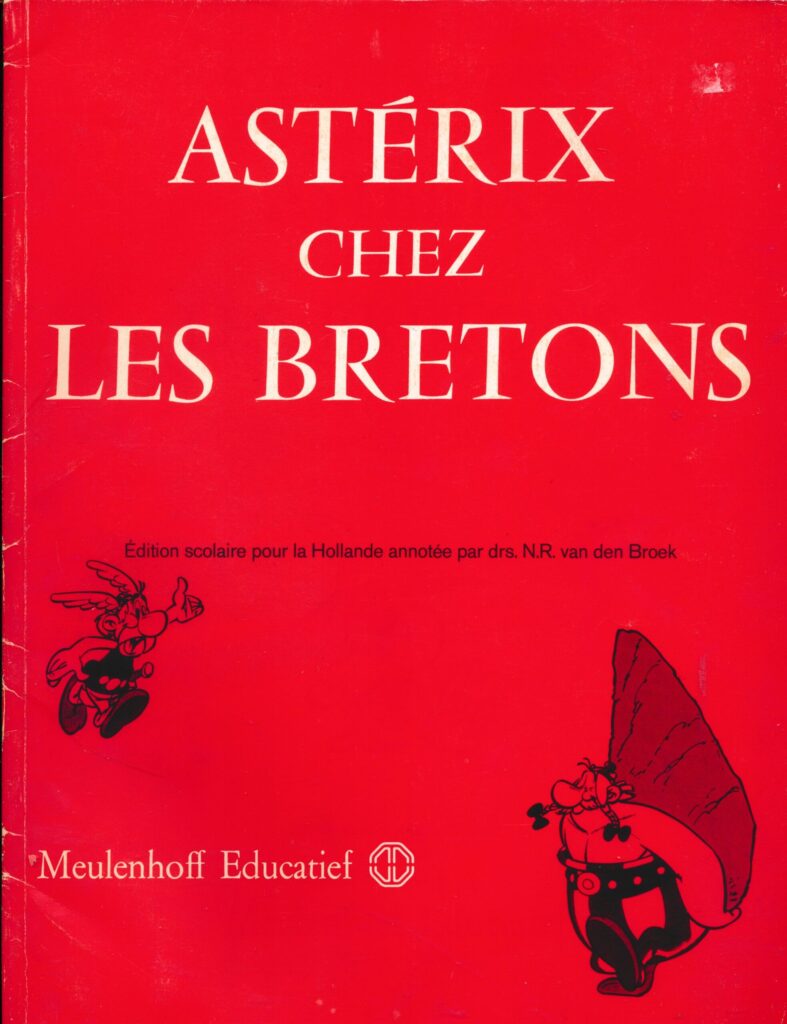
- Astérix chez les Bretons (annotated by Drs. N. R. van den Broek)
- Le Tour de Gaule d’Astérix (annotated D.M Offringa)
These were not standard French editions. Each book came with a special glossary, designed to help Dutch students tackle authentic French texts. The glossaries were organized into three columns of difficulty:
- Essential vocabulary to memorize.
- Important but slightly less common words.
- More complex or idiomatic expressions.
This approach allowed students to read the French text with support, while still engaging with Goscinny and Uderzo’s original words.
A Modern Method for Its Time
The project reflected a forward-thinking approach to language teaching. Comics were still relatively new in the classroom, and using Asterix was an innovative way to motivate students. The combination of text and illustrations helped learners infer meaning, while the humor and adventures of Asterix kept them turning the pages.
The method targeted different Dutch school levels of the era, roughly corresponding to ages 14–16: MAVO (lower general secondary education), HAVO (senior general secondary education), and VWO (pre-university education).
Dull Covers for a Fun Idea
While the concept was exciting, the design was less so. The Meulenhoff editions featured plain, one-color covers with simple lettering and small line drawings of Asterix or Obelix. For a method that promised so much fun, the visual presentation looked more like a dry schoolbook than a lively comic adventure. The panels inside were in full-color though.


Why No “Learn French with Asterix”?
Looking back, it is striking that no publisher has ever created a proper “Learn French with Asterix” series for the wider public. The Dutch Meulenhoff editions were strictly classroom materials and are now collector’s items. Fans who want to use Asterix to improve their French have to rely on standard French editions and their own dictionaries.
Given the enduring popularity of the series, it seems surprising that nobody has yet created a structured, engaging French-learning method with Asterix. For many fans, that would surely be a dream way to study the language of the Gauls.


Over the decades, Asterix has been used in various educational projects. Most of these were designed to help students learn English. Examples include J’apprends l’anglais avec Astérix chez les Bretons in France, English and the English Language with Asterix in the UK, and even a Spanish series with bilingual comics and audio cassettes by StudyComics. DeAgostini in Italy did something similar with their Comics with me-series.
But what about learning French with Asterix? Considering that the little Gaul was born in France, it would make sense to find books aimed at teaching French through the adventures of Asterix and Obelix. Strangely, such editions have never been produced for the general market.
The Dutch Experiment of the 1970s
There is, however, one fascinating exception. In the early 1970s, Dutch educational publisher Meulenhoff Educatief created a school method that used Asterix to teach French in Dutch secondary schools.
Three albums were selected for this project:
- Astérix en Hispanie (annotated by Drs. W. Landgraaf)
- Astérix chez les Bretons (annotated by Drs. N. R. van den Broek)
- Le Tour de Gaule d’Astérix (annotated D.M Offringa)
These were not standard French editions. Each book came with a special glossary, designed to help Dutch students tackle authentic French texts. The glossaries were organized into three columns of difficulty:
- Essential vocabulary to memorize.
- Important but slightly less common words.
- More complex or idiomatic expressions.
This approach allowed students to read the French text with support, while still engaging with Goscinny and Uderzo’s original words.
A Modern Method for Its Time
The project reflected a forward-thinking approach to language teaching. Comics were still relatively new in the classroom, and using Asterix was an innovative way to motivate students. The combination of text and illustrations helped learners infer meaning, while the humor and adventures of Asterix kept them turning the pages.
The method targeted different Dutch school levels of the era, roughly corresponding to ages 14–16: MAVO (lower general secondary education), HAVO (senior general secondary education), and VWO (pre-university education).
Dull Covers for a Fun Idea
While the concept was exciting, the design was less so. The Meulenhoff editions featured plain, one-color covers with simple lettering and small line drawings of Asterix or Obelix. For a method that promised so much fun, the visual presentation looked more like a dry schoolbook than a lively comic adventure. The panels inside were in full-color though.
Why No “Learn French with Asterix”?
Looking back, it is striking that no publisher has ever created a proper “Learn French with Asterix” series for the wider public. The Dutch Meulenhoff editions were strictly classroom materials and are now collector’s items. Fans who want to use Asterix to improve their French have to rely on standard French editions and their own dictionaries.
Given the enduring popularity of the series, it seems surprising that nobody has yet created a structured, engaging French-learning method with Asterix. For many fans, that would surely be a dream way to study the language of the Gauls.