In 1969, the 13th volume of the Asterix series, Asterix and the Cauldron (Astérix et le Chaudron), took our favorite Gaul into surprisingly modern territory. Unlike the usual adventures of superhuman feats and clever escapes, this story is a satire of money, pride, and human folly, pitting Asterix against a villain whose currency is more treacherous than a Roman sword.
A Darker Shade of Gaul

This is one of the few stories where Asterix, the seemingly invincible warrior, shows real emotion. Overcome by shame after a failure, he even sheds tears—a moment that signals a subtle shift toward more complex characterisation.
The villain, Whosemoralsarelastix (French: Moralélastix—“elastic morals” (which parents name their kids like this?)), is unusually detestable. Uderzo modeled him after the “filthy collaborators” of the Nazi Occupation. His excuse for trading with the Romans—“I sell to them, sure, but always at double the price I’d ask a Gaul!”—is a sly jab at wartime profiteers. Unlike the usual bumbling or “idiotic” villains in the series, Whosemoralsarelastix is truly greedy and Machiavellian.
May ’68, Money, and Anxiety
The story was serialized in Pilote magazine starting October 1968, just months after the student protests of May ’68 shook France. This period, defined by skepticism toward authority and money, is reflected in the album’s theme.
Even the authors were not immune. Having grown wealthy from Asterix’s success, Goscinny and Uderzo were often accused of being “men of money.” Asterix and the Cauldron lets them play with that guilt: exploring the tension of earning money in a “crazy profession” while keeping one’s integrity intact.
Cultural Easter Eggs and “Artsy” Nods
The Latin phrase “ubi solitudinem faciunt, pacem appellant” comes from the Roman historian Tacitus, in his work Agricola (chapter 30). It means that conquerors destroy lands and peoples, then call the resulting emptiness “peace.” It criticizes the hypocrisy of presenting violence and domination as stability or order.
The Theater Scene: A director named Éléonoradus appears—a pun on actress Eleonora Duse, yet drawn with angular, ethereal features reminiscent of David Bowie. According to French fans however, it isn’t Bowie but the French actor Laurent Terzieff. In the English translation the actor goes by Laurensolivius, a nod to actor Laurence Olivier. Another actor, Juleraimus in French, is named Alecguinus in English. These are nods to Raimu and Alec Guinness.
Credit Latin: this name of the bank is of course a nod to Crédit Lyonnais. The English translators used Barclus Bank.
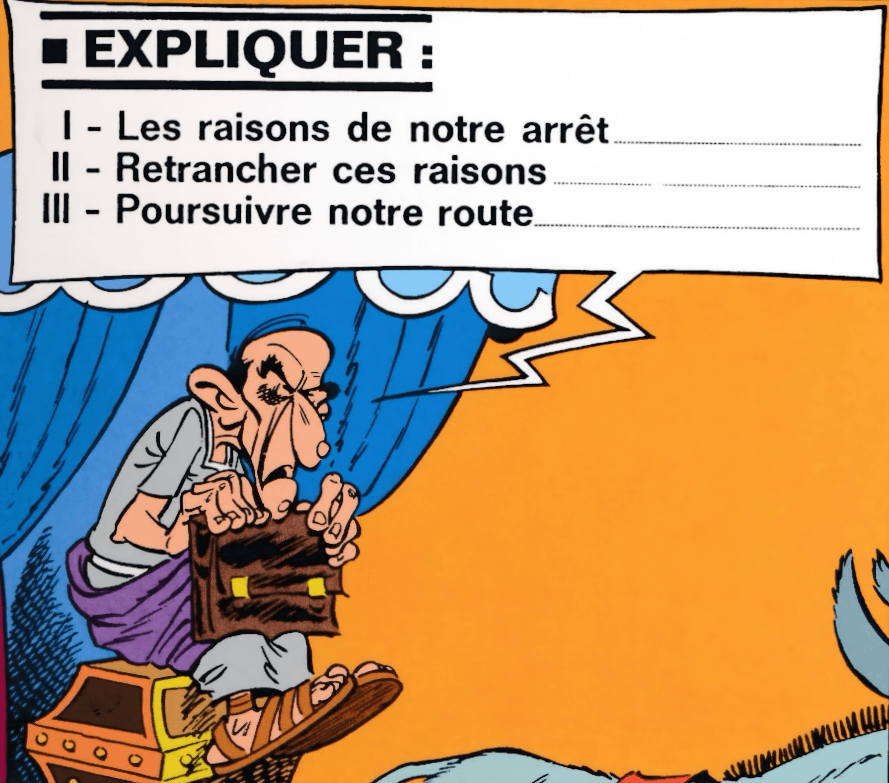
The Tax Collector: A Roman official caricatures Valéry Giscard d’Estaing, then French Minister of Finance. Even his speech bubbles resemble tax forms, adding a visual pun to the satire.
Sword fight: in this album it is for the first time we see Asterix engage in a sword fight. Asterix stands his ground, but is disarmed in the end.


Lost in Translation: French Wordplay Explained
Many of the funniest lines rely on French puns, impossible to fully capture in English. For those fans who don’t know French, but still want to know what the original says, here are some highlights:
The “Rehearsal” Nag
Fullitautomatix stops the bard from singing: “Je te répète que non, tu ne chanteras pas !” In French, répétitions means both nagging and concert rehearsals. The bard complains that the nagging is ruining his voice—comic wordplay at its finest. (page 3, panel 1)

Income Tax Logic
Dialogue: “Jamais ! Donc, pas de revenu, pas d’impôts !” Revenu can mean returned, income, and is part of impôt sur le revenu (income tax). The joke: if someone never returns, there’s no income, and so—no tax. (page 4, panel 8)
“Bannir” vs. “Partir”
Obelix insists on accompanying Asterix into exile: “Tu ne bannirais pas loin sans nous !” Bannir = banish, partir = leave. Obelix treats punishment as a road trip, turning legal exile into a comical adventure. (page 10, panel 2)
Buried Taxes and Stranded Pirates
Pirates lament: “Depuis que ces Gaulois nous ont mis sur le sable…” Être sur le sable = stranded on sand or broke. The Romans have buried so many taxes that coins may resurface for centuries—a pun layered in both literal and figurative ruin. (page 13, panel 7)
Marron: Chestnuts, Punches, and the Black Pirate
“La saison des marrons a été précoce cette année…” Marron = chestnut, punch, or dark brown. Slapstick hits are described as a “chestnut harvest,” while the black pirate Baba visually echoes the pun—dark brown/marron—without any racial implication. Classic Asterix layering: slapstick, wordplay, and visual gag. (page 14, panel 9)
The “Boudin” Song
A legionnaire asks, “Vous avez du boudin ?” referencing the French Foreign Legion song “Tiens, voilà du boudin”. A clever mix of military life and grocery humor. (page 17, panel 5)
Impossible is not a Gaulish word
This is an allusian to the French idiom “impossible n’est pas français“. While it sounds like a literal claim about the French language, it is actually a motivational idiom attributed to Napoleon Bonaparte. It is the French equivalent of saying: “Nothing is impossible.” (page 34, panel 3)

Fluctuat / Mergitur
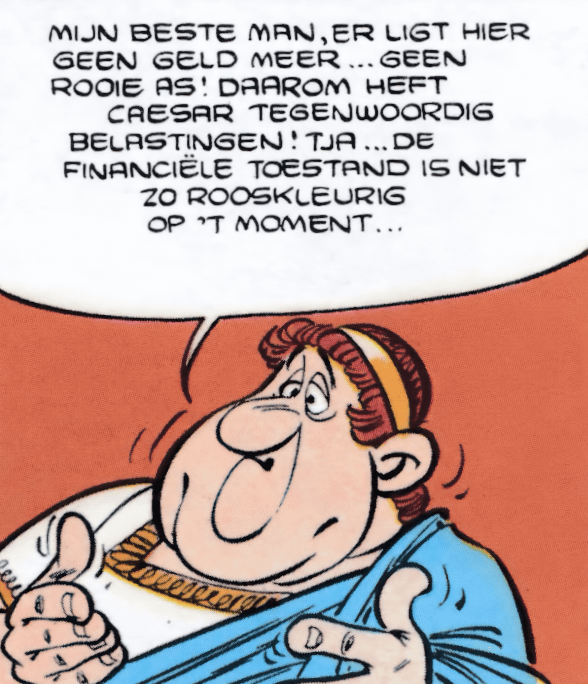
The bank director groans: “Nous avons mergitur… et je ne sais pas quand nous allons fluctuat de nouveau !” A twist on Paris’s motto Fluctuat nec mergitur (“Tossed but not sunk”), humorously admitting that the bank has indeed “sunk.” Fluctuat nec mergitur became the motto of Paris in 1853. It became a symbol of Parisian resillence after the 2015 terror attacks.
The translators of Asterix seem to have trouble with the Latin text. Below you see several translations and only the Italian translator seems to be able to just insert the Mergitur and Fluctaut in his text. The German translator needs to explain it, while the English translators replace it with a bunch of other Latin terms. The Dutch translator doesn’t even try.


Money Has No Smell
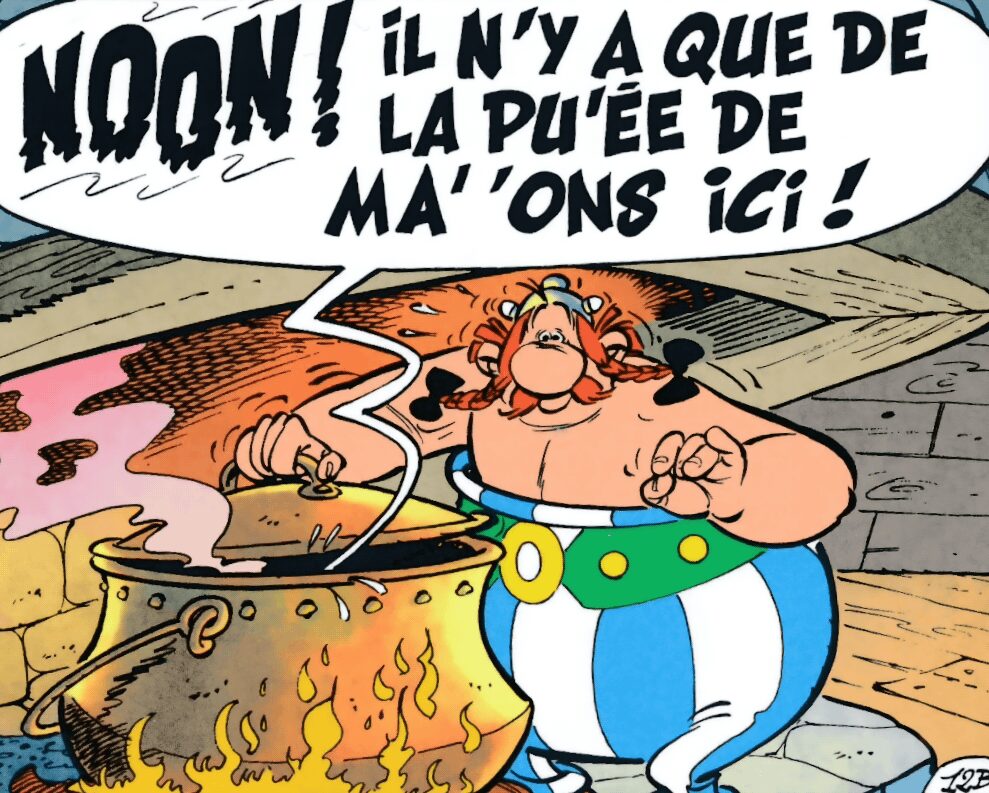
In the end, Obelix remarks, “Sentir de l’argent ? Mais ça n’a pas d’odeur !”—except when it smells like onions! Sniffing the stolen coins reveals Whosemoralsarelastix’s treachery. Victory is sweet: honor, cleverness, and Gaulish stubbornness triumph once more. (page 42, panel 8)
A reader sent us the following: There is a famous anecdote involving the Roman emperor Vespasian and his son Titus, who objected to a tax on urine; in response, Vespasian reportedly held up a gold coin and pointed out that although it had no smell, it still originated from urine—an early illustration of the idea that money’s value is independent of its source. This is where the phrase Pecunia non olet comes from.
Conclusion
Asterix and the Cauldron is more than a treasure hunt—it’s a satire of greed, history, and human foibles, wrapped in the sharpest French wordplay and Uderzo’s visual comedy. Between buried taxes, chestnut punches, and morally “elastic” villains, this adventure reminds us that impossible is not Gaulish (Impossible n’est pas gaulois), and that a clever Gaul can turn even money and misfortune into an unforgettable adventure.


In 1969, the 13th volume of the Asterix series, Asterix and the Cauldron (Astérix et le Chaudron), took our favorite Gaul into surprisingly modern territory. Unlike the usual adventures of superhuman feats and clever escapes, this story is a satire of money, pride, and human folly, pitting Asterix against a villain whose currency is more treacherous than a Roman sword.
A Darker Shade of Gaul
This is one of the few stories where Asterix, the seemingly invincible warrior, shows real emotion. Overcome by shame after a failure, he even sheds tears—a moment that signals a subtle shift toward more complex characterisation.
The villain, Whosemoralsarelastix (French: Moralélastix—“elastic morals” (which parents name their kids like this?)), is unusually detestable. Uderzo modeled him after the “filthy collaborators” of the Nazi Occupation. His excuse for trading with the Romans—“I sell to them, sure, but always at double the price I’d ask a Gaul!”—is a sly jab at wartime profiteers. Unlike the usual bumbling or “idiotic” villains in the series, Whosemoralsarelastix is truly greedy and Machiavellian.
May ’68, Money, and Anxiety
The story was serialized in Pilote magazine starting October 1968, just months after the student protests of May ’68 shook France. This period, defined by skepticism toward authority and money, is reflected in the album’s theme.
Even the authors were not immune. Having grown wealthy from Asterix’s success, Goscinny and Uderzo were often accused of being “men of money.” Asterix and the Cauldron lets them play with that guilt: exploring the tension of earning money in a “crazy profession” while keeping one’s integrity intact.
Cultural Easter Eggs and “Artsy” Nods
The Latin phrase “ubi solitudinem faciunt, pacem appellant” comes from the Roman historian Tacitus, in his work Agricola (chapter 30). It means that conquerors destroy lands and peoples, then call the resulting emptiness “peace.” It criticizes the hypocrisy of presenting violence and domination as stability or order.
The Theater Scene: A director named Éléonoradus appears—a pun on actress Eleonora Duse, yet drawn with angular, ethereal features reminiscent of David Bowie. According to French fans however, it isn’t Bowie but the French actor Laurent Terzieff. In the English translation the actor goes by Laurensolivius, a nod to actor Laurence Olivier. Another actor, Juleraimus in French, is named Alecguinus in English. These are nods to Raimu and Alec Guinness.
Credit Latin: this name of the bank is of course a nod to Crédit Lyonnais. The English translators used Barclus Bank.
The Tax Collector: A Roman official caricatures Valéry Giscard d’Estaing, then French Minister of Finance. Even his speech bubbles resemble tax forms, adding a visual pun to the satire.
Sword fight: in this album it is for the first time we see Asterix engage in a sword fight. Asterix stands his ground, but is disarmed in the end.
Lost in Translation: French Wordplay Explained
Many of the funniest lines rely on French puns, impossible to fully capture in English. For those fans who don’t know French, but still want to know what the original says, here are some highlights:
The “Rehearsal” Nag
Fullitautomatix stops the bard from singing: “Je te répète que non, tu ne chanteras pas !” In French, répétitions means both nagging and concert rehearsals. The bard complains that the nagging is ruining his voice—comic wordplay at its finest. (page 3, panel 1)
Income Tax Logic
Dialogue: “Jamais ! Donc, pas de revenu, pas d’impôts !” Revenu can mean returned, income, and is part of impôt sur le revenu (income tax). The joke: if someone never returns, there’s no income, and so—no tax. (page 4, panel 8)
“Bannir” vs. “Partir”
Obelix insists on accompanying Asterix into exile: “Tu ne bannirais pas loin sans nous !” Bannir = banish, partir = leave. Obelix treats punishment as a road trip, turning legal exile into a comical adventure. (page 10, panel 2)
Buried Taxes and Stranded Pirates
Pirates lament: “Depuis que ces Gaulois nous ont mis sur le sable…” Être sur le sable = stranded on sand or broke. The Romans have buried so many taxes that coins may resurface for centuries—a pun layered in both literal and figurative ruin. (page 13, panel 7)
Marron: Chestnuts, Punches, and the Black Pirate
“La saison des marrons a été précoce cette année…” Marron = chestnut, punch, or dark brown. Slapstick hits are described as a “chestnut harvest,” while the black pirate Baba visually echoes the pun—dark brown/marron—without any racial implication. Classic Asterix layering: slapstick, wordplay, and visual gag. (page 14, panel 9)
The “Boudin” Song
A legionnaire asks, “Vous avez du boudin ?” referencing the French Foreign Legion song “Tiens, voilà du boudin”. A clever mix of military life and grocery humor. (page 17, panel 5)
Impossible is not a Gaulish word
This is an allusian to the French idiom “impossible n’est pas français“. While it sounds like a literal claim about the French language, it is actually a motivational idiom attributed to Napoleon Bonaparte. It is the French equivalent of saying: “Nothing is impossible.” (page 34, panel 3)
Fluctuat / Mergitur
The bank director groans: “Nous avons mergitur… et je ne sais pas quand nous allons fluctuat de nouveau !” A twist on Paris’s motto Fluctuat nec mergitur (“Tossed but not sunk”), humorously admitting that the bank has indeed “sunk.” Fluctuat nec mergitur became the motto of Paris in 1853. It became a symbol of Parisian resillence after the 2015 terror attacks.
The translators of Asterix seem to have trouble with the Latin text. Below you see several translations and only the Italian translator seems to be able to just insert the Mergitur and Fluctaut in his text. The German translator needs to explain it, while the English translators replace it with a bunch of other Latin terms. The Dutch translator doesn’t even try.
Money Has No Smell
In the end, Obelix remarks, “Sentir de l’argent ? Mais ça n’a pas d’odeur !”—except when it smells like onions! Sniffing the stolen coins reveals Whosemoralsarelastix’s treachery. Victory is sweet: honor, cleverness, and Gaulish stubbornness triumph once more. (page 42, panel 8)
A reader sent us the following: There is a famous anecdote involving the Roman emperor Vespasian and his son Titus, who objected to a tax on urine; in response, Vespasian reportedly held up a gold coin and pointed out that although it had no smell, it still originated from urine—an early illustration of the idea that money’s value is independent of its source. This is where the phrase Pecunia non olet comes from.
Conclusion
Asterix and the Cauldron is more than a treasure hunt—it’s a satire of greed, history, and human foibles, wrapped in the sharpest French wordplay and Uderzo’s visual comedy. Between buried taxes, chestnut punches, and morally “elastic” villains, this adventure reminds us that impossible is not Gaulish (Impossible n’est pas gaulois), and that a clever Gaul can turn even money and misfortune into an unforgettable adventure.