When Asterix in Lusitania (Vol. 41) arrived in October 2025, fans once again followed the indomitable Gauls on a whirlwind journey—this time to the lands of ancient Lusitania, the region that would one day become Portugal. As always with Fabcaro’s writing and Didier Conrad’s illustrations, readers eagerly examined every pun, visual gag, and hidden Easter egg. Yet one small detail caught the attention of eagle-eyed fans comparing the various editions: a single background joke that diverged dramatically between the French, Dutch, German, and English translations.
The original joke
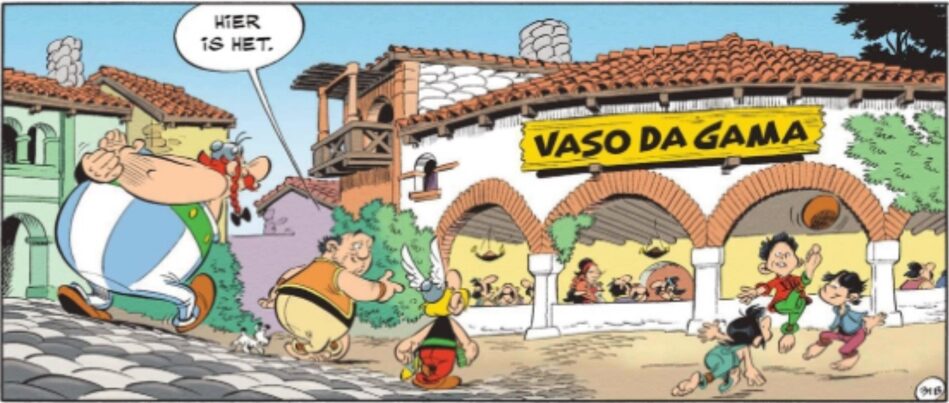
In the original French, as well as the Dutch and German versions, the joke appears in a sign for a local tavern named “Vaso da Gama.” This classic Asterix pun works on several levels. It nods to the famed Portuguese explorer Vasco da Gama, the first European to reach India by sea, rooting the scene firmly in Lusitania’s history. At the same time, the slight tweak to “Vaso” (“vessel” or “glass” in Romance languages) transforms the explorer’s name into a fitting moniker for a tavern or wine bar. The humor relies on cultural literacy: readers familiar with world history recognize the clever wordplay and appreciate its timeless charm.

The translation
The UK English edition, translated by Adriana Hunter, takes a very different route. The tavern becomes “Deli Furtado”, a pun referencing Canadian-Portuguese singer Nelly Furtado. By turning “Nelly” into “Deli” (short for delicatessen), the sign functions as a shop name while giving a playful nod to a modern pop culture figure of Portuguese heritage. The result is a joke that lands immediately for readers who remember the early 2000s music charts—but it trades historical weight for contemporary recognition.
US English
It is even more remarkable that in the US English translation, done by Nanette McGuinness, the joke stays. Be it in a somewhat altered form. Here the wine bar is named Vas & Co which is run by Gama.

Italian does it best
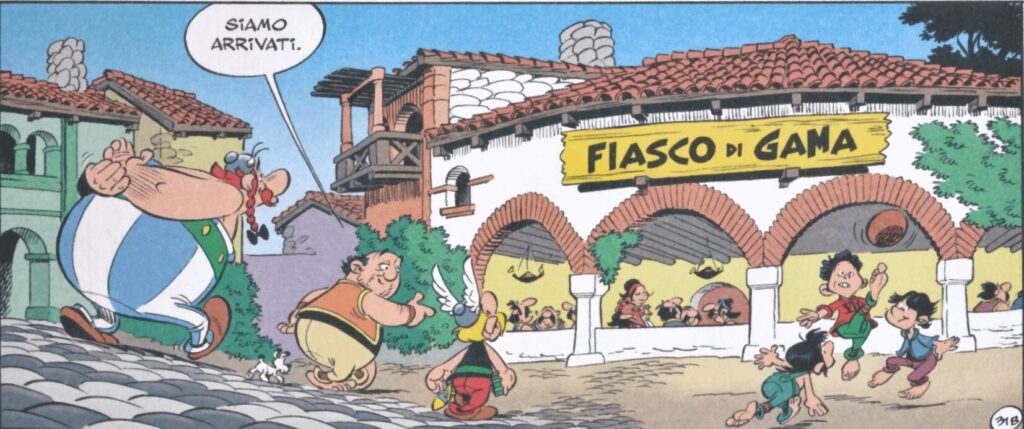
In my opinion the Italian translator did it best. No explanation needed.
Tension?
This small change illustrates a broader tension in the art of translation: timelessness versus topicality. most translators seem to favor historical continuity, trusting that readers would understand the reference to a 15th-century explorer, and in doing so, created a pun that will likely remain amusing for centuries. By contrast, the UK English translation favors an instant laugh rooted in modern pop culture, a choice that may resonate today but risks becoming obscure in the future. While Vasco da Gama’s name is firmly etched in history, Nelly Furtado’s fame may fade, potentially requiring footnotes for future readers.
In the end, “Vaso da Gama” versus “Deli Furtado” is more than just a pun: it is a small but telling example of how Asterix adapts across cultures. French, Dutch, and German readers receive a wink to history, while English readers enjoy a pop-culture nod. Both choices are funny, but they reveal the delicate balance translators must strike between honoring the past and entertaining the present.
Post Scriptum
You probably also spotted a famous soccer player in this panel. He appears twice in this album.


When Asterix in Lusitania (Vol. 41) arrived in October 2025, fans once again followed the indomitable Gauls on a whirlwind journey—this time to the lands of ancient Lusitania, the region that would one day become Portugal. As always with Fabcaro’s writing and Didier Conrad’s illustrations, readers eagerly examined every pun, visual gag, and hidden Easter egg. Yet one small detail caught the attention of eagle-eyed fans comparing the various editions: a single background joke that diverged dramatically between the French, Dutch, German, and English translations.
The original joke
In the original French, as well as the Dutch and German versions, the joke appears in a sign for a local tavern named “Vaso da Gama.” This classic Asterix pun works on several levels. It nods to the famed Portuguese explorer Vasco da Gama, the first European to reach India by sea, rooting the scene firmly in Lusitania’s history. At the same time, the slight tweak to “Vaso” (“vessel” or “glass” in Romance languages) transforms the explorer’s name into a fitting moniker for a tavern or wine bar. The humor relies on cultural literacy: readers familiar with world history recognize the clever wordplay and appreciate its timeless charm.
The translation
The UK English edition, translated by Adriana Hunter, takes a very different route. The tavern becomes “Deli Furtado”, a pun referencing Canadian-Portuguese singer Nelly Furtado. By turning “Nelly” into “Deli” (short for delicatessen), the sign functions as a shop name while giving a playful nod to a modern pop culture figure of Portuguese heritage. The result is a joke that lands immediately for readers who remember the early 2000s music charts—but it trades historical weight for contemporary recognition.
US English
It is even more remarkable that in the US English translation, done by Nanette McGuinness, the joke stays. Be it in a somewhat altered form. Here the wine bar is named Vas & Co which is run by Gama.
Italian does it best
In my opinion the Italian translator did it best. No explanation needed.
Tension?
This small change illustrates a broader tension in the art of translation: timelessness versus topicality. most translators seem to favor historical continuity, trusting that readers would understand the reference to a 15th-century explorer, and in doing so, created a pun that will likely remain amusing for centuries. By contrast, the UK English translation favors an instant laugh rooted in modern pop culture, a choice that may resonate today but risks becoming obscure in the future. While Vasco da Gama’s name is firmly etched in history, Nelly Furtado’s fame may fade, potentially requiring footnotes for future readers.
In the end, “Vaso da Gama” versus “Deli Furtado” is more than just a pun: it is a small but telling example of how Asterix adapts across cultures. French, Dutch, and German readers receive a wink to history, while English readers enjoy a pop-culture nod. Both choices are funny, but they reveal the delicate balance translators must strike between honoring the past and entertaining the present.
Post Scriptum
You probably also spotted a famous soccer player in this panel. He appears twice in this album.