Asterix has been translated into many Mundarts (German dialects). For a collector and someone who is interested in languages, these can sometimes be tricky to categorize. The publisher mixes dialects, subdialects, and regional varieties without making clear distinctions, and it is not organized in a way a linguist would. In the following article I will try to clear things up a bit.
Introduction to German and Its Dialects

German is part of the Indo-European language family, within the Germanic branch, and more specifically the West Germanic subgroup, alongside English, Dutch, and Frisian. Within German, there exists a continuum of regional dialects, often referred to as Mundarten, which are not sharply separated but blend gradually from one region to the next. These dialects are distinguished by phonetic, grammatical, lexical, and syntactic characteristics and have evolved over centuries through geographical separation, historical political boundaries, and contact with neighboring languages. Linguists classify German dialects based on these characteristics, allowing a coherent understanding of the linguistic landscape.
A key classification is based on the historical High German consonant shift, a series of sound changes that affected southern regions more than northern ones. The effect of this shift led to the three major dialect groups: Low German (Plattdeutsch) in the north, which remained largely unaffected by the shift; Central German (Mitteldeutsch) in the central regions, partially affected; and Upper German (Oberdeutsch) in the south, fully affected. This classification explains the seemingly counterintuitive naming: Upper and Lower German do not refer to geographical altitude. Northern German dialects are associated with the low-lying North German Plain, while southern dialects are spoken in the higher terrain of southern Germany, including the Alps and surrounding uplands. This historical-geographical perspective clarifies why “Upper” dialects appear in the south and “Lower” dialects in the north.
Low German
Low German, also known as Plattdeutsch or Niederdeutsch, is spoken in northern Germany, including regions such as Schleswig-Holstein, Lower Saxony, and Mecklenburg. It preserves many features of older Germanic forms and was largely unaffected by the High German consonant shift. Low German dialects have distinct verb forms, phonetic patterns, and vocabulary that differentiate them from Standard German.

Plattdeutsch (or Niederdeutsch / Low German) is the umbrella term for the Low German dialects spoken in northern Germany. Low Saxon (Nedersaksisch / Niedersächsisch) is one of the main dialects within Plattdeutsch, historically centered in Lower Saxony and parts of northern Netherlands.
In other words:
- Plattdeutsch / Low German / Niederdeutsch = the broad dialect group of northern Germany, largely unaffected by the High German consonant shift.
- Low Saxon = one dialect within this group. Other dialects include East Frisian Low Saxon, Westphalian, Northern Low Saxon, etc.
Central German
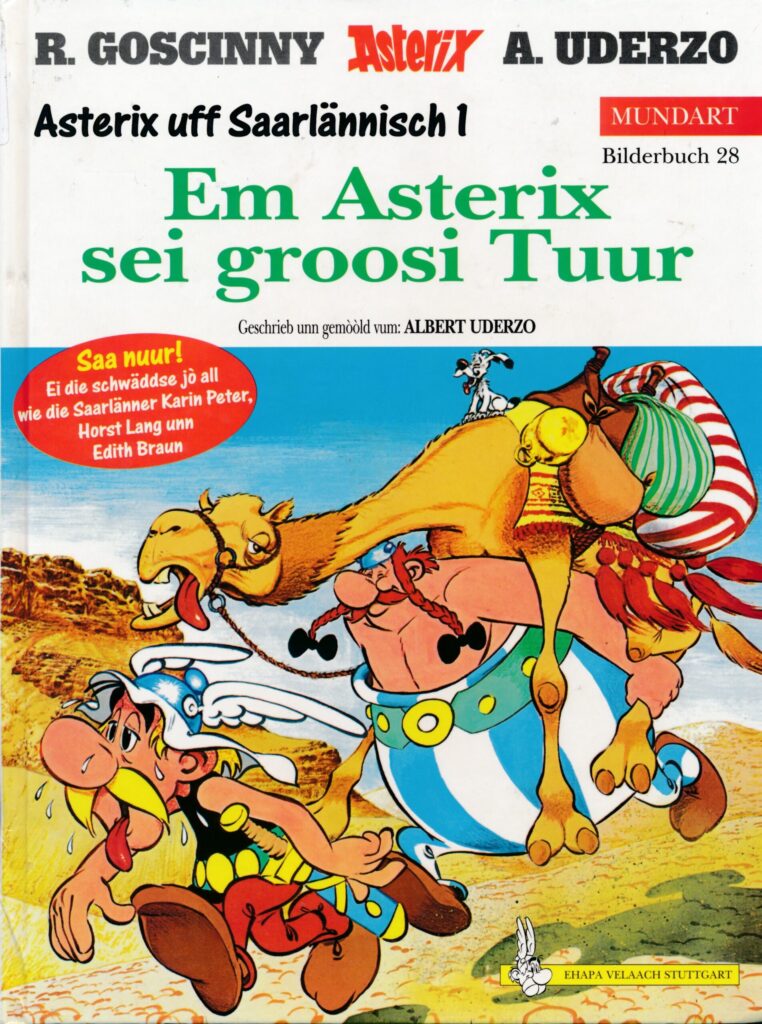
Central German dialects occupy the central portion of Germany and form a transitional zone between the Low German north and Upper German south. Within Central German, two major subgroups are distinguished: West Central German and East Central German. West Central German includes dialects such as Rheinfränkisch, Moselfränkisch, and their local varieties, including Saarländisch. Saarländisch is a regional variety of Moselle Franconian, influenced by neighboring Rheinfränkisch, and is represented by three Asterix albums. Badisch, often associated with Alemannic German but listed separately in the Asterix translations, is another West Central variety spoken in the Baden region. East Central German includes dialects such as Thuringian, Upper Saxon, and Silesian German.
Upper German
Upper German dialects are spoken in the southern regions of Germany, Switzerland, and Austria. This group includes Alemannic and Bavarian dialects. Alemannic dialects, which include Low Alemannic in northern Baden, High Alemannic in Switzerland, and Alsatian in France, are represented in Asterix translations under the broad label “Alemannic,” covering a general Upper German dialect. Badisch can also be considered part of Low Alemannic, though for marketing purposes it is treated as a distinct entry. Bavarian dialects, including Northern, Central, and Southern Bavarian, are found in Bavaria and Austria. Styrian, spoken in Austria, is part of the Austro-Bavarian subgroup of Upper German. These translations carefully adapt the original text’s humor, wordplay, and narrative flow to each dialect’s phonetic and lexical characteristics, allowing readers familiar with the dialects to experience Asterix authentically.
Mapping Asterix Mundarts to Linguistic Families
High German (Hochdeutsch) Dialects
Alemannisch (Alemannic) → subgroup of Upper German (Oberdeutsch).
Badisch (Baden dialect) → Alemannic (Upper German).
Bairisch (Bavarian) → subgroup of Upper German (Oberdeutsch).
Kärntnerisch (Carinthian) → Southern Bavarian (Bairisch).
Münchnerisch (Munich dialect) → Central Bavarian (Bairisch).
Oberpfälzisch (Upper Palatinate) → Northern Bavarian (Bairisch).
Steirisch (Styrian) → Southern Bavarian (Bairisch).
Südtirolerisch (South Tyrolean) → Southern Bavarian (Bairisch).
Tirolerisch (Tyrolean) → Southern Bavarian (Bairisch).
Schwäbisch (Swabian) → Alemannic (Upper German).
Schwyzerdütsch (Swiss German) → Alemannic (Upper German).
Central German (Mitteldeutsch) Dialects
Fränkisch (Franconian) → umbrella term for several Central German dialects.
Meefränggisch (Main-Franconian) → East Franconian (Mitteldeutsch).
Oberfränkisch (Upper Franconian) → East Franconian.
Mainzerisch (Mainz dialect) → Rhenish Franconian.
Moselfränkisch (Moselle Franconian) → Central Franconian.
Pfälzisch (Palatine German) → Rhenish Franconian (Mitteldeutsch).
Saarländisch (Saarland dialect) → Rhenish Franconian (Mitteldeutsch).
Öcher Platt (Aachen dialect) → Ripuarian Franconian (Mitteldeutsch).
Kölsch (Cologne dialect) → Ripuarian Franconian (Mitteldeutsch).
Hunsrücker Platt (Hunsrück dialect) → Moselle Franconian (Mitteldeutsch).
Hessisch (Hessian) → Central German (Rhine Franconian subgroup).
Sächsisch (Saxon / Upper Saxon) → East Central German (Mitteldeutsch).
Thüringisch (Thuringian) → East Central German (Mitteldeutsch).
Low German (Niederdeutsch / Plattdeutsch) Dialects
Plattdeutsch (Low German) → broad category.
Hamburgisch (Hamburg dialect) → Northern Low Saxon (Low German).
Ostfriesisch (East Frisian Low Saxon) → Low German (distinct from Frisian language!).
Westfälisch (Westphalian) → West Low German.
Dialectal Variants / Mixed Urban Dialects
Berlinerisch (Berlin dialect) → East Central German with Low German substratum.
Düsseldorferisch (Düsseldorf dialect) → Ripuarian Franconian influence.
Ruhrdeutsch (Ruhr German) → Mixed regiolect (Central German + Low German + immigrant influences).
Wienerisch (Viennese) → Eastern Bavarian with unique urban features.
My collection of Mundarts
It’s a work in progress




Asterix has been translated into many Mundarts (German dialects). For a collector and someone who is interested in languages, these can sometimes be tricky to categorize. The publisher mixes dialects, subdialects, and regional varieties without making clear distinctions, and it is not organized in a way a linguist would. In the following article I will try to clear things up a bit.
Introduction to German and Its Dialects
German is part of the Indo-European language family, within the Germanic branch, and more specifically the West Germanic subgroup, alongside English, Dutch, and Frisian. Within German, there exists a continuum of regional dialects, often referred to as Mundarten, which are not sharply separated but blend gradually from one region to the next. These dialects are distinguished by phonetic, grammatical, lexical, and syntactic characteristics and have evolved over centuries through geographical separation, historical political boundaries, and contact with neighboring languages. Linguists classify German dialects based on these characteristics, allowing a coherent understanding of the linguistic landscape.
A key classification is based on the historical High German consonant shift, a series of sound changes that affected southern regions more than northern ones. The effect of this shift led to the three major dialect groups: Low German (Plattdeutsch) in the north, which remained largely unaffected by the shift; Central German (Mitteldeutsch) in the central regions, partially affected; and Upper German (Oberdeutsch) in the south, fully affected. This classification explains the seemingly counterintuitive naming: Upper and Lower German do not refer to geographical altitude. Northern German dialects are associated with the low-lying North German Plain, while southern dialects are spoken in the higher terrain of southern Germany, including the Alps and surrounding uplands. This historical-geographical perspective clarifies why “Upper” dialects appear in the south and “Lower” dialects in the north.
Low German
Low German, also known as Plattdeutsch or Niederdeutsch, is spoken in northern Germany, including regions such as Schleswig-Holstein, Lower Saxony, and Mecklenburg. It preserves many features of older Germanic forms and was largely unaffected by the High German consonant shift. Low German dialects have distinct verb forms, phonetic patterns, and vocabulary that differentiate them from Standard German.
Plattdeutsch (or Niederdeutsch / Low German) is the umbrella term for the Low German dialects spoken in northern Germany. Low Saxon (Nedersaksisch / Niedersächsisch) is one of the main dialects within Plattdeutsch, historically centered in Lower Saxony and parts of northern Netherlands.
In other words:
- Plattdeutsch / Low German / Niederdeutsch = the broad dialect group of northern Germany, largely unaffected by the High German consonant shift.
- Low Saxon = one dialect within this group. Other dialects include East Frisian Low Saxon, Westphalian, Northern Low Saxon, etc.
Central German
Central German dialects occupy the central portion of Germany and form a transitional zone between the Low German north and Upper German south. Within Central German, two major subgroups are distinguished: West Central German and East Central German. West Central German includes dialects such as Rheinfränkisch, Moselfränkisch, and their local varieties, including Saarländisch. Saarländisch is a regional variety of Moselle Franconian, influenced by neighboring Rheinfränkisch, and is represented by three Asterix albums. Badisch, often associated with Alemannic German but listed separately in the Asterix translations, is another West Central variety spoken in the Baden region. East Central German includes dialects such as Thuringian, Upper Saxon, and Silesian German.
Upper German
Upper German dialects are spoken in the southern regions of Germany, Switzerland, and Austria. This group includes Alemannic and Bavarian dialects. Alemannic dialects, which include Low Alemannic in northern Baden, High Alemannic in Switzerland, and Alsatian in France, are represented in Asterix translations under the broad label “Alemannic,” covering a general Upper German dialect. Badisch can also be considered part of Low Alemannic, though for marketing purposes it is treated as a distinct entry. Bavarian dialects, including Northern, Central, and Southern Bavarian, are found in Bavaria and Austria. Styrian, spoken in Austria, is part of the Austro-Bavarian subgroup of Upper German. These translations carefully adapt the original text’s humor, wordplay, and narrative flow to each dialect’s phonetic and lexical characteristics, allowing readers familiar with the dialects to experience Asterix authentically.
Mapping Asterix Mundarts to Linguistic Families
High German (Hochdeutsch) Dialects
Alemannisch (Alemannic) → subgroup of Upper German (Oberdeutsch).
Badisch (Baden dialect) → Alemannic (Upper German).
Bairisch (Bavarian) → subgroup of Upper German (Oberdeutsch).
Kärntnerisch (Carinthian) → Southern Bavarian (Bairisch).
Münchnerisch (Munich dialect) → Central Bavarian (Bairisch).
Oberpfälzisch (Upper Palatinate) → Northern Bavarian (Bairisch).
Steirisch (Styrian) → Southern Bavarian (Bairisch).
Südtirolerisch (South Tyrolean) → Southern Bavarian (Bairisch).
Tirolerisch (Tyrolean) → Southern Bavarian (Bairisch).
Schwäbisch (Swabian) → Alemannic (Upper German).
Schwyzerdütsch (Swiss German) → Alemannic (Upper German).
Central German (Mitteldeutsch) Dialects
Fränkisch (Franconian) → umbrella term for several Central German dialects.
Meefränggisch (Main-Franconian) → East Franconian (Mitteldeutsch).
Oberfränkisch (Upper Franconian) → East Franconian.
Mainzerisch (Mainz dialect) → Rhenish Franconian.
Moselfränkisch (Moselle Franconian) → Central Franconian.
Pfälzisch (Palatine German) → Rhenish Franconian (Mitteldeutsch).
Saarländisch (Saarland dialect) → Rhenish Franconian (Mitteldeutsch).
Öcher Platt (Aachen dialect) → Ripuarian Franconian (Mitteldeutsch).
Kölsch (Cologne dialect) → Ripuarian Franconian (Mitteldeutsch).
Hunsrücker Platt (Hunsrück dialect) → Moselle Franconian (Mitteldeutsch).
Hessisch (Hessian) → Central German (Rhine Franconian subgroup).
Sächsisch (Saxon / Upper Saxon) → East Central German (Mitteldeutsch).
Thüringisch (Thuringian) → East Central German (Mitteldeutsch).
Low German (Niederdeutsch / Plattdeutsch) Dialects
Plattdeutsch (Low German) → broad category.
Hamburgisch (Hamburg dialect) → Northern Low Saxon (Low German).
Ostfriesisch (East Frisian Low Saxon) → Low German (distinct from Frisian language!).
Westfälisch (Westphalian) → West Low German.
Dialectal Variants / Mixed Urban Dialects
Berlinerisch (Berlin dialect) → East Central German with Low German substratum.
Düsseldorferisch (Düsseldorf dialect) → Ripuarian Franconian influence.
Ruhrdeutsch (Ruhr German) → Mixed regiolect (Central German + Low German + immigrant influences).
Wienerisch (Viennese) → Eastern Bavarian with unique urban features.
My collection of Mundarts
It’s a work in progress