Long-running comic franchises frequently experience minor continuity shifts as they transition between creative teams, and the Asterix series is no exception. A subtle discrepancy regarding the edibility of wolves appears when comparing the early work of René Goscinny and Albert Uderzo with the contemporary albums by Jean-Yves Ferri and Didier Conrad. For readers who enjoy examining translation choices and the historical background of the franchise’s publication, this detail provides an interesting textual footnote.
In the second album of the series, The Golden Sickle (1960), the creators establish a clear rule regarding local wildlife. During a nocturnal forest skirmish, Obelix fends off a pack of wolves and explicitly expresses his frustration with their lack of nutritional value.
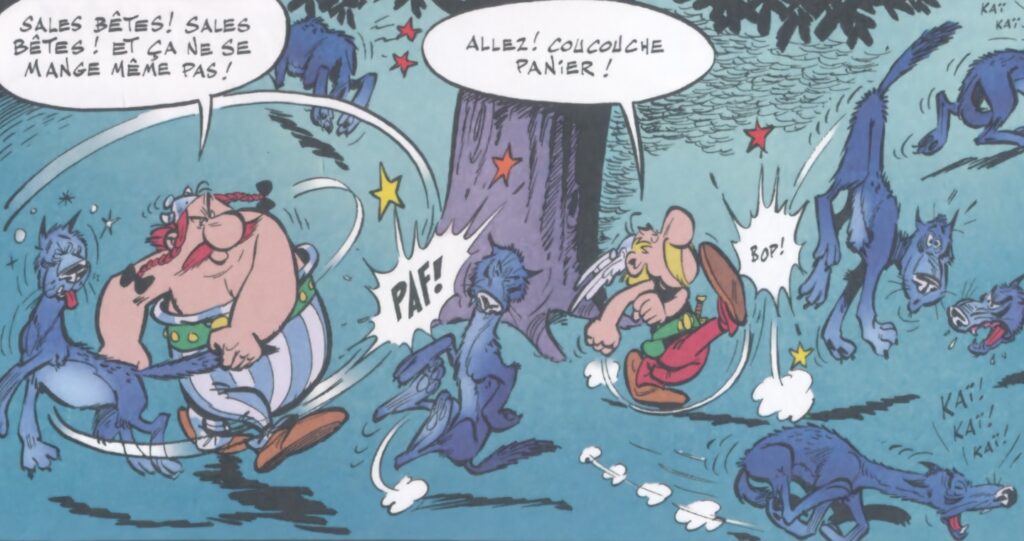
- Original French text: “Sales bêtes ! Et ça ne se mange même pas !”
- English translation: “Filthy beasts! And you can’t even eat them!”
This panel confirms that Obelix is fully aware that wolves are not suitable for consumption. However, the 39th album, Asterix and the Griffin (2021), presents a different perspective. As the Gauls traverse a frozen wasteland, a hungry voice off-panel—widely interpreted by readers as Obelix, given his defining characterization—questions the culinary potential of a nearby wolf.
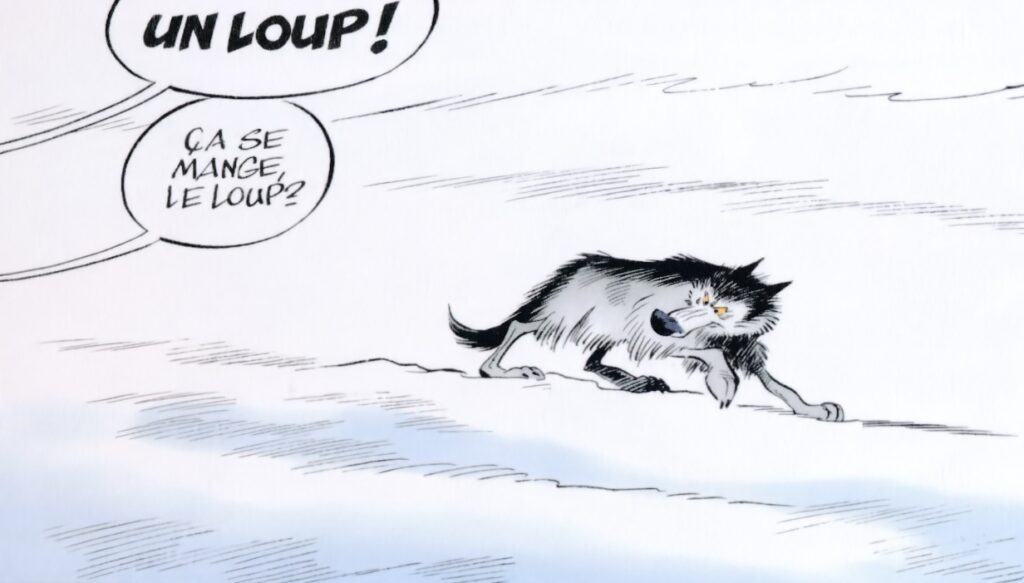
- Original French text: “Un loup ! … Ça se mange, le loup ?”
- English translation: “A wolf! … Is wolf edible?”
This variation likely stems from prioritizing an immediate comedic payoff over strict adherence to a minor detail established over sixty years prior. Situational humor, especially concerning Obelix’s insatiable appetite, often takes precedence in modern comic writing. While this discontinuity functions as a minor editorial oversight rather than a significant narrative flaw, observing these variations remains a fascinating exercise for those tracking the evolving character portrayals across the franchise’s extensive history.


Long-running comic franchises frequently experience minor continuity shifts as they transition between creative teams, and the Asterix series is no exception. A subtle discrepancy regarding the edibility of wolves appears when comparing the early work of René Goscinny and Albert Uderzo with the contemporary albums by Jean-Yves Ferri and Didier Conrad. For readers who enjoy examining translation choices and the historical background of the franchise’s publication, this detail provides an interesting textual footnote.
In the second album of the series, The Golden Sickle (1960), the creators establish a clear rule regarding local wildlife. During a nocturnal forest skirmish, Obelix fends off a pack of wolves and explicitly expresses his frustration with their lack of nutritional value.
- Original French text: “Sales bêtes ! Et ça ne se mange même pas !”
- English translation: “Filthy beasts! And you can’t even eat them!”
This panel confirms that Obelix is fully aware that wolves are not suitable for consumption. However, the 39th album, Asterix and the Griffin (2021), presents a different perspective. As the Gauls traverse a frozen wasteland, a hungry voice off-panel—widely interpreted by readers as Obelix, given his defining characterization—questions the culinary potential of a nearby wolf.
- Original French text: “Un loup ! … Ça se mange, le loup ?”
- English translation: “A wolf! … Is wolf edible?”
This variation likely stems from prioritizing an immediate comedic payoff over strict adherence to a minor detail established over sixty years prior. Situational humor, especially concerning Obelix’s insatiable appetite, often takes precedence in modern comic writing. While this discontinuity functions as a minor editorial oversight rather than a significant narrative flaw, observing these variations remains a fascinating exercise for those tracking the evolving character portrayals across the franchise’s extensive history.