Long before Getafix brewed his famous magic potion, the druids of ancient Gaul already held a special place in the imagination of the Romans. They were priests, philosophers, and judges, feared and respected in equal measure. This article explores what we actually know about the druids from ancient sources, and then compares those historical facts to Goscinny and Uderzo’s depiction of Getafix—the archetypal druid of Asterix. We will see which parts of his character are rooted in history, and which belong purely to the realm of fiction.

What the Romans Told Us About Druids
The only written accounts of druids come from Greek and Roman authors. The druids themselves left no texts, because their teachings were transmitted entirely by word of mouth. Julius Caesar, who encountered them during his conquest of Gaul, is our main source. In De Bello Gallico, he describes the druids as a powerful class responsible for religion, law, and education. Other writers, including Strabo, Diodorus Siculus, Pomponius Mela, and Pliny the Elder, confirm this picture.
According to Caesar, Gaulish society was divided into three groups: the warriors, the common people, and the druids. The druids formed the intellectual and spiritual elite. They supervised sacrifices, taught philosophy, and acted as judges. They believed that souls were immortal and passed from one body to another, a doctrine that gave courage in battle and comfort in death.
Caesar also notes that a druid’s education could last up to twenty years. They learned vast quantities of verses by heart, since they were forbidden to write down their teachings. While the Gauls used Greek letters for ordinary business, their sacred knowledge was preserved through memory alone. This aspect of their oral culture is one of the most firmly attested facts about them.
Rituals and Sacred Symbols
Pliny the Elder adds vivid detail to the Roman picture of druidic ritual. In Natural History, he describes how druids, clad in white robes, would climb an oak tree to cut mistletoe with a golden sickle (see Asterix and the Golden Sickle), catching it in a white cloth. The mistletoe, he says, was sacred and thought to cure infertility and poison. Although this is the only ancient reference to such a ceremony, it became one of the most enduring images of the druid.

Archaeological discoveries, however, tell a more cautious story. Several crescent-shaped sickles made of bronze or iron have been found in Celtic ritual sites, but none made of gold. Historians therefore regard Pliny’s “golden” sickle as symbolic rather than literal—perhaps referring to ritual purity or the sacred status of the ceremony. The white robes he describes also appear to have been ceremonial, rather than everyday attire. Despite the lack of material evidence, these details have powerfully shaped how later generations imagined the druids.
The druids’ authority extended beyond religion. Caesar reports that they met once a year in the land of the Carnutes (see Asterix and the Goths), a tribe in central France, to discuss laws and settle disputes. He also claims that Britain served as the main center for their instruction, suggesting that druidic practices were widespread across Celtic territories. Their influence was such that the Roman emperors eventually banned them. Under Augustus, Tiberius, and Claudius, druidic practices were outlawed, and by the first century CE the druids had largely vanished from public life in Gaul.
Getafix: The Archetypal Druid
When René Goscinny and Albert Uderzo introduced Getafix (Panoramix in French), they drew directly on this handful of ancient descriptions. Getafix quickly became the world’s best-known druid: a wise elder with a long white beard, dressed in white, cutting mistletoe with a golden sickle, and brewing potions of extraordinary power.
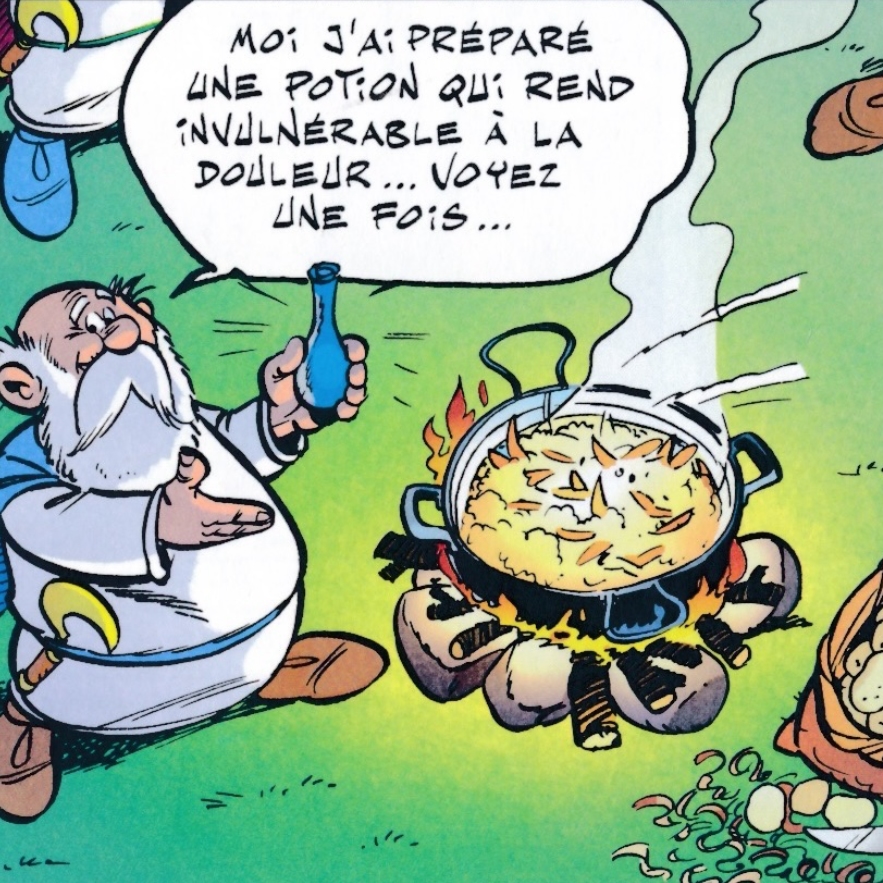
The image of the golden sickle and mistletoe comes straight from Pliny’s account, which inspired countless later depictions of druids. While no golden sickles have ever been found, the detail offered Goscinny and Uderzo a perfect visual symbol of druidic ritual. The white robes too have some historical basis, even if the evidence rests on that single Roman text. These features helped fix the druid’s identity in both scholarship and popular culture.
Where the authors took full creative liberty was with the famous potion. There is no evidence that historical druids brewed anything resembling Getafix’s strength potion. Roman writers credit druids with knowledge of nature and healing, so it is possible that they prepared herbal remedies. Yet the idea of a bubbling cauldron that grants superhuman power is a modern invention, not an ancient tradition.
Knowledge, Memory, and Age
One of the most accurate aspects of Getafix’s portrayal appears in Asterix and the Missing Scroll, where we learn that druids rely on memorization rather than writing. This reflects Caesar’s account exactly. The druid’s role as the custodian of oral knowledge, preserving sacred traditions through memory, is historically sound.
The image of Getafix as an elderly sage also fits with what we can infer about the real druids. While ancient texts never describe their age or appearance, their long training and advisory role imply maturity and wisdom. In the Asterix village, Getafix is not only the maker of potions but the community’s moral compass and intellectual authority—precisely the kind of influence Caesar attributes to the druids of Gaul.
Between History and Imagination

The Asterix version of the druid blends history and fantasy in equal measure. The golden sickle, mistletoe, and white robes all trace back to Roman descriptions, while the emphasis on oral learning matches Caesar’s testimony. The figure of the wise, respected elder also corresponds to the druids’ social function. Only the potion, central to the comic’s humor and adventure, is entirely fictional. Yet it is this invention that transformed the druid from a shadowy figure of ancient religion into one of the most beloved characters in popular culture.
By combining scholarship and storytelling, Goscinny and Uderzo created a druid who is both authentic and imaginative. Through Getafix, the memory of the ancient Gaulish druids lives on—not as stern priests of a vanished world, but as cheerful symbols of wisdom, tradition, and resilience.


Long before Getafix brewed his famous magic potion, the druids of ancient Gaul already held a special place in the imagination of the Romans. They were priests, philosophers, and judges, feared and respected in equal measure. This article explores what we actually know about the druids from ancient sources, and then compares those historical facts to Goscinny and Uderzo’s depiction of Getafix—the archetypal druid of Asterix. We will see which parts of his character are rooted in history, and which belong purely to the realm of fiction.
What the Romans Told Us About Druids
The only written accounts of druids come from Greek and Roman authors. The druids themselves left no texts, because their teachings were transmitted entirely by word of mouth. Julius Caesar, who encountered them during his conquest of Gaul, is our main source. In De Bello Gallico, he describes the druids as a powerful class responsible for religion, law, and education. Other writers, including Strabo, Diodorus Siculus, Pomponius Mela, and Pliny the Elder, confirm this picture.
According to Caesar, Gaulish society was divided into three groups: the warriors, the common people, and the druids. The druids formed the intellectual and spiritual elite. They supervised sacrifices, taught philosophy, and acted as judges. They believed that souls were immortal and passed from one body to another, a doctrine that gave courage in battle and comfort in death.
Caesar also notes that a druid’s education could last up to twenty years. They learned vast quantities of verses by heart, since they were forbidden to write down their teachings. While the Gauls used Greek letters for ordinary business, their sacred knowledge was preserved through memory alone. This aspect of their oral culture is one of the most firmly attested facts about them.
Rituals and Sacred Symbols
Pliny the Elder adds vivid detail to the Roman picture of druidic ritual. In Natural History, he describes how druids, clad in white robes, would climb an oak tree to cut mistletoe with a golden sickle (see Asterix and the Golden Sickle), catching it in a white cloth. The mistletoe, he says, was sacred and thought to cure infertility and poison. Although this is the only ancient reference to such a ceremony, it became one of the most enduring images of the druid.
Archaeological discoveries, however, tell a more cautious story. Several crescent-shaped sickles made of bronze or iron have been found in Celtic ritual sites, but none made of gold. Historians therefore regard Pliny’s “golden” sickle as symbolic rather than literal—perhaps referring to ritual purity or the sacred status of the ceremony. The white robes he describes also appear to have been ceremonial, rather than everyday attire. Despite the lack of material evidence, these details have powerfully shaped how later generations imagined the druids.
The druids’ authority extended beyond religion. Caesar reports that they met once a year in the land of the Carnutes (see Asterix and the Goths), a tribe in central France, to discuss laws and settle disputes. He also claims that Britain served as the main center for their instruction, suggesting that druidic practices were widespread across Celtic territories. Their influence was such that the Roman emperors eventually banned them. Under Augustus, Tiberius, and Claudius, druidic practices were outlawed, and by the first century CE the druids had largely vanished from public life in Gaul.
Getafix: The Archetypal Druid
When René Goscinny and Albert Uderzo introduced Getafix (Panoramix in French), they drew directly on this handful of ancient descriptions. Getafix quickly became the world’s best-known druid: a wise elder with a long white beard, dressed in white, cutting mistletoe with a golden sickle, and brewing potions of extraordinary power.
The image of the golden sickle and mistletoe comes straight from Pliny’s account, which inspired countless later depictions of druids. While no golden sickles have ever been found, the detail offered Goscinny and Uderzo a perfect visual symbol of druidic ritual. The white robes too have some historical basis, even if the evidence rests on that single Roman text. These features helped fix the druid’s identity in both scholarship and popular culture.
Where the authors took full creative liberty was with the famous potion. There is no evidence that historical druids brewed anything resembling Getafix’s strength potion. Roman writers credit druids with knowledge of nature and healing, so it is possible that they prepared herbal remedies. Yet the idea of a bubbling cauldron that grants superhuman power is a modern invention, not an ancient tradition.
Knowledge, Memory, and Age
One of the most accurate aspects of Getafix’s portrayal appears in Asterix and the Missing Scroll, where we learn that druids rely on memorization rather than writing. This reflects Caesar’s account exactly. The druid’s role as the custodian of oral knowledge, preserving sacred traditions through memory, is historically sound.
The image of Getafix as an elderly sage also fits with what we can infer about the real druids. While ancient texts never describe their age or appearance, their long training and advisory role imply maturity and wisdom. In the Asterix village, Getafix is not only the maker of potions but the community’s moral compass and intellectual authority—precisely the kind of influence Caesar attributes to the druids of Gaul.
Between History and Imagination
The Asterix version of the druid blends history and fantasy in equal measure. The golden sickle, mistletoe, and white robes all trace back to Roman descriptions, while the emphasis on oral learning matches Caesar’s testimony. The figure of the wise, respected elder also corresponds to the druids’ social function. Only the potion, central to the comic’s humor and adventure, is entirely fictional. Yet it is this invention that transformed the druid from a shadowy figure of ancient religion into one of the most beloved characters in popular culture.
By combining scholarship and storytelling, Goscinny and Uderzo created a druid who is both authentic and imaginative. Through Getafix, the memory of the ancient Gaulish druids lives on—not as stern priests of a vanished world, but as cheerful symbols of wisdom, tradition, and resilience.