Look closely at Asterix across the albums and a curious detail begins to emerge: he does not always use the same hand.
He can punch with his left, throw with his left, drink the magic potion with either hand, and wield his sword predominantly with his right. At first glance, this might suggest that Asterix is ambidextrous. But the albums do not appear to establish ambidexterity as a deliberate character trait.


The simpler explanation is that Asterix is essentially right-handed, while Albert Uderzo was willing to change which hand he used whenever the composition of a panel or cover worked better that way.
Asterix’s right hand
The strongest recurring indication of Asterix’s handedness comes from his sword.
Asterix normally wears his scabbard on his left side, putting the sword in a natural position for a right-handed draw. When he is actually shown drawing or wielding the weapon, he is also predominantly using his right hand.
This gives us a reasonably consistent visual baseline. If we had to assign Asterix a dominant hand based on the drawings, right-handed would be the most natural conclusion.
That does not mean, however, that every action has to follow the same pattern.
Comic-book characters are not anatomical diagrams. Their bodies have to work within a rectangular panel, alongside speech balloons, other characters, props and the direction in which the reader’s eye is expected to move. Asterix’s handedness is therefore not treated with the kind of continuity that would be expected from a real person.
The left-handed Asterix
There are several memorable exceptions.
On the cover of Astérix le Gaulois, Asterix throws a punch with his left hand. In Astérix et Cléopâtre, he is shown throwing a stone with his left hand. His magic potion is likewise not permanently associated with one particular hand: depending on the scene, he can hold the gourd in either his right or left hand.
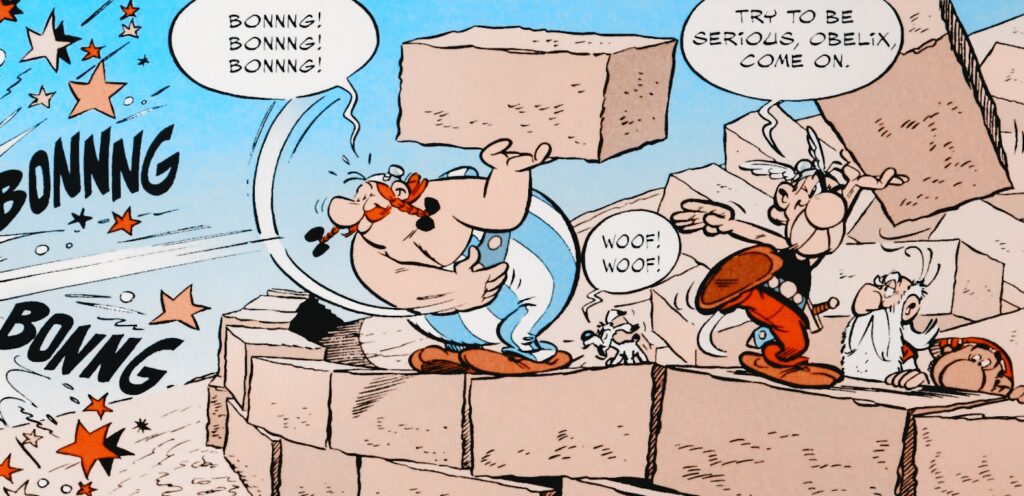
These are not isolated cases of an otherwise carefully maintained rule being broken once. They occur throughout the series.
That makes it difficult to argue that Asterix’s left hand is simply a mistake in one particular drawing. At the same time, there is little evidence that Goscinny and Uderzo intended readers to understand Asterix as deliberately ambidextrous.
Instead, the inconsistency seems to reflect something fundamental about the way the albums were drawn.
Comics have different rules from real life
A comic artist has to make a character’s action immediately understandable.
Suppose Asterix is facing towards the right side of the page and needs to throw a punch. A left-handed punch can leave his face and upper body clearly visible to the reader. A right-handed punch from the same position could bring the arm across the body and interfere with the character’s face.
For a character such as Asterix, that matters. His facial expression is part of the joke, and his body language is an important part of the visual storytelling.
The same principle applies to throwing objects, drinking the magic potion or holding a weapon. The hand that produces the clearest image is not necessarily the hand that a consistently right-handed person would use.
This is particularly noticeable in a series whose visual humour depends heavily on clean silhouettes and instantly readable action.
The famous punch on the cover of Astérix le Gaulois is a good example. Asterix’s left arm delivers the blow while his face remains completely visible. The pose is visually clear and energetic. Whether this was consciously chosen for that particular reason cannot be established from the drawing alone, but the composition certainly benefits from it.
The cover of Astérix le Gladiateur demonstrates the same broader principle from another angle. There Asterix’s right arm is used for an upward punch, but the pose allows his face to remain unobstructed.
The important point is not that Uderzo had a strict rule saying “use the left hand here and the right hand there.” Rather, the composition could determine the most effective position of the character’s body.
The magic potion is especially revealing

Asterix’s gourd provides an amusing example because drinking is such a familiar action.
If Asterix is already holding something in one hand, that hand is unavailable. If another character occupies part of the panel, one position may create a cleaner composition than another. If Asterix needs to face in a particular direction, switching hands can make the action easier to read.
There is therefore no compelling reason for the artist to preserve the same hand every time Asterix drinks.
And from the reader’s perspective, there is little reason to notice the difference. The important information is that Asterix is drinking the magic potion—not which hand happens to be holding the gourd.
What about the Gaulish sword?
Asterix’s sword also raises an interesting historical point.
The Roman legionary’s gladius was normally carried on the right side, a position associated with drawing the sword while carrying the large scutum shield in the left hand. Asterix’s sword, by contrast, is normally positioned on his left side, consistent with the conventional arrangement for a right-handed swordsman.

But this should not be pushed too far. The placement of a weapon in a comic illustration is not necessarily intended as a historically precise statement about handedness. Uderzo was creating a visually recognizable fictional Gaul, not reconstructing military equipment according to archaeological specifications.
Still, taken together with the way Asterix normally handles his sword, the placement provides additional support for describing him as predominantly right-handed.
So is Asterix ambidextrous?
Possibly, but the albums do not establish it as a character trait.
Within the fictional world, one could certainly describe Asterix as functionally ambidextrous. He can perform actions with either hand without apparent difficulty.
But there is an important distinction between saying that a character can use both hands and saying that the creators intended ambidexterity to be part of his characterization.
There is little evidence for the latter.
The changing handedness is better understood as a consequence of the visual language of the comic. Uderzo repeatedly had to fit a small, highly expressive character into a carefully constructed composition. The position of Asterix’s body, his relationship to other characters, the direction of movement and the need to keep his expressions visible could all affect which hand appeared in use.
This does not mean that every left-handed depiction can be explained individually. Some may simply be inconsistencies. Others may have resulted from the artist choosing the pose that looked best. Without direct comments from Uderzo about particular drawings, we should be cautious about assigning a specific reason to each one.
A right-handed Gaul with two useful hands
The most accurate description, therefore, may be that Asterix is predominantly right-handed but visually ambidextrous.
His sword use gives us the clearest recurring indication of a dominant right hand. His occasional use of the left hand does not necessarily contradict that. Real people also use their non-dominant hand for particular tasks, and fictional characters in comics have even more freedom to do so.
More importantly, the variation tells us something about the nature of the Asterix albums themselves.
The drawings are not simply illustrations of an already-existing physical reality. The characters are constructed for the page. Their poses, gestures and movements have to communicate quickly and humorously within a fixed visual space.
Asterix therefore does not need to behave like a perfectly consistent anatomical model.
He needs to look right in the panel.
And sometimes, apparently, that means putting the magic potion in the other hand.


Look closely at Asterix across the albums and a curious detail begins to emerge: he does not always use the same hand.
He can punch with his left, throw with his left, drink the magic potion with either hand, and wield his sword predominantly with his right. At first glance, this might suggest that Asterix is ambidextrous. But the albums do not appear to establish ambidexterity as a deliberate character trait.
The simpler explanation is that Asterix is essentially right-handed, while Albert Uderzo was willing to change which hand he used whenever the composition of a panel or cover worked better that way.
Asterix’s right hand
The strongest recurring indication of Asterix’s handedness comes from his sword.
Asterix normally wears his scabbard on his left side, putting the sword in a natural position for a right-handed draw. When he is actually shown drawing or wielding the weapon, he is also predominantly using his right hand.
This gives us a reasonably consistent visual baseline. If we had to assign Asterix a dominant hand based on the drawings, right-handed would be the most natural conclusion.
That does not mean, however, that every action has to follow the same pattern.
Comic-book characters are not anatomical diagrams. Their bodies have to work within a rectangular panel, alongside speech balloons, other characters, props and the direction in which the reader’s eye is expected to move. Asterix’s handedness is therefore not treated with the kind of continuity that would be expected from a real person.
The left-handed Asterix
There are several memorable exceptions.
On the cover of Astérix le Gaulois, Asterix throws a punch with his left hand. In Astérix et Cléopâtre, he is shown throwing a stone with his left hand. His magic potion is likewise not permanently associated with one particular hand: depending on the scene, he can hold the gourd in either his right or left hand.
These are not isolated cases of an otherwise carefully maintained rule being broken once. They occur throughout the series.
That makes it difficult to argue that Asterix’s left hand is simply a mistake in one particular drawing. At the same time, there is little evidence that Goscinny and Uderzo intended readers to understand Asterix as deliberately ambidextrous.
Instead, the inconsistency seems to reflect something fundamental about the way the albums were drawn.
Comics have different rules from real life
A comic artist has to make a character’s action immediately understandable.
Suppose Asterix is facing towards the right side of the page and needs to throw a punch. A left-handed punch can leave his face and upper body clearly visible to the reader. A right-handed punch from the same position could bring the arm across the body and interfere with the character’s face.
For a character such as Asterix, that matters. His facial expression is part of the joke, and his body language is an important part of the visual storytelling.
The same principle applies to throwing objects, drinking the magic potion or holding a weapon. The hand that produces the clearest image is not necessarily the hand that a consistently right-handed person would use.
This is particularly noticeable in a series whose visual humour depends heavily on clean silhouettes and instantly readable action.
The famous punch on the cover of Astérix le Gaulois is a good example. Asterix’s left arm delivers the blow while his face remains completely visible. The pose is visually clear and energetic. Whether this was consciously chosen for that particular reason cannot be established from the drawing alone, but the composition certainly benefits from it.
The cover of Astérix le Gladiateur demonstrates the same broader principle from another angle. There Asterix’s right arm is used for an upward punch, but the pose allows his face to remain unobstructed.
The important point is not that Uderzo had a strict rule saying “use the left hand here and the right hand there.” Rather, the composition could determine the most effective position of the character’s body.
The magic potion is especially revealing
Asterix’s gourd provides an amusing example because drinking is such a familiar action.
If Asterix is already holding something in one hand, that hand is unavailable. If another character occupies part of the panel, one position may create a cleaner composition than another. If Asterix needs to face in a particular direction, switching hands can make the action easier to read.
There is therefore no compelling reason for the artist to preserve the same hand every time Asterix drinks.
And from the reader’s perspective, there is little reason to notice the difference. The important information is that Asterix is drinking the magic potion—not which hand happens to be holding the gourd.
What about the Gaulish sword?
Asterix’s sword also raises an interesting historical point.
The Roman legionary’s gladius was normally carried on the right side, a position associated with drawing the sword while carrying the large scutum shield in the left hand. Asterix’s sword, by contrast, is normally positioned on his left side, consistent with the conventional arrangement for a right-handed swordsman.
But this should not be pushed too far. The placement of a weapon in a comic illustration is not necessarily intended as a historically precise statement about handedness. Uderzo was creating a visually recognizable fictional Gaul, not reconstructing military equipment according to archaeological specifications.
Still, taken together with the way Asterix normally handles his sword, the placement provides additional support for describing him as predominantly right-handed.
So is Asterix ambidextrous?
Possibly, but the albums do not establish it as a character trait.
Within the fictional world, one could certainly describe Asterix as functionally ambidextrous. He can perform actions with either hand without apparent difficulty.
But there is an important distinction between saying that a character can use both hands and saying that the creators intended ambidexterity to be part of his characterization.
There is little evidence for the latter.
The changing handedness is better understood as a consequence of the visual language of the comic. Uderzo repeatedly had to fit a small, highly expressive character into a carefully constructed composition. The position of Asterix’s body, his relationship to other characters, the direction of movement and the need to keep his expressions visible could all affect which hand appeared in use.
This does not mean that every left-handed depiction can be explained individually. Some may simply be inconsistencies. Others may have resulted from the artist choosing the pose that looked best. Without direct comments from Uderzo about particular drawings, we should be cautious about assigning a specific reason to each one.
A right-handed Gaul with two useful hands
The most accurate description, therefore, may be that Asterix is predominantly right-handed but visually ambidextrous.
His sword use gives us the clearest recurring indication of a dominant right hand. His occasional use of the left hand does not necessarily contradict that. Real people also use their non-dominant hand for particular tasks, and fictional characters in comics have even more freedom to do so.
More importantly, the variation tells us something about the nature of the Asterix albums themselves.
The drawings are not simply illustrations of an already-existing physical reality. The characters are constructed for the page. Their poses, gestures and movements have to communicate quickly and humorously within a fixed visual space.
Asterix therefore does not need to behave like a perfectly consistent anatomical model.
He needs to look right in the panel.
And sometimes, apparently, that means putting the magic potion in the other hand.