Since its debut in 1959, Asterix has grown far beyond the pages of a bande dessinée. What began as a humorous comic about a tiny Gaulish village resisting Rome has evolved into one of Europe’s most enduring cultural phenomena. While the stories are often seen as light entertainment, their longevity rests on something deeper: Asterix works simultaneously as playful adventure for younger readers and as layered satire for adults.

Yet as the series enters its seventh decade, the global picture is uneven. Asterix remains extraordinarily strong in continental Europe, while its presence in the Anglophone world has gradually weakened. Understanding why requires looking at the series’ roots, its evolution, and how it adapts to different cultures.
Satire, Not Chauvinism
When Asterix became wildly popular in the 1960s, academics quickly took notice. Some critics — particularly from left-leaning French intellectual circles — accused the series of promoting simplistic nationalism. The “indomitable Gauls” seemed, at first glance, to reinforce a flattering image of French resistance and moral superiority.
But a closer reading reveals something quite different.
René Goscinny and Albert Uderzo built their famous village as a playful microcosm of modern France. The humor is often directed inward rather than outward. French bureaucracy is mercilessly mocked — most famously in the legendary “Form A38” sequence. Regional stereotypes are exaggerated for comedic effect. Even the villagers themselves constantly argue, bicker, and undermine one another.
In fact, nobody escapes the satire. Romans, Goths, Britons, Belgians, Corsicans, and even the Gauls themselves all become targets. Rather than promoting chauvinism, Asterix dismantles it. The series uses history as a playful mirror to expose modern habits, national quirks, and political absurdities.
The Translation Miracle
One of Asterix’s greatest strengths — and biggest challenges — is its language. Goscinny’s scripts are packed with wordplay, cultural references, and layered jokes. Many seemed impossible to translate.

Yet translators found creative solutions.
In Britain, Anthea Bell and Derek Hockridge became legendary for their adaptive approach. Rather than translating literally, they reinvented jokes for English readers. Assurancetourix became Cacofonix. Ordralfabétix became Unhygienix. The spirit of the humor survived, even when the wording changed.
Germany developed a different strategy. There, publishers embraced dialect editions — Bavarian, Swabian, Plattdeutsch, and more. By embedding Asterix into regional identities, the series became deeply rooted in German culture. In some regions, Asterix became as culturally embedded as in France itself.
This adaptability — linguistic and cultural — became one of the franchise’s defining strengths.
After Goscinny: A Divided Era
The death of René Goscinny in 1977 marked the most significant turning point in Asterix history. Albert Uderzo continued alone, maintaining the series’ visual brilliance, but many readers felt the storytelling shifted.
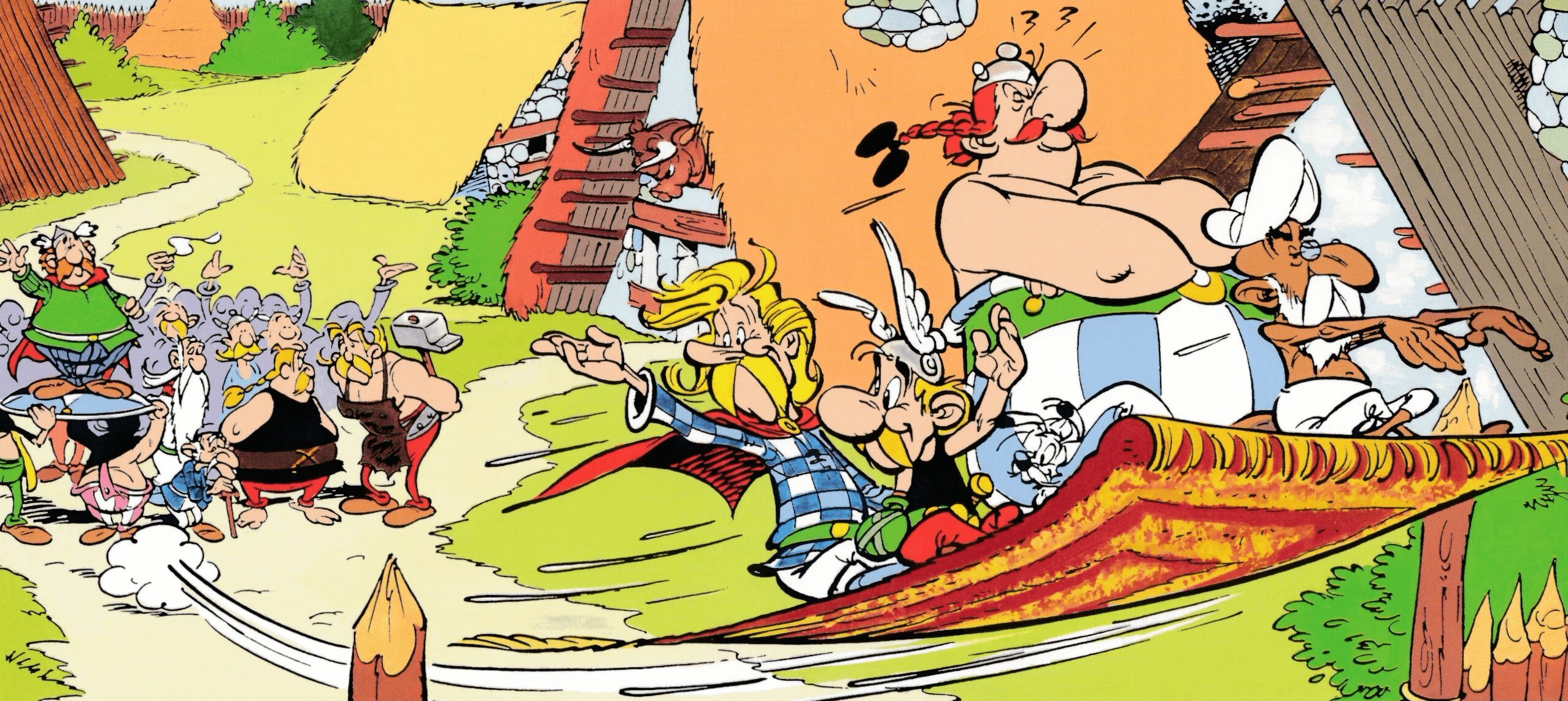
The satire softened. The plots became more fantastical. The balance between humor and commentary changed. While albums like The Great Divide and Asterix and the Magic Carpet found fans, a divide emerged between “classic” and “later” Asterix.
In recent years, new creative teams have attempted to restore the original tone. Jean-Yves Ferri and Didier Conrad brought back travel stories, historical satire, and layered humor. More recently, Fabcaro has continued this approach with a modern comedic sensibility.
Albums like Asterix in Lusitania (2025) demonstrate that the formula still works. Yet the shadow of the Goscinny era remains strong, particularly in English-speaking markets, where Asterix is increasingly viewed as a beloved classic rather than a contemporary cultural force.

Beyond the Books
Asterix has also expanded into films, animation, and streaming.
Animated films have generally preserved the spirit of the comics. Many recent CGI adaptations modernize the pacing while retaining the humor and character dynamics.
Live-action films have been more divisive. Mission Cleopatra (2002), directed by Alain Chabat, remains widely praised for capturing the comic’s wit and absurdity. Later entries, however, sometimes leaned more heavily on celebrity appearances and slapstick humor, leading some fans to feel the tone had shifted.
Today, Asterix is entering the streaming era. New high-profile productions aim to introduce the Gauls to a global audience raised on fast-paced modern animation. These projects represent both an opportunity and a challenge: expanding globally without losing the distinctive Asterix identity.
A European Stronghold

In the 21st century, Asterix remains strongest in France and Germany.
In France, new albums still dominate bestseller lists. The series is widely considered a cultural institution. References to Asterix appear in politics, journalism, and everyday conversation.
Germany shows similar enthusiasm. The series is frequently used in education, linguistic studies, and cultural discussions. Dialect editions continue to reinforce regional connections.
The Anglophone world presents a contrast. American comic traditions, shifting translation strategies, and changing reading habits have reduced Asterix’s mainstream visibility. The series still commands respect, but occupies a smaller niche.
An Indomitable Legacy

Despite these challenges, Asterix remains one of Europe’s most resilient cultural creations. Its core idea — a small community resisting a powerful empire — is timeless. Its humor adapts to different cultures. Its language invites reinterpretation.
More than sixty years after its creation, Asterix still thrives because it does something rare: it makes readers laugh while gently poking fun at power, identity, and human nature.
Asterix is not just a comic series.
It is a cultural tradition — and, like the famous village itself, still holding out against the passage of time.


Since its debut in 1959, Asterix has grown far beyond the pages of a bande dessinée. What began as a humorous comic about a tiny Gaulish village resisting Rome has evolved into one of Europe’s most enduring cultural phenomena. While the stories are often seen as light entertainment, their longevity rests on something deeper: Asterix works simultaneously as playful adventure for younger readers and as layered satire for adults.
Yet as the series enters its seventh decade, the global picture is uneven. Asterix remains extraordinarily strong in continental Europe, while its presence in the Anglophone world has gradually weakened. Understanding why requires looking at the series’ roots, its evolution, and how it adapts to different cultures.
Satire, Not Chauvinism
When Asterix became wildly popular in the 1960s, academics quickly took notice. Some critics — particularly from left-leaning French intellectual circles — accused the series of promoting simplistic nationalism. The “indomitable Gauls” seemed, at first glance, to reinforce a flattering image of French resistance and moral superiority.
But a closer reading reveals something quite different.
René Goscinny and Albert Uderzo built their famous village as a playful microcosm of modern France. The humor is often directed inward rather than outward. French bureaucracy is mercilessly mocked — most famously in the legendary “Form A38” sequence. Regional stereotypes are exaggerated for comedic effect. Even the villagers themselves constantly argue, bicker, and undermine one another.
In fact, nobody escapes the satire. Romans, Goths, Britons, Belgians, Corsicans, and even the Gauls themselves all become targets. Rather than promoting chauvinism, Asterix dismantles it. The series uses history as a playful mirror to expose modern habits, national quirks, and political absurdities.
The Translation Miracle
One of Asterix’s greatest strengths — and biggest challenges — is its language. Goscinny’s scripts are packed with wordplay, cultural references, and layered jokes. Many seemed impossible to translate.
Yet translators found creative solutions.
In Britain, Anthea Bell and Derek Hockridge became legendary for their adaptive approach. Rather than translating literally, they reinvented jokes for English readers. Assurancetourix became Cacofonix. Ordralfabétix became Unhygienix. The spirit of the humor survived, even when the wording changed.
Germany developed a different strategy. There, publishers embraced dialect editions — Bavarian, Swabian, Plattdeutsch, and more. By embedding Asterix into regional identities, the series became deeply rooted in German culture. In some regions, Asterix became as culturally embedded as in France itself.
This adaptability — linguistic and cultural — became one of the franchise’s defining strengths.
After Goscinny: A Divided Era
The death of René Goscinny in 1977 marked the most significant turning point in Asterix history. Albert Uderzo continued alone, maintaining the series’ visual brilliance, but many readers felt the storytelling shifted.
The satire softened. The plots became more fantastical. The balance between humor and commentary changed. While albums like The Great Divide and Asterix and the Magic Carpet found fans, a divide emerged between “classic” and “later” Asterix.
In recent years, new creative teams have attempted to restore the original tone. Jean-Yves Ferri and Didier Conrad brought back travel stories, historical satire, and layered humor. More recently, Fabcaro has continued this approach with a modern comedic sensibility.
Albums like Asterix in Lusitania (2025) demonstrate that the formula still works. Yet the shadow of the Goscinny era remains strong, particularly in English-speaking markets, where Asterix is increasingly viewed as a beloved classic rather than a contemporary cultural force.
Beyond the Books
Asterix has also expanded into films, animation, and streaming.
Animated films have generally preserved the spirit of the comics. Many recent CGI adaptations modernize the pacing while retaining the humor and character dynamics.
Live-action films have been more divisive. Mission Cleopatra (2002), directed by Alain Chabat, remains widely praised for capturing the comic’s wit and absurdity. Later entries, however, sometimes leaned more heavily on celebrity appearances and slapstick humor, leading some fans to feel the tone had shifted.
Today, Asterix is entering the streaming era. New high-profile productions aim to introduce the Gauls to a global audience raised on fast-paced modern animation. These projects represent both an opportunity and a challenge: expanding globally without losing the distinctive Asterix identity.
A European Stronghold
In the 21st century, Asterix remains strongest in France and Germany.
In France, new albums still dominate bestseller lists. The series is widely considered a cultural institution. References to Asterix appear in politics, journalism, and everyday conversation.
Germany shows similar enthusiasm. The series is frequently used in education, linguistic studies, and cultural discussions. Dialect editions continue to reinforce regional connections.
The Anglophone world presents a contrast. American comic traditions, shifting translation strategies, and changing reading habits have reduced Asterix’s mainstream visibility. The series still commands respect, but occupies a smaller niche.
An Indomitable Legacy
Despite these challenges, Asterix remains one of Europe’s most resilient cultural creations. Its core idea — a small community resisting a powerful empire — is timeless. Its humor adapts to different cultures. Its language invites reinterpretation.
More than sixty years after its creation, Asterix still thrives because it does something rare: it makes readers laugh while gently poking fun at power, identity, and human nature.
Asterix is not just a comic series.
It is a cultural tradition — and, like the famous village itself, still holding out against the passage of time.