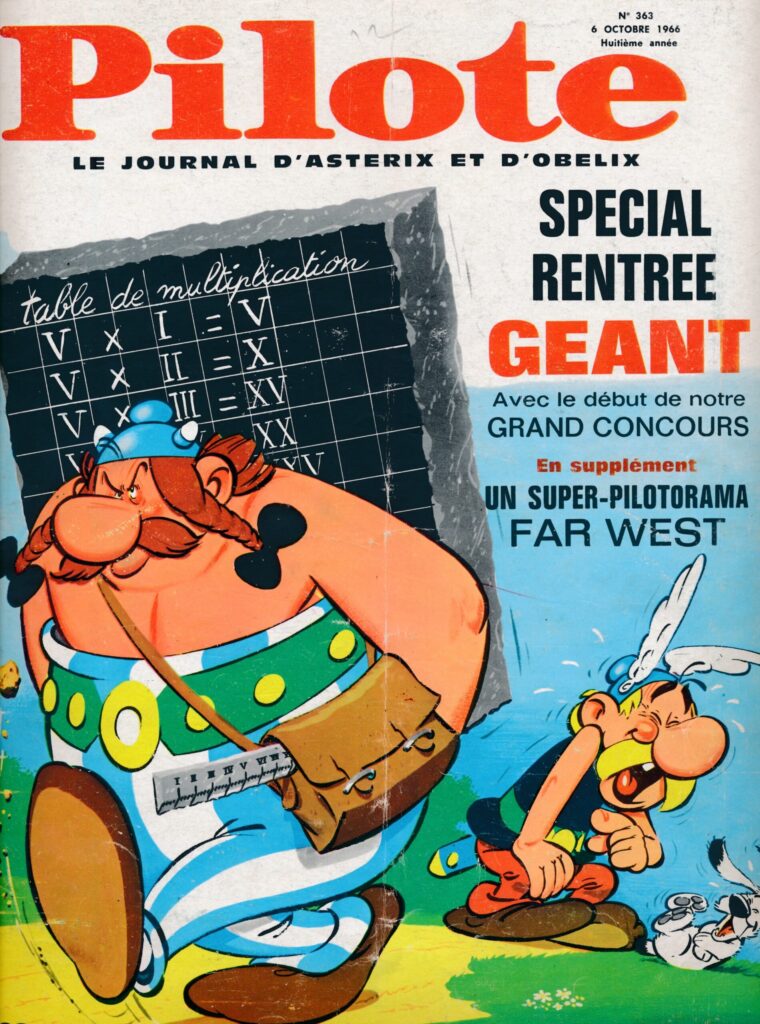
Pilote was a French weekly comics magazine founded in 1959 by a team that included François Clauteaux, René Goscinny, Albert Uderzo, and Jean-Michel Charlier, with heavy financial backing from Radio Luxembourg (now RTL). It played a decisive role in the development of modern Franco-Belgian comics and introduced several influential series, including Astérix, Blueberry, Achille Talon, and Valérian. Between its first issue in 1959 and its transition into a monthly publication in the 1970s, Pilote shaped both the format and the expectations of serialized comic storytelling in France.
Founding and Editorial Philosophy

The magazine debuted on 29 October 1959 with massive media support from Radio Luxembourg. It was launched by François Clauteaux as a publication aimed at older children and teenagers, with the ambition to blend humor, adventure, and high-quality writing. While Clauteaux was the original director, René Goscinny became the leading editorial voice (officially taking the helm in 1963). His approach emphasized tight stories, recurring characters, and a balance between humor and narrative clarity. The magazine also sought to modernize French comics by placing writers on equal footing with artists, which was not always the case in earlier Franco-Belgian publications.
Pilote’s Place in the Franco-Belgian Comics Landscape
When Pilote entered the market, magazines like Spirou and Tintin dominated the scene. These publications followed well-established formats and long-running series. Pilote distinguished itself through its more contemporary tone, its irreverent humor, and its willingness to address themes closer to daily life in the 1960s and 1970s. This editorial strategy attracted both established creators and emerging talents.
Serialization and the Constraints of Weekly Publication
One of the defining features of Pilote was its reliance on weekly serialization. Every issue had to provide readers with a complete and satisfying unit of entertainment, even when it was part of a larger storyline. The classic Franco-Belgian “one page per week” format played a significant role in shaping pacing, story structure, and character dialogue.
Episodic Structure Adventure series such as Astérix, Blueberry, and Valérian were typically serialized in weekly installments of one to three pages. Each episode had to: • advance the plot, • contain its own small narrative arc, • end on a hook or moment encouraging readers to buy the next issue.
This format forced writers to construct stories with tightly controlled rhythm. A single week’s installment could not rely on long stretches of silent action or multi-page build-up. Instead, creators had to craft compact sequences that moved the story forward efficiently.
One-Page Gags and Self-Contained Humor
Alongside longer adventure stories, Pilote featured a significant number of one-page humor strips. Many of these became reader favorites because each issue delivered a complete joke from start to finish. Examples include: • Claire Bretécher’s social satire, • Marcel Gotlib’s comedic inventions (such as Rubrique-à-Brac), • Greg’s humorous contributions, • The early appearances of Philémon by Fred (though it later expanded into longer stories).
These one-page gags established a tonal balance in the magazine: even readers who followed no long-form series could enjoy self-contained comics every week.
The Role of Pilote in Launching Major Series
Pilote served as the platform for many of the most influential French and Franco-Belgian comic series, though not all originated there.
Astérix (Goscinny & Uderzo) Astérix le Gaulois debuted in the very first issue. It was initially only one of several new series, but its popularity grew quickly. Serialization in Pilote shaped the early albums, which were written at the rhythm of weekly installments before being collected into books.

Blueberry (Charlier & Giraud) Introduced in 1963, Blueberry provided the magazine with a serious Western series. Its realistic tone contrasted with the humor of Astérix and demonstrated Pilote’s editorial breadth.
Valérian (Mézières & Christin) Beginning in 1967, Valérian introduced readers to a serialized science-fiction world built through short episodes at first and later expanded into longer stories. Its publication in Pilote helped define science-fiction comics in Europe.
Iznogoud (Goscinny & Tabary) While closely associated with the magazine, Iznogoud actually debuted in the magazine Record in 1962 before moving to Pilote in 1968. Once established in Pilote, it adhered strongly to the one-episode-one-gag structure, contributing significantly to the magazine’s humor section.
Editorial Evolution and the Rise of Author-Driven Comics
By the late 1960s and early 1970s, Pilote began to shift from a magazine strictly for young readers to one addressing older teenagers and adults. A pivotal moment in this evolution was the civil unrest of May 1968, which triggered an internal “mutiny” at the magazine. Artists confronted Goscinny in a famous “tribunal,” demanding more creative freedom and a move away from traditional structures.
Following this, the magazine increasingly embraced experimental forms and personal expression. This evolution eventually led to two major creative splits. In 1972, Gotlib, Bretécher, and Mandryka left Pilote to create L’Écho des Savanes. Then, in 1974, Jean Giraud (Moebius) and Philippe Druillet departed to found Métal Hurlant (Heavy Metal). These departures symbolized the generational transformation occurring within French comics, and Pilote gradually adapted by allowing more sophisticated narratives.
Transition to a Monthly Magazine
In 1974, Pilote changed from a weekly to a monthly publication. This shift altered the pace of serialization and allowed for longer, more complex stories in a single issue. It reflected both market pressures and the changing expectations of readers who were becoming accustomed to albums and graphic novels rather than short episodic installments.
However, the monthly format also made competition more challenging, and the magazine’s influence slowly decreased. Pilote continued through the 1980s before ceasing regular publication in October 1989.
The Legacy of Pilote
Pilote remains one of the most important magazines in the history of Franco-Belgian comics. Its contribution includes:
- establishing modern standards for serialized storytelling,
- elevating the role of scriptwriters,
- launching some of the most enduring series in European comic history,
- supporting experimentation in art and narrative,
- shaping the transition from weekly comics magazines to album-based publishing.
Many series that ran in Pilote went on to become international phenomena, particularly Astérix, which became one of the best-selling comic series in the world.


Pilote was a French weekly comics magazine founded in 1959 by a team that included François Clauteaux, René Goscinny, Albert Uderzo, and Jean-Michel Charlier, with heavy financial backing from Radio Luxembourg (now RTL). It played a decisive role in the development of modern Franco-Belgian comics and introduced several influential series, including Astérix, Blueberry, Achille Talon, and Valérian. Between its first issue in 1959 and its transition into a monthly publication in the 1970s, Pilote shaped both the format and the expectations of serialized comic storytelling in France.
Founding and Editorial Philosophy
The magazine debuted on 29 October 1959 with massive media support from Radio Luxembourg. It was launched by François Clauteaux as a publication aimed at older children and teenagers, with the ambition to blend humor, adventure, and high-quality writing. While Clauteaux was the original director, René Goscinny became the leading editorial voice (officially taking the helm in 1963). His approach emphasized tight stories, recurring characters, and a balance between humor and narrative clarity. The magazine also sought to modernize French comics by placing writers on equal footing with artists, which was not always the case in earlier Franco-Belgian publications.
Pilote’s Place in the Franco-Belgian Comics Landscape
When Pilote entered the market, magazines like Spirou and Tintin dominated the scene. These publications followed well-established formats and long-running series. Pilote distinguished itself through its more contemporary tone, its irreverent humor, and its willingness to address themes closer to daily life in the 1960s and 1970s. This editorial strategy attracted both established creators and emerging talents.
Serialization and the Constraints of Weekly Publication
One of the defining features of Pilote was its reliance on weekly serialization. Every issue had to provide readers with a complete and satisfying unit of entertainment, even when it was part of a larger storyline. The classic Franco-Belgian “one page per week” format played a significant role in shaping pacing, story structure, and character dialogue.
Episodic Structure Adventure series such as Astérix, Blueberry, and Valérian were typically serialized in weekly installments of one to three pages. Each episode had to: • advance the plot, • contain its own small narrative arc, • end on a hook or moment encouraging readers to buy the next issue.
This format forced writers to construct stories with tightly controlled rhythm. A single week’s installment could not rely on long stretches of silent action or multi-page build-up. Instead, creators had to craft compact sequences that moved the story forward efficiently.
One-Page Gags and Self-Contained Humor
Alongside longer adventure stories, Pilote featured a significant number of one-page humor strips. Many of these became reader favorites because each issue delivered a complete joke from start to finish. Examples include: • Claire Bretécher’s social satire, • Marcel Gotlib’s comedic inventions (such as Rubrique-à-Brac), • Greg’s humorous contributions, • The early appearances of Philémon by Fred (though it later expanded into longer stories).
These one-page gags established a tonal balance in the magazine: even readers who followed no long-form series could enjoy self-contained comics every week.
The Role of Pilote in Launching Major Series
Pilote served as the platform for many of the most influential French and Franco-Belgian comic series, though not all originated there.
Astérix (Goscinny & Uderzo) Astérix le Gaulois debuted in the very first issue. It was initially only one of several new series, but its popularity grew quickly. Serialization in Pilote shaped the early albums, which were written at the rhythm of weekly installments before being collected into books.
Blueberry (Charlier & Giraud) Introduced in 1963, Blueberry provided the magazine with a serious Western series. Its realistic tone contrasted with the humor of Astérix and demonstrated Pilote’s editorial breadth.
Valérian (Mézières & Christin) Beginning in 1967, Valérian introduced readers to a serialized science-fiction world built through short episodes at first and later expanded into longer stories. Its publication in Pilote helped define science-fiction comics in Europe.
Iznogoud (Goscinny & Tabary) While closely associated with the magazine, Iznogoud actually debuted in the magazine Record in 1962 before moving to Pilote in 1968. Once established in Pilote, it adhered strongly to the one-episode-one-gag structure, contributing significantly to the magazine’s humor section.
Editorial Evolution and the Rise of Author-Driven Comics
By the late 1960s and early 1970s, Pilote began to shift from a magazine strictly for young readers to one addressing older teenagers and adults. A pivotal moment in this evolution was the civil unrest of May 1968, which triggered an internal “mutiny” at the magazine. Artists confronted Goscinny in a famous “tribunal,” demanding more creative freedom and a move away from traditional structures.
Following this, the magazine increasingly embraced experimental forms and personal expression. This evolution eventually led to two major creative splits. In 1972, Gotlib, Bretécher, and Mandryka left Pilote to create L’Écho des Savanes. Then, in 1974, Jean Giraud (Moebius) and Philippe Druillet departed to found Métal Hurlant (Heavy Metal). These departures symbolized the generational transformation occurring within French comics, and Pilote gradually adapted by allowing more sophisticated narratives.
Transition to a Monthly Magazine
In 1974, Pilote changed from a weekly to a monthly publication. This shift altered the pace of serialization and allowed for longer, more complex stories in a single issue. It reflected both market pressures and the changing expectations of readers who were becoming accustomed to albums and graphic novels rather than short episodic installments.
However, the monthly format also made competition more challenging, and the magazine’s influence slowly decreased. Pilote continued through the 1980s before ceasing regular publication in October 1989.
The Legacy of Pilote
Pilote remains one of the most important magazines in the history of Franco-Belgian comics. Its contribution includes:
- establishing modern standards for serialized storytelling,
- elevating the role of scriptwriters,
- launching some of the most enduring series in European comic history,
- supporting experimentation in art and narrative,
- shaping the transition from weekly comics magazines to album-based publishing.
Many series that ran in Pilote went on to become international phenomena, particularly Astérix, which became one of the best-selling comic series in the world.