While René Goscinny is best known as the co-creator of Asterix together with Albert Uderzo, he also worked on several other successful comic series. One of the most famous of these is Iznogoud, a satirical strip that first appeared in 1962 in the French magazine Record before moving to Pilote, the same magazine where Asterix debuted.
The series was co-created with illustrator Jean Tabary. Goscinny provided the witty scripts, while Tabary brought the bustling medieval Baghdad setting and its colorful characters to life.
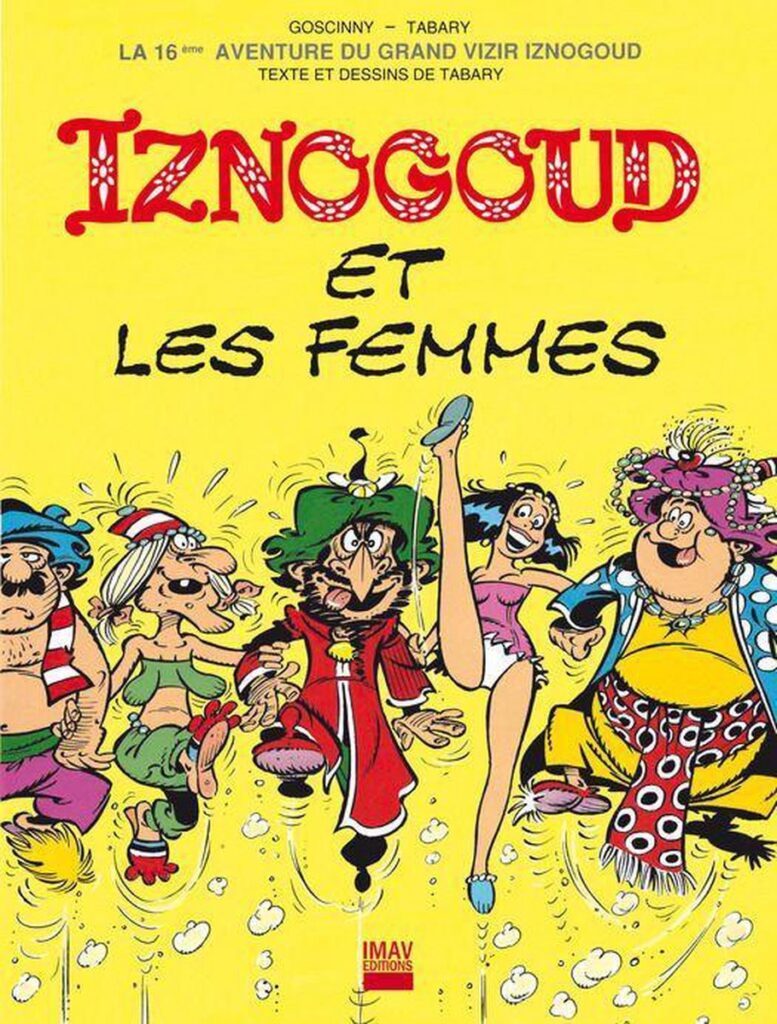
At the center of the story is Grand Vizier Iznogoud, an ambitious, unscrupulous, and comically unlucky man. His sole obsession is captured perfectly in the series’ recurring line: he wants to be “Caliph instead of the Caliph”. Despite his endless schemes, Iznogoud never succeeds in overthrowing the good-natured Caliph Haroun El Poussah. Much like Wile E. Coyote chasing the Road Runner, Iznogoud’s plans are doomed to fail, usually backfiring in spectacular and humorous ways.
What’s in a Name?
The name Iznogoud is a play on words. In English, it sounds like “he’s no good,” which immediately reflects the character’s devious nature. To French readers, however, this pun is less obvious, making the humor more apparent to international audiences.
Goscinny’s Albums
René Goscinny wrote the scripts for the first twelve Iznogoud albums before his death in 1977. These are:
- Le Grand Vizir Iznogoud (1966)
- Les Complots du Grand Vizir Iznogoud (1967)
- Les Vacances du Calife (1968)
- Iznogoud l’Infâme (1969)
- Des Astres pour Iznogoud (1970)
- Iznogoud et l’Ordinateur Magique (1971)
- Les Cauchemars d’Iznogoud (1972)
- Iznogoud et les Femmes (1973)
- Le Jour des Fous (1974)
- L’Enfance d’Iznogoud (1975)
- Iznogoud et le Magicien (1976)
- La Tête de Turc d’Iznogoud (1977)
After Goscinny’s passing, Jean Tabary continued the series on his own, ensuring that the scheming vizier remained a mainstay in French comics.
Asterix Connection
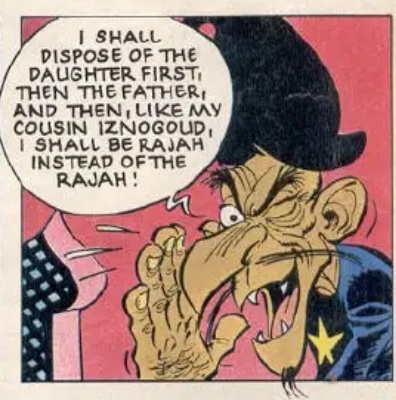
Albert Uderzo later included a playful nod to Iznogoud in Asterix and the Magic Carpet (1987). Hoodunnit’s catchphrase “I will be Rajah” is a reference to “I will be caliph” and he even mentions Iznogoud is his cousin. It’s a clever Easter egg that ties Uderzo’s solo Asterix adventure to Goscinny’s other great comic creation.
Iznogoud on Screen
The popularity of the series also led to several screen adaptations. An animated television series was produced in 1995, bringing Iznogoud’s misadventures to a younger audience. Later, in 2005, a French live-action film simply titled Iznogoud was released, starring Michaël Youn as the scheming vizier and Jacques Villeret as the Caliph. Despite high expectations, the film received mostly negative reviews from critics and fans, failing to capture the sharp humor of the comics. Nevertheless, it introduced the character to a wider public and stands as a reminder of Iznogoud’s cultural impact beyond the printed page.
Lasting Appeal
Iznogoud showcases the same sharp wit and satirical eye that Goscinny brought to Asterix, though in a very different setting. Where Asterix draws on ancient history and Roman conquest, Iznogoud dives into the world of Oriental tales, filled with viziers, genies, magic carpets, and court intrigue. Over the years, the series has been translated into many languages, adapted into animated cartoons, and even a live-action film.
For fans of Asterix, Iznogoud is well worth exploring. It reveals another side of Goscinny’s humor—fast-paced, mischievous, and timeless in its comedy of ambition gone wrong.


While René Goscinny is best known as the co-creator of Asterix together with Albert Uderzo, he also worked on several other successful comic series. One of the most famous of these is Iznogoud, a satirical strip that first appeared in 1962 in the French magazine Record before moving to Pilote, the same magazine where Asterix debuted.
The series was co-created with illustrator Jean Tabary. Goscinny provided the witty scripts, while Tabary brought the bustling medieval Baghdad setting and its colorful characters to life.
At the center of the story is Grand Vizier Iznogoud, an ambitious, unscrupulous, and comically unlucky man. His sole obsession is captured perfectly in the series’ recurring line: he wants to be “Caliph instead of the Caliph”. Despite his endless schemes, Iznogoud never succeeds in overthrowing the good-natured Caliph Haroun El Poussah. Much like Wile E. Coyote chasing the Road Runner, Iznogoud’s plans are doomed to fail, usually backfiring in spectacular and humorous ways.
What’s in a Name?
The name Iznogoud is a play on words. In English, it sounds like “he’s no good,” which immediately reflects the character’s devious nature. To French readers, however, this pun is less obvious, making the humor more apparent to international audiences.
Goscinny’s Albums
René Goscinny wrote the scripts for the first twelve Iznogoud albums before his death in 1977. These are:
- Le Grand Vizir Iznogoud (1966)
- Les Complots du Grand Vizir Iznogoud (1967)
- Les Vacances du Calife (1968)
- Iznogoud l’Infâme (1969)
- Des Astres pour Iznogoud (1970)
- Iznogoud et l’Ordinateur Magique (1971)
- Les Cauchemars d’Iznogoud (1972)
- Iznogoud et les Femmes (1973)
- Le Jour des Fous (1974)
- L’Enfance d’Iznogoud (1975)
- Iznogoud et le Magicien (1976)
- La Tête de Turc d’Iznogoud (1977)
After Goscinny’s passing, Jean Tabary continued the series on his own, ensuring that the scheming vizier remained a mainstay in French comics.
Asterix Connection
Albert Uderzo later included a playful nod to Iznogoud in Asterix and the Magic Carpet (1987). Hoodunnit’s catchphrase “I will be Rajah” is a reference to “I will be caliph” and he even mentions Iznogoud is his cousin. It’s a clever Easter egg that ties Uderzo’s solo Asterix adventure to Goscinny’s other great comic creation.
Iznogoud on Screen
The popularity of the series also led to several screen adaptations. An animated television series was produced in 1995, bringing Iznogoud’s misadventures to a younger audience. Later, in 2005, a French live-action film simply titled Iznogoud was released, starring Michaël Youn as the scheming vizier and Jacques Villeret as the Caliph. Despite high expectations, the film received mostly negative reviews from critics and fans, failing to capture the sharp humor of the comics. Nevertheless, it introduced the character to a wider public and stands as a reminder of Iznogoud’s cultural impact beyond the printed page.
Lasting Appeal
Iznogoud showcases the same sharp wit and satirical eye that Goscinny brought to Asterix, though in a very different setting. Where Asterix draws on ancient history and Roman conquest, Iznogoud dives into the world of Oriental tales, filled with viziers, genies, magic carpets, and court intrigue. Over the years, the series has been translated into many languages, adapted into animated cartoons, and even a live-action film.
For fans of Asterix, Iznogoud is well worth exploring. It reveals another side of Goscinny’s humor—fast-paced, mischievous, and timeless in its comedy of ambition gone wrong.