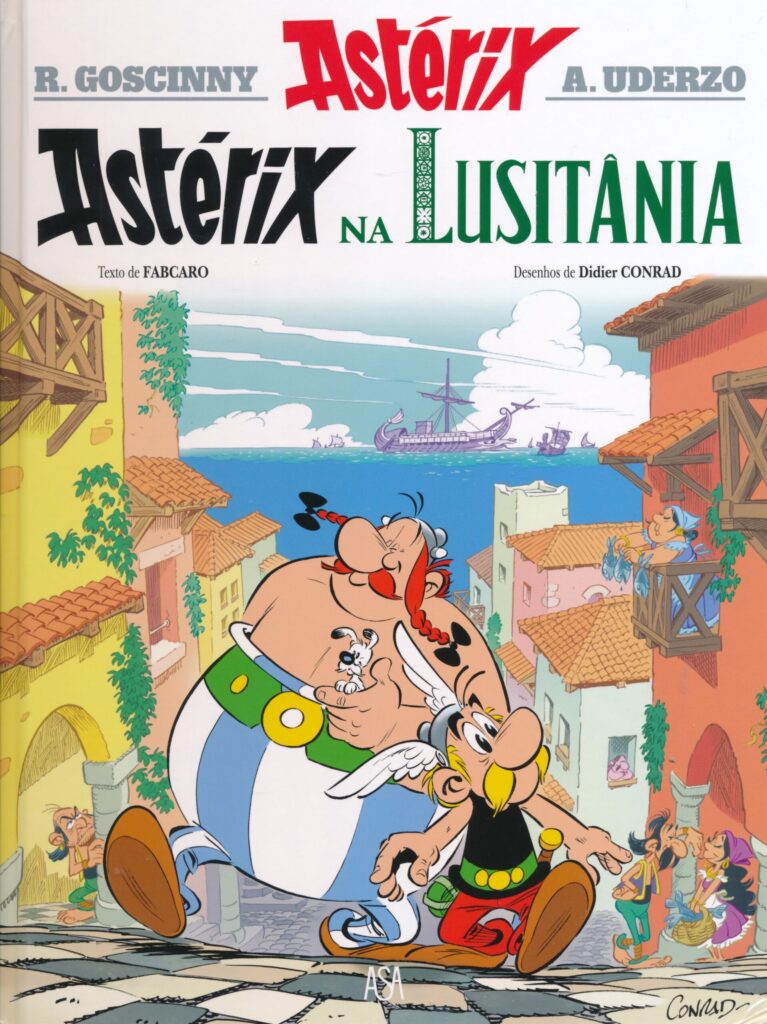
41. Asterix in Lusitania

Asterix in Lusitania was released on October 23, 2025. It is the forty-first album in the Asterix series, the second written by Fabcaro, and the seventh illustrated by Didier Conrad. The album was promoted by Asterix and Obelix before the release with an interview.
No Spoilers
If you haven’t read the album yet, here is a spoiler-free synopsis. The full synopsis, with spoilers, can be found below.
One day, Ekonomikrisis arrives in the Gaulish village, bringing along a Lusitanian named Randomaxess — a former slave who once helped build the Mansions of the Gods. He asks Chief Vitalstatistix for help: his friend Umaminess, known for producing an excellent garum, has been accused of attempting to poison Julius Caesar.
Asterix, Obelix, and Dogmatix accompany him to Lusitania (roughly corresponding to modern-day Portugal) to uncover the truth behind the accusation. What follows is a lively mix of intrigue, humor, and cultural references, in a somewhat more modern Asterix style than some fans will probably like.
Synopsis (Spoiler Alert)
When Ekonomikrisis arrives at the Gaulish village, he brings an unexpected passenger: a Lusitanian named Randomaxess, a former slave from the Mansion of the Gods. Randomaxess urgently seeks the Gauls’ help. His friend, Umaminess, the famed producer of garum favored by Julius Caesar, has been falsely accused of attempting to poison Caesar and is about to face the lions.
The real culprit is none other than the Roman governor of Lusitania, Upwardlimobilus, aided by his local collaborator Fethermyness. Their goal is to frame Umaminess, boost the garum business of Upwardlimobilus’ cousin Croesus Lupus (whom we have met in The Chariot Race before), gain Caesar’s favor, secure a promotion, and ultimately pave the way for Upwardlimobilus to ascend to dictator following Caesar’s “accident.”

Outraged, Vitalstatistix immediately sends Asterix and Obelix to Lusitania to set things right, with Ekonomikrisis providing transportation. After a brief encounter with the Pirates, the Gauls and Randomaxess reach his home village of Josemarina, where they meet Umaminess’ worried daughter, Oxala.
Investigating the Plot in Olisipo
The next day, Asterix and Obelix head to Olisipo, where Umaminess is imprisoned. They investigate the dock warehouse where his garum was stored for shipment to Rome. There, Asterix notices that Croesus Lupus’ garum now dominates the storage space. Planning to confront him, the Gauls are overheard by Fethermyness, who rushes to warn Upwardlimobilus and his henchman Centurion Extraneus.
Attempting to visit Lupus’ office, Asterix and Obelix find him absent. As they leave, they are ambushed by Extraneus and a troop of legionaries. After swiftly defeating them, they learn a bounty has been placed on their heads, forcing them to move in secret.

The Prison Rescue
At the prison, the Gauls meet Oldogotrix and his wife Perlclutcha, two Gaulish tourists they encountered earlier. The couple disguises Asterix and Obelix as Lusitanians, allowing them to infiltrate the prison as new cooks. Inside, they finally meet Umaminess, who reveals Upwardlimobilus’ treachery.
With the help of Bouillabess, another prison cook, they contact Nellia Furtado, whose family runs a restaurant and is regularly forced to cater for the governor’s lavish parties. One such event, held on the governor’s pleasure galley, is scheduled for Caesar’s visit to Lusitania the following day.
Exposing the Conspiracy
To clear Umaminess and expose Upwardlimobilus, Asterix devises a clever plan. He convinces Fethermyness to grant an invitation to the party by having Oldogotrix and Perlclutcha pose as wealthy businesspeople, with Asterix and Obelix as their bodyguards.
During the party, Asterix instructs Nellia to offer Fethermyness plenty of wine. Once drunk, the snitch unwittingly confesses Upwardlimobilus’ entire conspiracy in front of Caesar. Chaos ensues, but Caesar quickly intervenes, arresting Upwardlimobilus, Croesus Lupus, and Fethermyness. Umaminess is reinstated as Caesar’s primary garum supplier.
After celebrating with their Lusitanian friends, Asterix and Obelix return to their village for the traditional triumphal feast, bringing justice and laughter back to their peaceful home.

What’s in a name?
The following was pointed out to me by a French Asterix fan: In the original French story, Randomaxess is called Boulquiès, a clear pun on Boules Quiès, a well-known brand of earplugs in France. The name boules Quiès has become so familiar that it is often used generically to refer to hearing protection, making the joke immediately obvious to French readers. As with many names in Asterix, the humor lies in this everyday cultural reference rather than in a literal description of the character, and the original wordplay is therefore difficult to reproduce in translation.
His role in the story is quite limited. After coming to the village to ask the help of the Gauls and taking them back to Lusitania, he doesn’t really add anything to the story anymore.
Interesting facts and details
- In both the French and English editions, the Lusitanian characters’ speech can be recognized by the ending “-ação” in words where you would normally expect “-ation.” For example: aberração instead of aberration.
- Randomaxess was first seen — though unnamed — in The Mansions of the Gods. His original French name is Boulquiès.
- Artist Didier Conrad drew inspiration from Uderzo’s earlier work while adding clear Portuguese influences, such as traditional dress, azulejos, pastéis de nata, and the patterned Portuguese pavement (calçada portuguesa).
- A number of playful cultural details appear throughout the album. There is even a cameo by a young boy kicking a football in the colors of Portugal, a wink to a famous Portuguese player.
- The soccer player actually gets two cameos, one in front of a restaurant with a familar name.
- The Roman centurion in the story is a caricature of Ricky Gervais, while Baba the Numidian pirate returns with a slightly updated design and without his earlier speech impediment.
- In the Portuguese translation the servicestation our friends use, is of a different brand.

Latin quotes
While Latin quotations were rare in the previous albums, Asterix in Lusitania includes many of them. Some of them were already used in previous albums however.
1. O tempora, o mores!
Literal translation: “Oh the times, oh the customs!”
Meaning: A lament about the decline of morals or values in society.
Origin: From Cicero’s speech In Catilinam I (63 BC), where he complains about the corruption and moral decay of Rome.
2. Veni, vidi, vendidi
Literal translation: “I came, I saw, I sold.”
Meaning: A humorous twist on Julius Caesar’s famous Veni, vidi, vici (“I came, I saw, I conquered”).
Use: In this album it is the name of a marketing company.
3. Caligae
Literal translation: “Military boots” or “soldier’s sandals.”
Meaning: Refers to the heavy-soled boots worn by Roman soldiers. Not really a quote of course, but I figured not everyone might know the meaning of the term.
Historical note: The nickname Caligula (“Little Boot”) was given to the young Gaius Caesar, later Emperor Caligula, by soldiers who found his miniature military outfit amusing.
4. Alea jacta est
Literal translation: “The die is cast.”
Meaning: A decisive step has been taken; there is no turning back.
Origin: Attributed to Julius Caesar when he crossed the Rubicon River in 49 BC, an act that started the Roman Civil War.
5. Vanitas vanitatum, et omnia vanitas
Literal translation: “Vanity of vanities, all is vanity.”
Meaning: All earthly things are fleeting and meaningless in the face of mortality.
Origin: From the Book of Ecclesiastes (1:2) in the Vulgate Bible. Commonly used in art and literature to express the futility of human ambition.
6. In vino veritas
Literal translation: “In wine, [there is] truth.”
Meaning: People are more likely to speak their true thoughts or feelings when drunk.
Origin: Ancient proverb; recorded by Pliny the Elder and others.
7. Roma traditoribus non praemiat
Literal translation: “Rome does not reward traitors.”
Meaning: A statement of principle and warning — even if a traitor helps you, betrayal itself is despised.
Origin: Not from classical antiquity, but often used in historical fiction or modern adaptations inspired by Roman honor and loyalty.
My Collection