Saarland German

The Saarland is a small federal state in southwestern Germany, sharing borders with France and Luxembourg. Despite its small size, the region has been a cultural and linguistic crossroads for centuries. Political control over the Saarland has shifted multiple times throughout history, including periods under French rule, German administration, and as a semi-autonomous territory after World War II before finally joining the Federal Republic of Germany in 1957. These changes have left enduring traces in the culture, language, and everyday life of the region. Saarland’s landscape includes urban centers such as Saarbrücken, industrial valleys shaped by coal and steel production, and rural areas with vineyards, forests, and quaint villages. The cultural life is equally diverse: Saarbrücken hosts theaters, museums, and festivals, while rural areas preserve traditional customs, music, and folk events. French influence is notable in cuisine (such as Quiche Lorraine, Flammkuchen, and pastries), architecture, and vocabulary in everyday speech. Saarlanders often describe their identity in terms that reflect this rich blend of Germanic and Romance cultural heritage.
The Saarländisch Mundart
Saarländisch is the native dialect of the region and belongs to the Moselle Franconian branch of West Central German dialects, closely related to Luxembourgish and Palatinate German. It is a fully distinct dialect, with its own phonetic, grammatical, and lexical characteristics that set it apart from neighboring Moselfränkisch and Rheinfränkisch. Phonetically, Saarländisch is marked by softened consonants, distinctive vowel shifts, and a melodic, sing-song intonation pattern. Lexically, it incorporates French loanwords, particularly in culinary, administrative, and household contexts, reflecting centuries of close contact with French. Grammatically, Saarländisch exhibits regional idiosyncrasies in verb conjugation, plural formation, and diminutive usage. The dialect also shows internal variation: northern Saarland tends to lean toward Moselfränkisch features, while southern and eastern areas lean toward Rheinfränkisch. Within villages, even subtle differences in pronunciation, word choice, and syntax can occur. Despite this variation, Saarländisch remains a cohesive and recognizable dialect, used in everyday speech, literature, and cultural productions, and it continues to serve as a marker of regional identity and community cohesion.
Asterix in Saarland
In the Saarländisch Asterix translations, this dialectal richness is highlighted through the way different character groups speak. Consistent with other Asterix Mundart editions, the Romans and Gauls are rendered in distinct ways to underline cultural and linguistic differences. In the Saarländisch versions, Romans often speak with features closer to Moselfränkisch, giving them a slightly “foreign” or formal tone compared to the Gauls, who speak in a more idiomatic Saarländisch that blends regional influences but preserves the natural flow and humor of the local dialect. This subtle differentiation allows readers to experience the social and cultural distinctions between the occupying Romans and the indigenous Gauls, while maintaining accessibility and humor across the Saarland. These kinds of character-specific dialect renderings are a hallmark of Asterix translations into regional languages, and they demonstrate the translators’ attention to linguistic nuance and cultural authenticity.
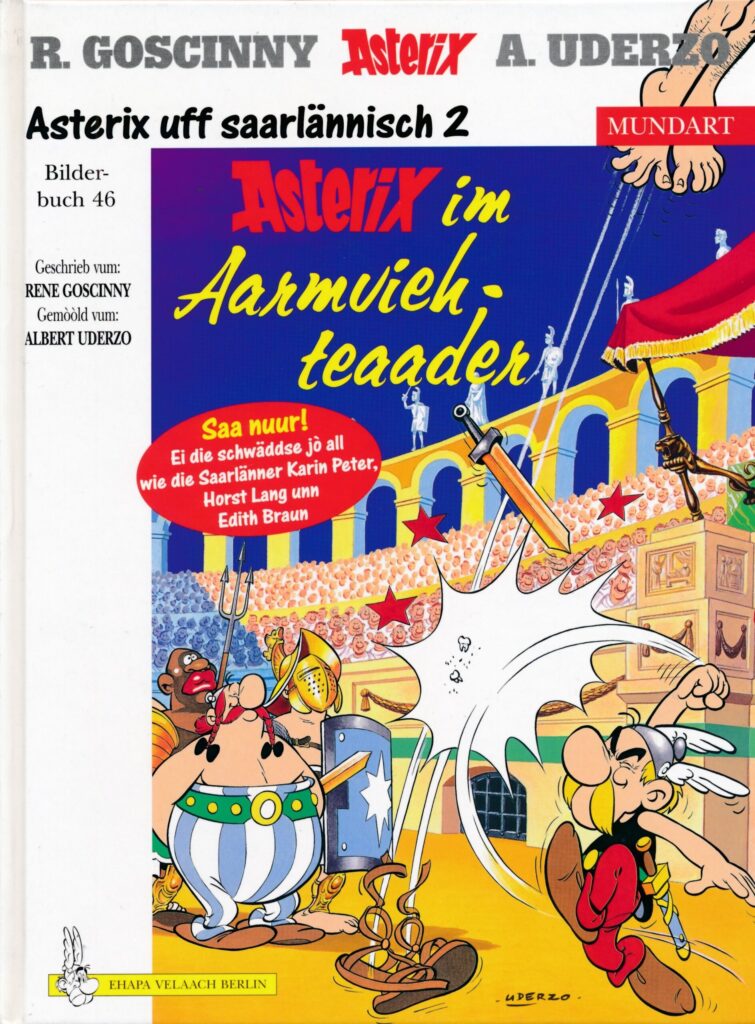
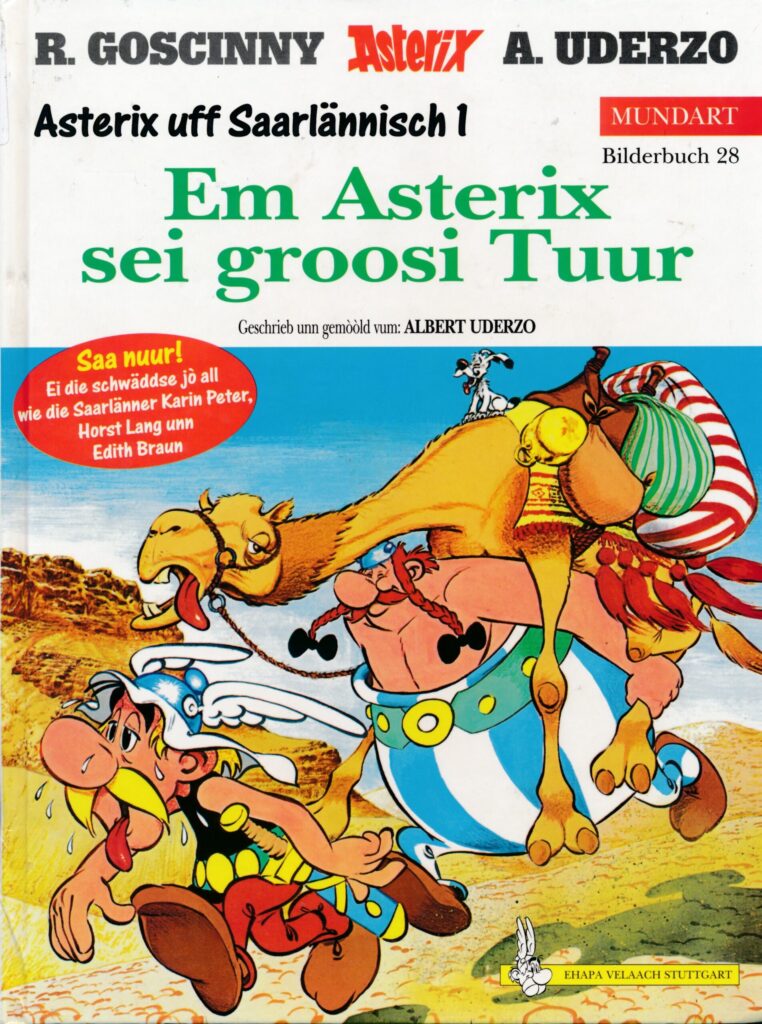
Asterix has been translated into Saarländisch in three albums, according to the official Asterix languages site asterix-obelix.nl: Em Asterix sei groosi Tuur (September 2000), Asterix im Armviehteaader (October 2001), and Die Sischel vun Gold (May 2007). These editions were published by Ehapa Velaach in Stuttgart and translated by Karin Peter, Horst Lang, and Edith Braun. Translating Asterix into Saarländisch involved capturing the linguistic diversity within Saarland while preserving the humor, puns, and narrative flow of the original French stories. To ensure readability and authenticity, the translators incorporated elements from both Moselfränkisch and Rheinfränkisch, reflecting internal variation while keeping the Saarländisch identity intact. The use of dialectal features, phonetic spellings, and idiomatic expressions creates a unique reading experience where the local color and linguistic flavor of Saarland shine through. Beyond entertainment, these albums serve as cultural artifacts, documenting the linguistic richness of Saarländisch and offering insight into the way regional dialects can mediate humor, social distinctions, and storytelling in literature.