Moselle Franconian
The Moselle (German: Mosel) is a major river in western Germany flowing through Rhineland-Palatinate and Saarland, before entering Luxembourg and eventually France. The region around the Moselle is known for its steep vineyards, wine growing (especially Riesling), charming villages, historical towns like Trier, and a mix of Germanic and Romance cultural influence. Bordering Luxembourg, Belgium and France, this borderland has seen centuries of shifting political control, multilingual populations, and trade. The landscape is hilly, broken by river valleys, and many communities are rural but with strong local identity, traditions, dialects, and festivals.
Because of its geography—valleys, isolated hills, small villages—and history, dialects tend to vary markedly from place to place. The Moselle region is also famous for wine tourism, Roman ruins, alpine‐style forests, and a sense of regional distinctiveness within Germany.
What is Moselle Franconian?
Linguistic Classification
Moselle Franconian (German: Moselfränkisch) is part of the West Central German (Westmitteldeutsch) group of High German dialects. Within that, it belongs to the Central Franconian area. It is closely related to Luxembourgish, Lorraine Franconian, and certain dialects in western Rhineland-Palatinate, Saarland, parts of Belgium, etc.
There are several sub-varieties: Trierisch, Eifelisch, Untermosellanisch, West-Westerwäldisch, Siegerländisch.
Characteristics: Phonology, Grammar, Vocabulary
Here are some traits typical of Moselle Franconian:
- Vowel changes and de-rounding: Sounds like ü, ö, eu may undergo changes (e.g. losing rounding) in certain environments.
- Extra “vowel insertions” (Sproßvokale) in certain words: e.g. elef instead of Standard elf (“eleven”), Kallef for Kalb (“calf”), fären for fern (“far”) etc.
- Change of initial consonants: In some dialects ‘t’ becomes ‘d’ at beginning of words: e.g. Dier for Tier (“animal”)
- “g” → “j” sound: such as jot for gut (“good”), Jlas for Glas (“glass”)
- Gender/article usage: sometimes feminine nouns or names are referred to with the neutral article das instead of die, e.g. das Kate instead of Standard German die Kate (for a girl or woman named Kate)
Grammar and usage also differ:
- Some verb forms are different, perhaps in how auxiliary verbs are used in perfect/passive forms (though many dialect-grammar traits overlap with Standard German or other Central German dialects).
- The case system (nominative, accusative, dative) is mostly intact but usage of genitive is weaker in many dialects, often replaced by other means (prepositional/dative) as in many German dialects.
- Vocabulary features regionally specific words, old Germanic forms, also borrowings or influence from neighbouring languages.
Use and Vitality
Moselle Franconian is still spoken in many rural and semi-urban communities throughout its area. In places like Luxembourg, variants (especially Luxembourgish) have official status or are widely used. lHowever, like many dialects, Moselle Franconian faces pressures: younger generations tend to use Standard German or national official languages more, dialects may be stigmatized or seen as rural. That said, there is strong regional interest in preserving local speech, literature, songs, etc.
In comparison to Standard German:
- Pronunciation differs significantly: sounds, vowel quality, consonants.
- Grammar has divergences: perhaps in word order, use of auxiliary verbs, loss or reduction of certain cases.
- Vocabulary includes dialect-specific words not found (or different) in Standard German.

In comparison to Main Franconian:
Moselle Franconian (Moselfränkisch) and Main Franconian (Meefränggisch) are both part of the High German dialect continuum, but they belong to different subgroups and are separated geographically and linguistically.
Mutual Intelligibility
Speakers of Moselle Franconian and Main Franconian usually notice strong differences. They can sometimes understand each other (both are High German dialects), but they are not mutually intelligible in detail without exposure. A Moselle Franconian speaker may find Main Franconian closer to Standard German in some respects, but with different vowel qualities and stress patterns.
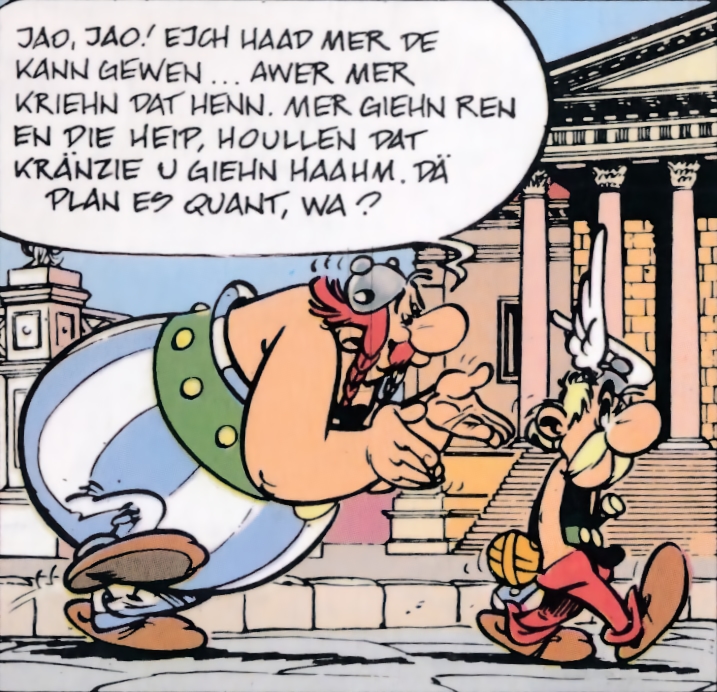
Em Cäsar saa Kränzie: The Only Asterix Album in Moselfränkisch
The one (and so far only) Asterix album available in Moselle Franconian is Em Cäsar saa Kränzie, a translation of Les lauriers de César (Asterix and the Laurel Wreath) into Moselfränkisch. Published in 1999 by Ehapa/Ehaba Valaach, translated by Dieter Zimmer. It is one of the harder to find albums.