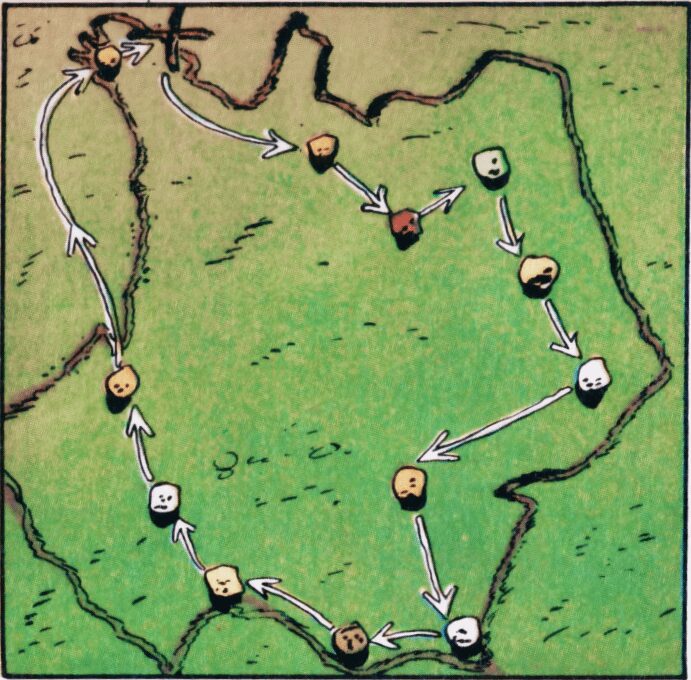
In this series of articles, we take a closer look at the places Asterix and Obelix visit during their journey around Gaul, focusing on the original French version of the story and the specific regional delicacies mentioned there. Le Tour de Gaule d’Astérix is widely regarded as one of the more difficult albums to translate, as much of its humor relies on cultural references, wordplay, and culinary traditions. By providing historical context, this series aims to clarify the puns that make this journey so memorable.
The Labyrinth of Lugdunum: Sausages, Quenelles, and the Secret Network
Leaving the betrayal of Divodurum behind, Asterix and Obelix travel south to Lugdunum (modern-day Lyon). This stop is perhaps the most sophisticated in the album, serving as a brilliant double-entendre: a Roman city that also functions as a subtle tribute to the French Resistance during World War II.
The way they get to Lugdunum deserver some extra attention. They hijack a car that is used to deliver mail from one town to another. It might not surprise you that the logo on the side of the car is that of the French postal services. The Roman officer that gets gagged by Asterix and Obelix thinks to himself: Je vous promets qu’on n’a pas fini d’en parler de l’affaire du courrier de Lugdunum !

The line alludes to the Affaire du Courrier de Lyon, a famous 18th-century French criminal case. In 1796, a mail coach from Paris to Lyon was robbed and the courier murdered; several men were convicted, including Joseph Lesurques, who was wrongly executed despite strong proof of his innocence. The affair became emblematic of judicial error in France and inspired numerous plays, novels, and films, notably Le Courrier de Lyon, making the phrase itself a synonym for scandal. Goscinny’s version replaces “Lyon” with its Roman name “Lugdunum,” turning a tragic historical case into a playful “ancient affair” that mocks bureaucratic pomp.
Lugdunum: Capital of the Three Gauls

Founded in 43 BC, Lugdunum was the most important city in Roman Gaul. It served as the federal capital of the Three Gauls (Celtica, Belgica, and Aquitania) and was the birthplace of two Roman emperors. Situated at the confluence of the Rhône and Saône rivers, it was a massive commercial hub. In the album, the Roman authorities wait for Asterix “de pied ferme” (steadfastly), knowing the Gauls must pass through this vital crossroads.
The “Resistance” and the Traboules
The highlight of this chapter is the introduction of Beaufix, the clandestine chef who secretly assists the heroes. His name is a pun on the French expression au beau fixe (“set fair” or “steady”), often used to describe stable weather or a positive situation.

Beaufix guides Asterix and Obelix through the traboules, narrow covered passages that run through buildings and connect one street to another. These secret routes allow the Gauls to evade the Roman garrison, mirroring Lyon’s real-world history: during WWII, the traboules were used by the French Resistance to escape the Gestapo, a reference that would have been immediately recognizable to the original French audience.
The Delicacies: Saucisson and Quenelles

Despite the pursuit, Beaufix ensures the heroes do not leave empty-handed, providing them with two of Lyon’s most iconic specialties. The first is Saucisson de Lyon, a large, high-quality dry-cured pork sausage. Renowned in French charcuterie, the Lyon variety is made from pure pork and often flavored with peppercorns. The second is quenelles, delicate, football-shaped dumplings traditionally made from creamed fish or meat mixed with breadcrumbs and egg. Modern versions are often served with pike (brochet) in a rich sauce, but in essence, quenelles represent Lyon’s culinary refinement and skill.
A Swift Departure
To continue their journey without further delay, Beaufix provides the heroes with a chariot, allowing them to speed toward their next destination, Nicae (modern-day Nice). This act of clandestine assistance cements Lugdunum’s reputation as the most helpful and resourceful city in the Gaulish tour.
Metz :Previous | Next: Nice


