One of the enduring pleasures of the Asterix series is the abundance of Latin phrases sprinkled throughout the albums. René Goscinny and Albert Uderzo used Latin both for humor and atmosphere, reinforcing the Roman setting while rewarding attentive readers with clever references.
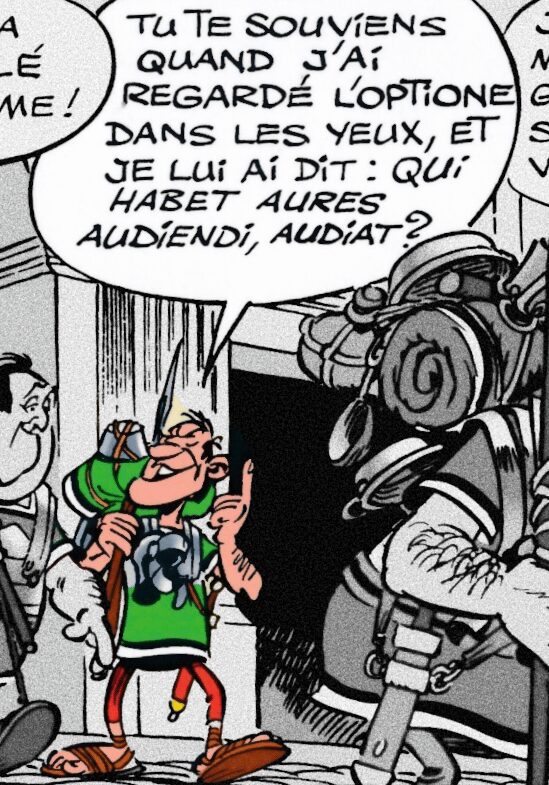
In Asterix and Caesar’s Gift (Le Cadeau de César, 1974), one such quotation appears — and it turns out to be more meaningful than it may first seem.
The Latin phrase reads:
Qui habet aures audiendi, audiat.
(He who has ears to hear, let him hear.)
This short sentence is not just decorative Latin. It is actually a direct reference to a well-known biblical passage.
A Quote from the Bible
The phrase originates from the New Testament, where it can be found in all the three synoptic gospels (Matthew 13:9, Mark 4:9 , Luke 8:8). It concludes the famous Parable of the Sower, in which Jesus describes seeds falling onto different kinds of ground:
- A path, where birds quickly eat the seeds
- Rocky ground, where plants cannot develop roots
- Among thorns, where growth is choked
- Good soil, where seeds flourish and produce fruit
After telling the parable, Jesus concludes with:
“He who has ears to hear, let him hear.”
Hearing vs. Understanding
In the biblical context, this phrase carries deeper meaning than simply hearing sounds. It distinguishes between:
- Hearing — the physical act
- Listening — understanding and reflecting
- Responding — allowing the message to change behavior
In other words, the quote is a call for attentiveness and insight. Not everyone who hears a message truly understands it — only those who are open to its meaning.
Punch line
In Asterix we miss the punch line. The phrase is uttered by a Roman legionair who says: “Do you remember when I looked the optio in the eyes and said: Qui habet aures audiendi, audiat?” … we as readers have however no idea what preceded that. We can only guess.
A Small Translation Curiosity

Interestingly, some readers of the Dutch edition may notice a small variation. In that version, the phrase appears as:
Qui habet aurus audiendi, audiat.
Here, aurus appears instead of aures. Since auris (ear) is a third-declension Latin noun, the correct plural form is aures. The word aurus is therefore grammatically incorrect.
What makes this especially notable is that the original French edition — as well as several English editions and at least one Italian edition — correctly use aures. This strongly suggests that the small slip was introduced in the Dutch translation rather than originating with Goscinny and Uderzo.


One of the enduring pleasures of the Asterix series is the abundance of Latin phrases sprinkled throughout the albums. René Goscinny and Albert Uderzo used Latin both for humor and atmosphere, reinforcing the Roman setting while rewarding attentive readers with clever references.
In Asterix and Caesar’s Gift (Le Cadeau de César, 1974), one such quotation appears — and it turns out to be more meaningful than it may first seem.
The Latin phrase reads:
Qui habet aures audiendi, audiat.
(He who has ears to hear, let him hear.)
This short sentence is not just decorative Latin. It is actually a direct reference to a well-known biblical passage.
A Quote from the Bible
The phrase originates from the New Testament, where it can be found in all the three synoptic gospels (Matthew 13:9, Mark 4:9 , Luke 8:8). It concludes the famous Parable of the Sower, in which Jesus describes seeds falling onto different kinds of ground:
- A path, where birds quickly eat the seeds
- Rocky ground, where plants cannot develop roots
- Among thorns, where growth is choked
- Good soil, where seeds flourish and produce fruit
After telling the parable, Jesus concludes with:
“He who has ears to hear, let him hear.”
Hearing vs. Understanding
In the biblical context, this phrase carries deeper meaning than simply hearing sounds. It distinguishes between:
- Hearing — the physical act
- Listening — understanding and reflecting
- Responding — allowing the message to change behavior
In other words, the quote is a call for attentiveness and insight. Not everyone who hears a message truly understands it — only those who are open to its meaning.
Punch line
In Asterix we miss the punch line. The phrase is uttered by a Roman legionair who says: “Do you remember when I looked the optio in the eyes and said: Qui habet aures audiendi, audiat?” … we as readers have however no idea what preceded that. We can only guess.
A Small Translation Curiosity
Interestingly, some readers of the Dutch edition may notice a small variation. In that version, the phrase appears as:
Qui habet aurus audiendi, audiat.
Here, aurus appears instead of aures. Since auris (ear) is a third-declension Latin noun, the correct plural form is aures. The word aurus is therefore grammatically incorrect.
What makes this especially notable is that the original French edition — as well as several English editions and at least one Italian edition — correctly use aures. This strongly suggests that the small slip was introduced in the Dutch translation rather than originating with Goscinny and Uderzo.