Published in 1968, Asterix and the Chieftain’s Shield (Le Bouclier Arverne) is the eleventh album in the series by René Goscinny and Albert Uderzo. By this point the creators were working at full confidence, and the result is an adventure that mixes historical references, gentle absurdity, and a touch of detective fiction. This album is filled to the brim with easter eggs and gags that you only notice after reading the album again and again. Which we recommend you do.
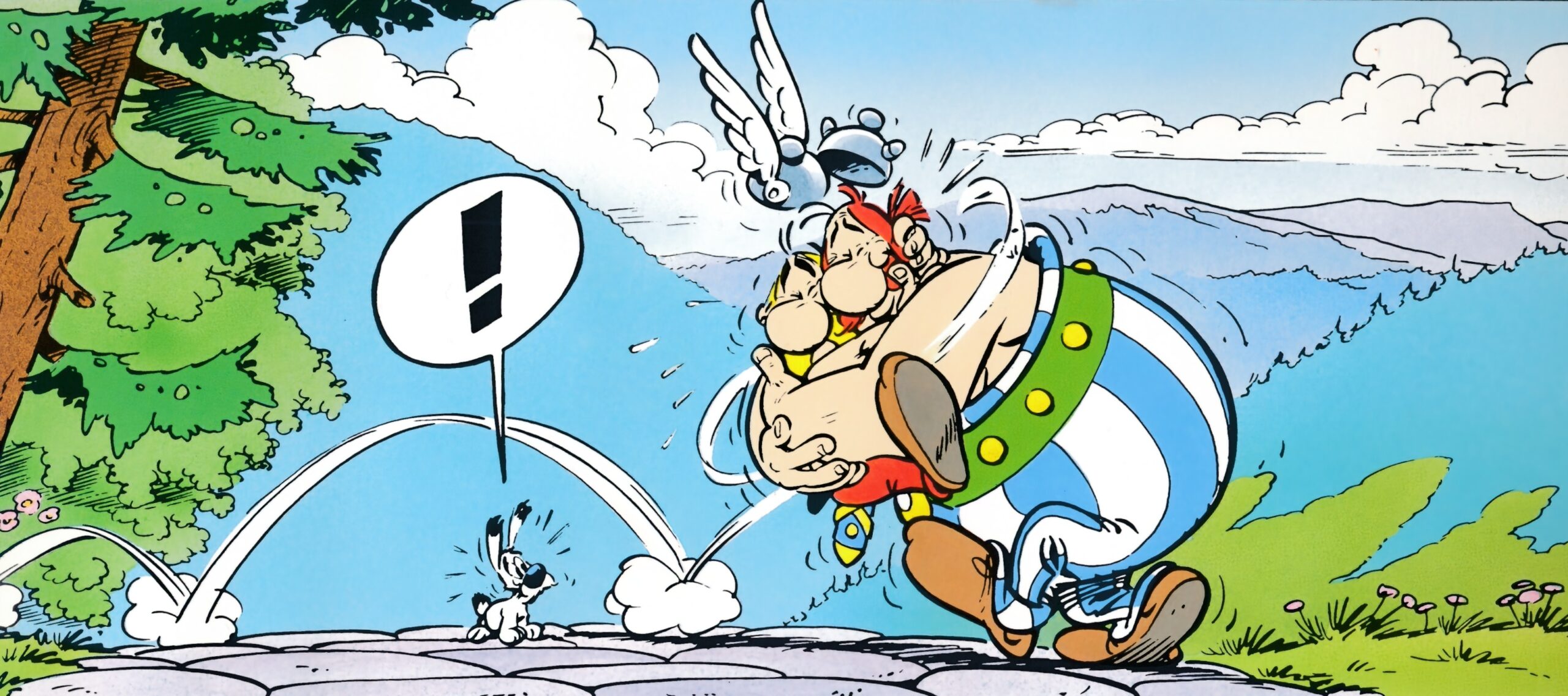
At the centre of the story lies one of the most famous moments in Gallic history: the defeat of Vercingetorix by Julius Caesar at the Battle of Alesia. But, as often happens in the world of Asterix, the grand events of history quickly become the starting point for a far more entertaining mystery.
Vercingetorix was the leader of the Arverni tribe, henche the French title Le Bouclier Arverne, Shield of the Arvernians.
A Nation That Forgot Alesia
One of the running jokes throughout the album is the Gauls’ refusal to acknowledge the existence of Alesia. Whenever the subject arises, someone inevitably replies: “Alesia? Never heard of it!”

The gag is simple, but it says much about the way history can be remembered—or conveniently forgotten. In reality the Battle of Alesia in 52 BC marked the decisive Roman victory over the Gallic coalition led by Vercingetorix. In the album, however, the Gauls prefer to pretend the whole thing never happened.
This denial sets the stage for the adventure. Vitalstatistix is sent to the spa town of Aquae Calidae (modern Vichy) to recover from a liver complaint, but events soon lead Asterix and Obelix to investigate the fate of Vercingetorix’s legendary shield. According to Roman tradition, Caesar stood upon that shield when the defeated chieftain laid down his arms. If the relic could be found again, it would be a powerful symbol of either the Roman conquest or Gallic pride, depending on who finds it first.
A Mystery Worthy of a Detective
Much of the album unfolds like a comic detective story. Asterix and Obelix follow clues across the land of the Arverni (roughly the Auvergne region), questioning suspicious characters and piecing together fragments of a story that stretches back years.

The trail leads through veterans who fought at Alesia, wine merchants, and Roman officials, each with their own hazy recollection of events. The narrative even opens with a flashback showing Vercingetorix surrendering to Caesar—a scene already familiar from the very first Asterix album, now revisited from a slightly different angle.
In typical Goscinny fashion, the investigation constantly collides with absurd misunderstandings and exaggerated personalities, keeping the tone light even while the story circles around a famous historical defeat.
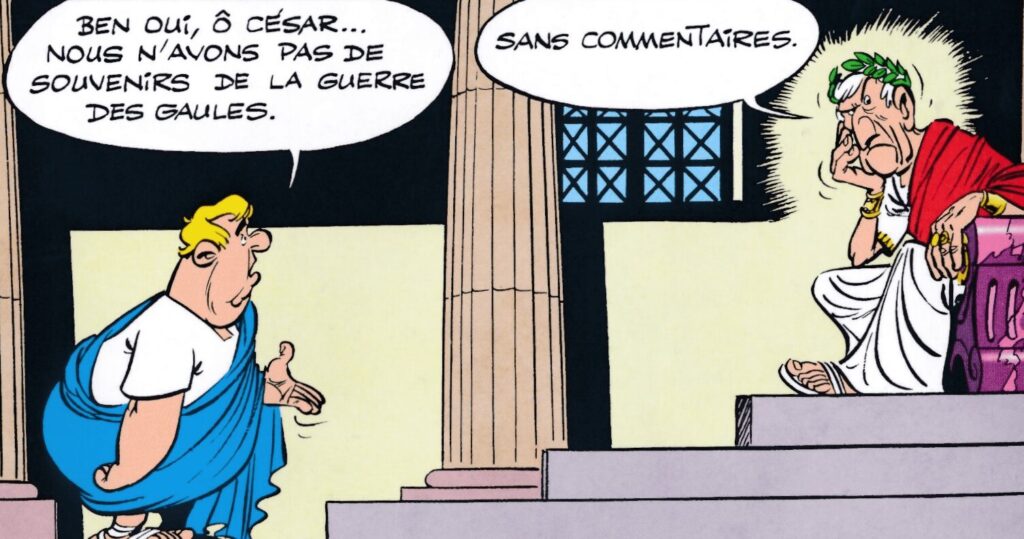
One particularly subtle joke appears when Caesar asks the officer Fanfrelus to bring him the trophies taken from Vercingetorix. The officer replies that he has no memory of the Gallic War. Caesar then dryly concludes: “Sans commentaire”—a wink to the famous Commentarii de Bello Gallico (“Commentaries on the Gallic War”) that Julius Caesar himself wrote about the campaign.
Spa Culture and Roman Bureaucracy
While the story takes place in ancient Gaul, many of the jokes clearly echo modern habits. The spa of Aquae Calidae is portrayed as a place where patients undergo strict cures involving diets, cold baths, and endless supervision by solemn attendants.

Although the fictional cure takes place in Aquae Calidae (modern Vichy), one visual detail points to another famous spa town in the Auvergne. The first panel on page 10 closely resembles the Source Eugénie and the thermal establishment of Royat, near Clermont-Ferrand. This architectural reference would have been immediately recognisable to French readers familiar with the region’s historic spa culture.
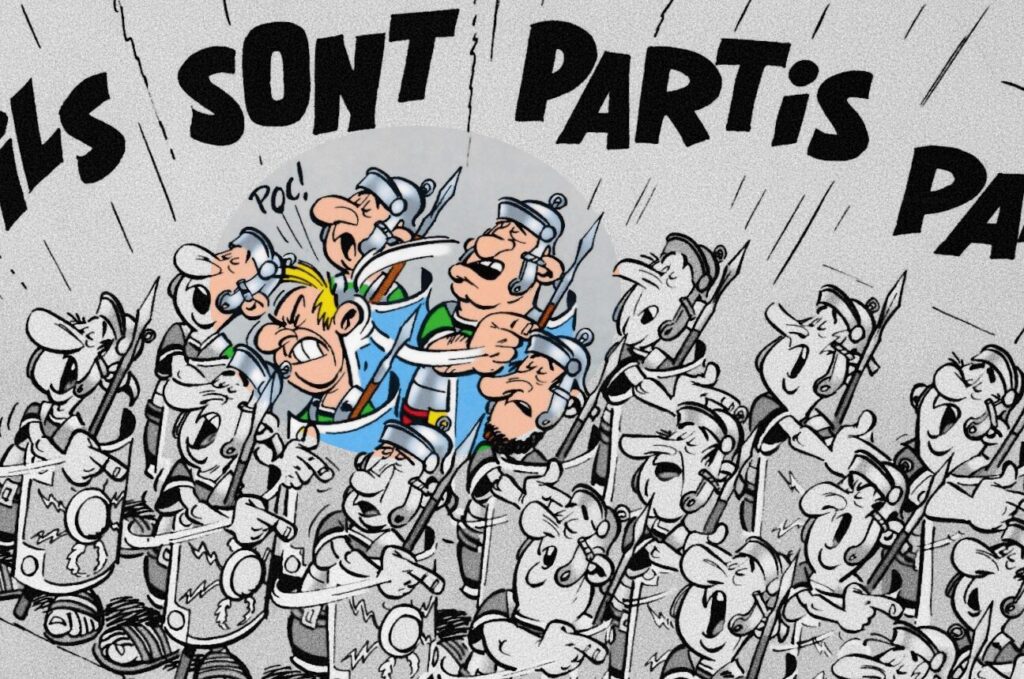
Roman administration receives its usual treatment as well. Officers, officials, and veterans appear more concerned with comfort and reputation than with efficiency. The Roman army, supposedly the most disciplined force in the ancient world, once again proves no match for the unpredictable Gauls.
The Arverni and Their Land
The album also introduces readers to the territory of the Arverni, one of the most powerful Gallic tribes in antiquity. Their chief city, Nemessos (modern Clermont-Ferrand), was an important centre long before Roman rule.
Goscinny and Uderzo fill the region with distinctive local colour. The Arverni are depicted as proud traders in coal and wine, and their speech is marked by a comic accent that replaces many s sounds with sh. The many wine-and-coal shops that appear in the Arvernian towns are a playful nod to the Bougnats—immigrants from the Auvergne region who later settled in Paris and traditionally ran small businesses selling wine, wood, and coal.

The album also includes several visual jokes tied to the real city of Clermont-Ferrand. When Asterix visits the industrialist Lucius Coquelus, director of a wheel factory in Nemessos, the scene clearly alludes to the famous Michelin factories that have produced tyres in Clermont-Ferrand since the early days of the automobile. Inspired by the factory, Obelix enthusiastically imagines how the industrial production of menhirs might make him rich—a humorous idea that would later become the central plot of Obelix and Co.
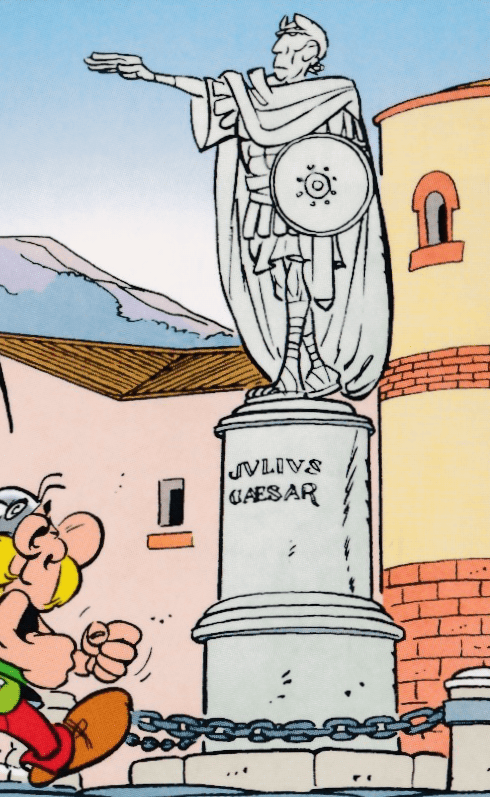
Another visual reference appears outside the factory, where a statue of Julius Caesar stands in the town square. The image mirrors the real statue of Vercingetorix that dominates the Place de Jaude in Clermont-Ferrand, cleverly reversing conqueror and conquered.
Like many Asterix adventures set outside the famous Armorican village, the story gently plays with the diversity of Gaul’s many tribes.
A Relic with a Humble Fate
After a long and winding search, the famous shield is finally rediscovered. The object that once symbolised Caesar’s triumph and the fall of Gaul turns out to have passed through many hands before ending up far from the centre of power.
In a final twist worthy of the series, the historic relic finds an entirely unexpected use in the village. The shield that once bore the weight of a conquered nation becomes something far more domestic.
Finally
The album also quietly introduces an important character here: this is the first clear appearance of Impedimenta (Bonemine), the formidable wife of Vitalstatistix. Earlier albums had shown a similar woman in the chief’s household, but this is the first time she firmly emerges as the chief’s outspoken spouse—a character who would become a regular presence in later stories.
What’s in a name?
The Roman tribune Tullius Fanfrelus (Noxius Vapus in the English translation) is extra funny when you pronounce it with the lisp of the locals. It become Fanfreluche which means a frill or trinket. In the German translation he is named Tullius Firlefanzus. The name is built on the wonderful German word Firlefanz. Which means “nonsense,” “trifles,” “frivolity,” or “useless bits and bobs.”

In our opinion the original Dutch translator goes home with the gold medal. He named him Tullius Lusuncus. When you add the lisp, is becomes luj-un-kushj. Which Dutch readers will recognize as “Lust je een kusje?” ergo “Do you fancy a little kiss?”.
Vade Retro …!
When Tulius Fanfrelus suggests to Caesar to use a nock off of the real Arvenian shield, Caesar angry replies “Vade Retro Fanfrelus!”. This is a nod to something Jesus said when he scolded Peter with “Vade Retro Satana!” (Mark 8:33) in the Vulgate. Get behind me Satan!. As if he wants to banish the evil spirit that seems to have taken possession of the tribune.
Bis repetita
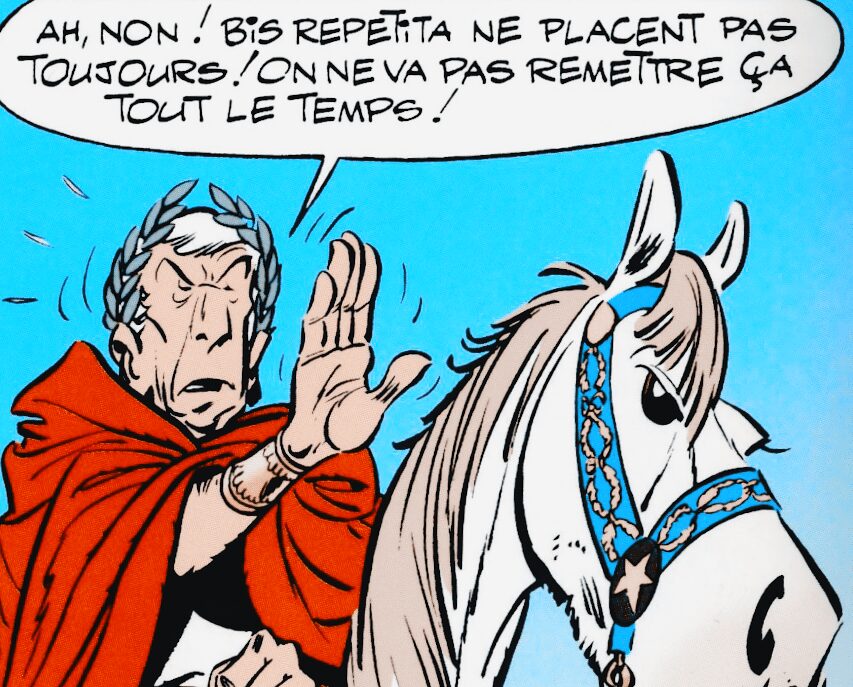
Another Latin line probably needs a bit more explanation. In the last panel of page 46 Caesar utters the line “bis repetita don’t always placent”. This humorously twists the Latin proverb bis repetita placent by reversing its meaning and mixing Latin with broken English to suggest that repeated events are not always enjoyable. The French version “bis repetita ne placent pas toujours” delivers the same joke by combining correct Latin with French negation, creating a mock-learned expression that similarly means repetition isn’t always pleasing.
The laughing slaves
Tullius Fanfrelus is carried around by four black slaves. Much has been said about how they are portrayed by Uderzo, something we won’t go into here. There is a running gag though. Every time Asterix and Obelix come across the tribune, it doesn’t end well for him. This leads to ever-increasing amusement for the slaves.

The end
It is a typical Asterix ending: grand history reduced to everyday life, and the mighty symbols of the past quietly absorbed into the cheerful chaos of the indomitable Gauls.
Like many of the best Asterix albums, Asterix and the Chieftain’s Shield works on several levels at once. Younger readers enjoy the jokes and the inevitable Roman brawls, while older readers can appreciate the playful treatment of history and national memory. The result is an adventure that remains as entertaining—and as slyly observant—as ever.


Published in 1968, Asterix and the Chieftain’s Shield (Le Bouclier Arverne) is the eleventh album in the series by René Goscinny and Albert Uderzo. By this point the creators were working at full confidence, and the result is an adventure that mixes historical references, gentle absurdity, and a touch of detective fiction. This album is filled to the brim with easter eggs and gags that you only notice after reading the album again and again. Which we recommend you do.
At the centre of the story lies one of the most famous moments in Gallic history: the defeat of Vercingetorix by Julius Caesar at the Battle of Alesia. But, as often happens in the world of Asterix, the grand events of history quickly become the starting point for a far more entertaining mystery.
Vercingetorix was the leader of the Arverni tribe, henche the French title Le Bouclier Arverne, Shield of the Arvernians.
A Nation That Forgot Alesia
One of the running jokes throughout the album is the Gauls’ refusal to acknowledge the existence of Alesia. Whenever the subject arises, someone inevitably replies: “Alesia? Never heard of it!”
The gag is simple, but it says much about the way history can be remembered—or conveniently forgotten. In reality the Battle of Alesia in 52 BC marked the decisive Roman victory over the Gallic coalition led by Vercingetorix. In the album, however, the Gauls prefer to pretend the whole thing never happened.
This denial sets the stage for the adventure. Vitalstatistix is sent to the spa town of Aquae Calidae (modern Vichy) to recover from a liver complaint, but events soon lead Asterix and Obelix to investigate the fate of Vercingetorix’s legendary shield. According to Roman tradition, Caesar stood upon that shield when the defeated chieftain laid down his arms. If the relic could be found again, it would be a powerful symbol of either the Roman conquest or Gallic pride, depending on who finds it first.
A Mystery Worthy of a Detective
Much of the album unfolds like a comic detective story. Asterix and Obelix follow clues across the land of the Arverni (roughly the Auvergne region), questioning suspicious characters and piecing together fragments of a story that stretches back years.
The trail leads through veterans who fought at Alesia, wine merchants, and Roman officials, each with their own hazy recollection of events. The narrative even opens with a flashback showing Vercingetorix surrendering to Caesar—a scene already familiar from the very first Asterix album, now revisited from a slightly different angle.
In typical Goscinny fashion, the investigation constantly collides with absurd misunderstandings and exaggerated personalities, keeping the tone light even while the story circles around a famous historical defeat.
One particularly subtle joke appears when Caesar asks the officer Fanfrelus to bring him the trophies taken from Vercingetorix. The officer replies that he has no memory of the Gallic War. Caesar then dryly concludes: “Sans commentaire”—a wink to the famous Commentarii de Bello Gallico (“Commentaries on the Gallic War”) that Julius Caesar himself wrote about the campaign.
Spa Culture and Roman Bureaucracy
While the story takes place in ancient Gaul, many of the jokes clearly echo modern habits. The spa of Aquae Calidae is portrayed as a place where patients undergo strict cures involving diets, cold baths, and endless supervision by solemn attendants.
Although the fictional cure takes place in Aquae Calidae (modern Vichy), one visual detail points to another famous spa town in the Auvergne. The first panel on page 10 closely resembles the Source Eugénie and the thermal establishment of Royat, near Clermont-Ferrand. This architectural reference would have been immediately recognisable to French readers familiar with the region’s historic spa culture.
Roman administration receives its usual treatment as well. Officers, officials, and veterans appear more concerned with comfort and reputation than with efficiency. The Roman army, supposedly the most disciplined force in the ancient world, once again proves no match for the unpredictable Gauls.
The Arverni and Their Land
The album also introduces readers to the territory of the Arverni, one of the most powerful Gallic tribes in antiquity. Their chief city, Nemessos (modern Clermont-Ferrand), was an important centre long before Roman rule.
Goscinny and Uderzo fill the region with distinctive local colour. The Arverni are depicted as proud traders in coal and wine, and their speech is marked by a comic accent that replaces many s sounds with sh. The many wine-and-coal shops that appear in the Arvernian towns are a playful nod to the Bougnats—immigrants from the Auvergne region who later settled in Paris and traditionally ran small businesses selling wine, wood, and coal.
The album also includes several visual jokes tied to the real city of Clermont-Ferrand. When Asterix visits the industrialist Lucius Coquelus, director of a wheel factory in Nemessos, the scene clearly alludes to the famous Michelin factories that have produced tyres in Clermont-Ferrand since the early days of the automobile. Inspired by the factory, Obelix enthusiastically imagines how the industrial production of menhirs might make him rich—a humorous idea that would later become the central plot of Obelix and Co.
Another visual reference appears outside the factory, where a statue of Julius Caesar stands in the town square. The image mirrors the real statue of Vercingetorix that dominates the Place de Jaude in Clermont-Ferrand, cleverly reversing conqueror and conquered.
Like many Asterix adventures set outside the famous Armorican village, the story gently plays with the diversity of Gaul’s many tribes.
A Relic with a Humble Fate
After a long and winding search, the famous shield is finally rediscovered. The object that once symbolised Caesar’s triumph and the fall of Gaul turns out to have passed through many hands before ending up far from the centre of power.
In a final twist worthy of the series, the historic relic finds an entirely unexpected use in the village. The shield that once bore the weight of a conquered nation becomes something far more domestic.
Finally
The album also quietly introduces an important character here: this is the first clear appearance of Impedimenta (Bonemine), the formidable wife of Vitalstatistix. Earlier albums had shown a similar woman in the chief’s household, but this is the first time she firmly emerges as the chief’s outspoken spouse—a character who would become a regular presence in later stories.
What’s in a name?
The Roman tribune Tullius Fanfrelus (Noxius Vapus in the English translation) is extra funny when you pronounce it with the lisp of the locals. It become Fanfreluche which means a frill or trinket. In the German translation he is named Tullius Firlefanzus. The name is built on the wonderful German word Firlefanz. Which means “nonsense,” “trifles,” “frivolity,” or “useless bits and bobs.”
In our opinion the original Dutch translator goes home with the gold medal. He named him Tullius Lusuncus. When you add the lisp, is becomes luj-un-kushj. Which Dutch readers will recognize as “Lust je een kusje?” ergo “Do you fancy a little kiss?”.
Vade Retro …!
When Tulius Fanfrelus suggests to Caesar to use a nock off of the real Arvenian shield, Caesar angry replies “Vade Retro Fanfrelus!”. This is a nod to something Jesus said when he scolded Peter with “Vade Retro Satana!” (Mark 8:33) in the Vulgate. Get behind me Satan!. As if he wants to banish the evil spirit that seems to have taken possession of the tribune.
Bis repetita
Another Latin line probably needs a bit more explanation. In the last panel of page 46 Caesar utters the line “bis repetita don’t always placent”. This humorously twists the Latin proverb bis repetita placent by reversing its meaning and mixing Latin with broken English to suggest that repeated events are not always enjoyable. The French version “bis repetita ne placent pas toujours” delivers the same joke by combining correct Latin with French negation, creating a mock-learned expression that similarly means repetition isn’t always pleasing.
The laughing slaves
Tullius Fanfrelus is carried around by four black slaves. Much has been said about how they are portrayed by Uderzo, something we won’t go into here. There is a running gag though. Every time Asterix and Obelix come across the tribune, it doesn’t end well for him. This leads to ever-increasing amusement for the slaves.
The end
It is a typical Asterix ending: grand history reduced to everyday life, and the mighty symbols of the past quietly absorbed into the cheerful chaos of the indomitable Gauls.
Like many of the best Asterix albums, Asterix and the Chieftain’s Shield works on several levels at once. Younger readers enjoy the jokes and the inevitable Roman brawls, while older readers can appreciate the playful treatment of history and national memory. The result is an adventure that remains as entertaining—and as slyly observant—as ever.