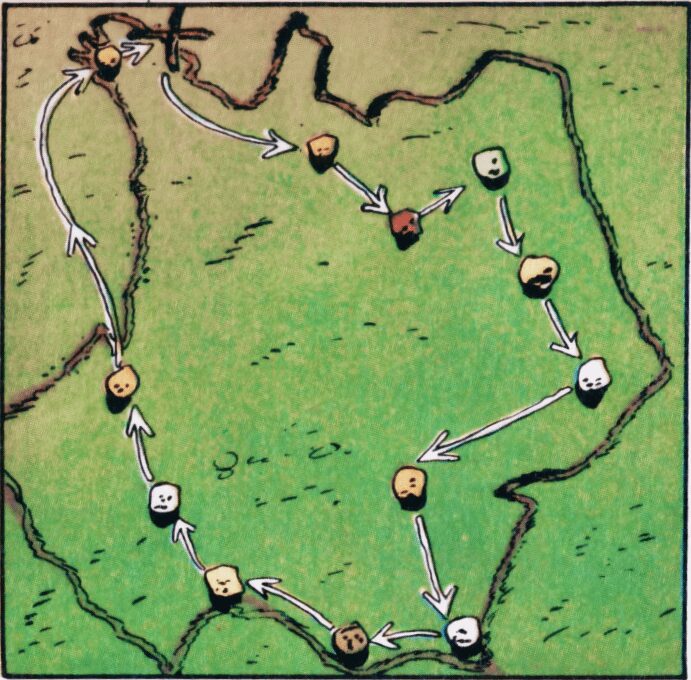
In this series of articles, we take a closer look at the places Asterix and Obelix visit during their journey around Gaul, focusing on the original French version of the story and the regional context for each stop. Le Tour de Gaule d’Astérix is widely regarded as one of the more difficult albums to translate, as much of its humor relies on cultural references, wordplay, and culinary traditions. By providing historical context, this series aims to clarify the puns and narrative details that make the journey so memorable.
Massalia (Marseille)
After passing through Nicae (modern-day Nice), Asterix and Obelix continue west along the Mediterranean coast until they reach Massalia, the ancient city that corresponds to modern-day Marseille. Their arrival is anything but conventional. After causing a commotion on the beach at Nicae, where vacationers from Lutetia are already treading on each other to tan, the pair takes to the sea.

They commandeer a small boat from a startled tourist who protests loudly. The pair sets off along the coast, eventually arriving in the busy harbor of Marseille. Leaving the tourist no option but to walk all the way back to Nice. Those Lutetians are crazy. In the original abum it reads “Tous fadas ces Lutéciens“. Fada is a core piece of Marseille slang (le parler marseillais). Derived from the Provençal word for “touched by fairies,” it is used to describe someone who is “crazy,” “cracked,” or “out of their mind”.
One of the Oldest Cities in Gaul
Massalia was already an ancient city in the time of Julius Caesar. Founded around 600 BC by Greek settlers from Phocaea, the city developed into one of the most important ports in the western Mediterranean. By 50 BC, it had long been a center of trade connecting the Mediterranean world with inland Gaul, receiving goods from as far as distant Britain. Because of this long history, Marseille is one of the few stops in Le Tour de Gaule d’Astérix that closely resembles a genuine ancient urban center rather than a purely comic invention.
A Tribute to Marcel Pagnol’s Marseille
While the historical background is genuine, the atmosphere of Marseille in the album is an “irresistible satirical portrait” clearly inspired by twentieth-century culture. René Goscinny and Albert Uderzo filled the sequence with references to the films of the French writer and director Marcel Pagnol, particularly the famous “Marseille Trilogy”: Marius (1931), Fanny (1932), and César (1936).
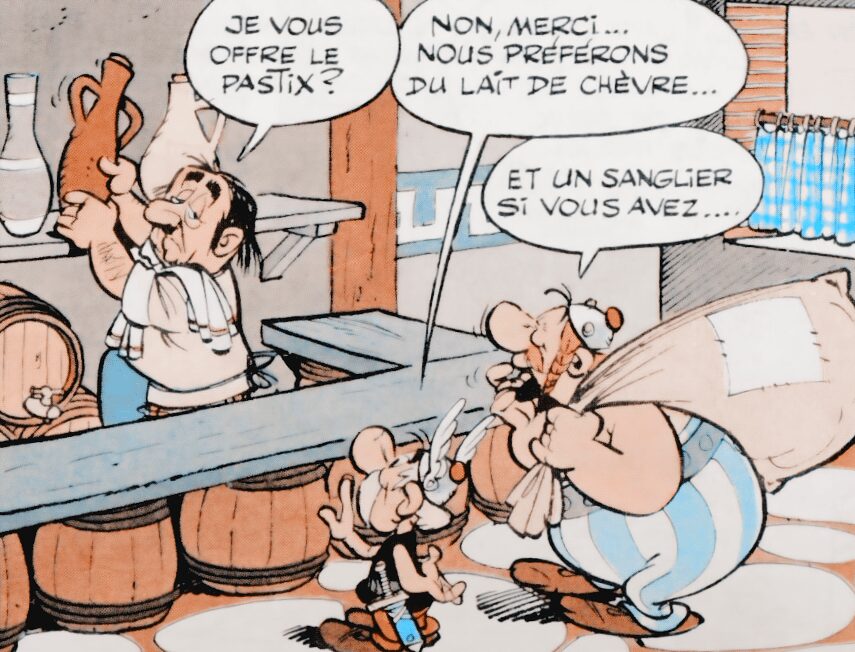
The tavern keeper César Labeldecadix, who assists the heroes, is a masterful caricature of the actor Raimu, who portrayed César in Pagnol’s films. French readers in the 1960s would have immediately recognized his “loquacity” and “legendary Southern temperament”.
His French name deserves some extra attention. The pun behind the name César Labeldecadix is a direct phonetic play on La Belle de Cadix, an immensely popular operetta that premiered in 1945. Starring the famous tenor Luis Mariano, the show was a cultural phenomenon in France, and its title song remained a ubiquitous “earworm” well into the 1960s when the album was written.
When César offers our friends some pastix (pastis) and one of the patron says he doesn’t need any. César calls him a stranger. In the context of Marseille, anyone not from the city—even if they are from a nearby city like Lugdunum (Lyon)—is treated as a total outsider, or “foreigner”.

In the English translation he is called César Drinklikafix.
The Tavern of the Sailors
After arriving in the harbor, Asterix and Obelix head to the “Taverne des Nautes” (Tavern of the Sailors). The name itself is a historical wink, as “Nautes” refers to the ancient boatmen of the region. The setting is a clear nod to the famous “Bar de la Marine” from Pagnol’s films. The interior is a “veritable festival of caricature,” filled with maritime decorations, a boat model, and shelves of amphorae.
Inside, the atmosphere is defined by relaxed hospitality and the “high-flown” speech of the patrons. The patron offers them bouillabaisse and pastis (eventhough Obelix can’t resist to check if they have wild boar on the menu), the traditional fish stew associated with Marseille.
Masslia de mes amours …

When Asterix and Obelix have fun with their new found friends a song can be heard “Massilia de mes amours” (Massilia of my loves). These lyrics are a direct play on the real song “Marseille de mes amours”. In the original lyrics, the singer mentions various neighborhoods of Marseille to show that the whole city is in love with its own beauty. It was the title track of a 1938–1939 “Marseille Operetta” and film of the same name.
If there is one city that is proof of how hard it was to translated this album, it is probably Marseille.
Bouillabaisse and the Tour of Gaul
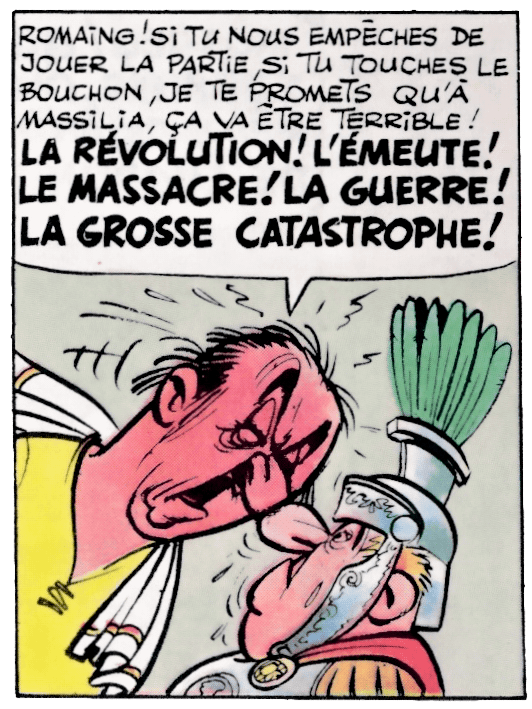
As in every stop of their journey, the heroes arrive in Marseille to obtain a local specialty. In this case, it is bouillabaisse, which is prepared by the cook Eponine (another Pagnol reference), while Labeldecadix and his friends eventually help the Gauls by using a game of pétanque to block the Roman legionaries.
A Memorable Southern Episode
Although the Massalia episode occupies only a few pages, it remains one of the most recognizable stops in the story. By combining authentic historical background with affectionate references to Pagnol’s Marseille, Goscinny and Uderzo created a sequence that celebrates the culture, cuisine, and legendary talkativeness associated with southern France.
Nice : Previous | Next: Toulouse


In this series of articles, we take a closer look at the places Asterix and Obelix visit during their journey around Gaul, focusing on the original French version of the story and the regional context for each stop. Le Tour de Gaule d’Astérix is widely regarded as one of the more difficult albums to translate, as much of its humor relies on cultural references, wordplay, and culinary traditions. By providing historical context, this series aims to clarify the puns and narrative details that make the journey so memorable.
Massalia (Marseille)
After passing through Nicae (modern-day Nice), Asterix and Obelix continue west along the Mediterranean coast until they reach Massalia, the ancient city that corresponds to modern-day Marseille. Their arrival is anything but conventional. After causing a commotion on the beach at Nicae, where vacationers from Lutetia are already treading on each other to tan, the pair takes to the sea.
They commandeer a small boat from a startled tourist who protests loudly. The pair sets off along the coast, eventually arriving in the busy harbor of Marseille. Leaving the tourist no option but to walk all the way back to Nice. Those Lutetians are crazy. In the original abum it reads “Tous fadas ces Lutéciens“. Fada is a core piece of Marseille slang (le parler marseillais). Derived from the Provençal word for “touched by fairies,” it is used to describe someone who is “crazy,” “cracked,” or “out of their mind”.
One of the Oldest Cities in Gaul
Massalia was already an ancient city in the time of Julius Caesar. Founded around 600 BC by Greek settlers from Phocaea, the city developed into one of the most important ports in the western Mediterranean. By 50 BC, it had long been a center of trade connecting the Mediterranean world with inland Gaul, receiving goods from as far as distant Britain. Because of this long history, Marseille is one of the few stops in Le Tour de Gaule d’Astérix that closely resembles a genuine ancient urban center rather than a purely comic invention.
A Tribute to Marcel Pagnol’s Marseille
While the historical background is genuine, the atmosphere of Marseille in the album is an “irresistible satirical portrait” clearly inspired by twentieth-century culture. René Goscinny and Albert Uderzo filled the sequence with references to the films of the French writer and director Marcel Pagnol, particularly the famous “Marseille Trilogy”: Marius (1931), Fanny (1932), and César (1936).
The tavern keeper César Labeldecadix, who assists the heroes, is a masterful caricature of the actor Raimu, who portrayed César in Pagnol’s films. French readers in the 1960s would have immediately recognized his “loquacity” and “legendary Southern temperament”.
His French name deserves some extra attention. The pun behind the name César Labeldecadix is a direct phonetic play on La Belle de Cadix, an immensely popular operetta that premiered in 1945. Starring the famous tenor Luis Mariano, the show was a cultural phenomenon in France, and its title song remained a ubiquitous “earworm” well into the 1960s when the album was written.
When César offers our friends some pastix (pastis) and one of the patron says he doesn’t need any. César calls him a stranger. In the context of Marseille, anyone not from the city—even if they are from a nearby city like Lugdunum (Lyon)—is treated as a total outsider, or “foreigner”.
In the English translation he is called César Drinklikafix.
The Tavern of the Sailors
After arriving in the harbor, Asterix and Obelix head to the “Taverne des Nautes” (Tavern of the Sailors). The name itself is a historical wink, as “Nautes” refers to the ancient boatmen of the region. The setting is a clear nod to the famous “Bar de la Marine” from Pagnol’s films. The interior is a “veritable festival of caricature,” filled with maritime decorations, a boat model, and shelves of amphorae.
Inside, the atmosphere is defined by relaxed hospitality and the “high-flown” speech of the patrons. The patron offers them bouillabaisse and pastis (eventhough Obelix can’t resist to check if they have wild boar on the menu), the traditional fish stew associated with Marseille.
Masslia de mes amours …
When Asterix and Obelix have fun with their new found friends a song can be heard “Massilia de mes amours” (Massilia of my loves). These lyrics are a direct play on the real song “Marseille de mes amours”. In the original lyrics, the singer mentions various neighborhoods of Marseille to show that the whole city is in love with its own beauty. It was the title track of a 1938–1939 “Marseille Operetta” and film of the same name.
If there is one city that is proof of how hard it was to translated this album, it is probably Marseille.
Bouillabaisse and the Tour of Gaul
As in every stop of their journey, the heroes arrive in Marseille to obtain a local specialty. In this case, it is bouillabaisse, which is prepared by the cook Eponine (another Pagnol reference), while Labeldecadix and his friends eventually help the Gauls by using a game of pétanque to block the Roman legionaries.
A Memorable Southern Episode
Although the Massalia episode occupies only a few pages, it remains one of the most recognizable stops in the story. By combining authentic historical background with affectionate references to Pagnol’s Marseille, Goscinny and Uderzo created a sequence that celebrates the culture, cuisine, and legendary talkativeness associated with southern France.
Nice : Previous | Next: Toulouse