When we open an Asterix album, the villagers of Armorica greet us in fluent French (or whichever language the comic is translated into). They outwit the Romans, resist occupation, and fiercely defend their independence. But history hides a striking irony: the Gauls of 50 BCE spoke Gaulish, a Celtic tongue, while French — the language we read in the albums — is a direct descendant of Latin, the language of their enemies.
This twist adds an unexpected depth to the world of Asterix. While the comics imagine a plucky band of Gauls defying Rome, the very language they use on the page is the ultimate proof that Rome won the cultural battle.
What Was Gaulish?
Gaulish was part of the Continental Celtic branch of the Indo-European family, closely related to Lepontic (northern Italy) and Celtiberian (Spain). It was spoken across most of ancient Gaul — modern France, Belgium, Luxembourg, Switzerland, and parts of northern Italy and Germany.
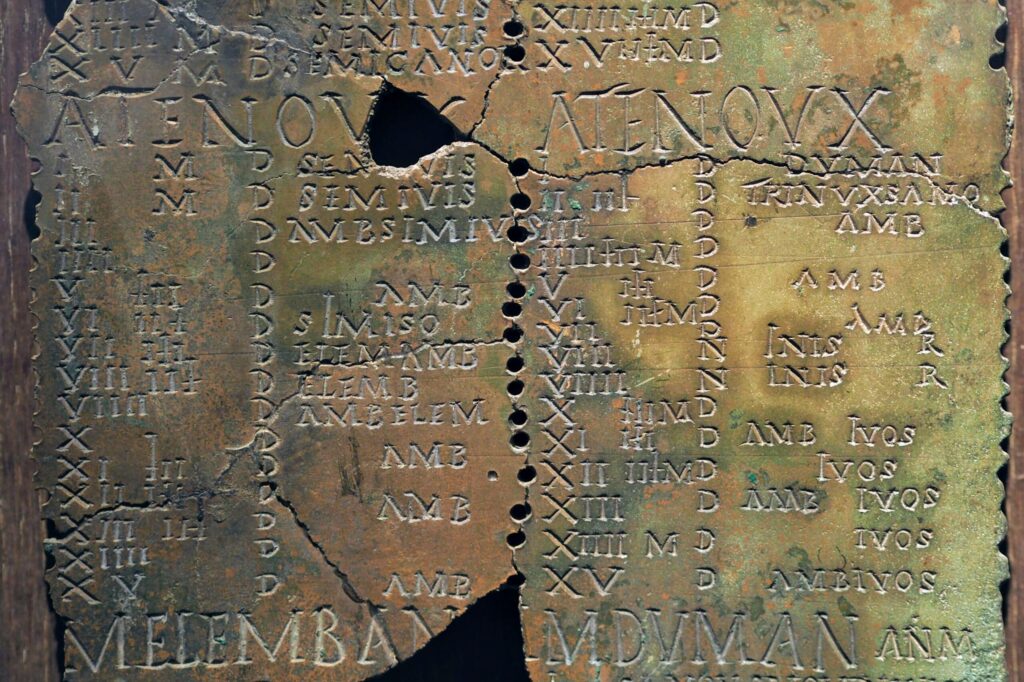
The language was written in several scripts depending on the region: Greek in the south, Etruscan in the north of Italy, and later Latin after the conquest. Inscriptions survive on coins, gravestones, dedications, and even curse tablets. The most remarkable artifact is the Coligny Calendar, a bronze lunar-solar calendar that shows the Gauls had a sophisticated system of reckoning time.
Words and Structure
From surviving inscriptions and Roman records, we know that Gaulish had a fully developed grammar with noun cases, flexible word order (often verb–subject–object), and vocabulary with strong Celtic roots. Examples include:
- rix = king (as in Vercingetorix, “great warrior king”)
- mapos = son (cognate with Welsh mab)
- epos = horse (related to Latin equus)
Gaulish words also live on in modern French. Everyday terms such as chemin (path), chêne (oak), and ardoise (slate) are believed to come from Gaulish roots. Place names like Paris (from the Parisii tribe) and Lyon (Lugdunum, “fort of the god Lugus”) also preserve this linguistic heritage.

The Fall of Gaulish and the Rise of Latin
After Julius Caesar’s conquest in the mid-1st century BCE, Latin quickly became the dominant language of administration, trade, and urban life. Gaulish retreated to rural areas but survived for centuries, likely until the 4th or 5th century CE. By then, it had been fully replaced by spoken Latin — the ancestor of French, Occitan, and other Romance languages.
This means that the descendants of Asterix and Obelix did not pass on their Celtic tongue. Instead, they adopted the speech of their conquerors, gradually transforming it into French.
What Would Asterix Sound Like in Gaulish?
For fun, linguists sometimes reconstruct Gaulish sentences based on the fragments we have. While these are hypothetical, they give us a glimpse of what the villagers in Asterix might have shouted.
- “Esus epos matīrīx!” – “By Esus, these Romans are crazy!” (Esus was a Gaulish god, epos = horse, used here like a mild curse; matīrīx = “very foolish” or “mad.”)
- “Nid anāman Rōmānos!” – “I don’t like the Romans!” (anāman = soul/spirit; “not pleasing to my soul.”)
- “Bitū mapon! Ambactos atrebos!” – “Life to the son! The warriors of the tribe!” (bitū = life, mapon = son, ambactos = servant/warrior, atrebos = tribe.)
These phrases are reconstructions, based on inscriptions and comparison with related Celtic languages like Old Irish and Welsh. They let us imagine a world where Asterix’s famous line “These Romans are crazy!” could have been uttered in the very language of the historical Gauls.

Asterix and the Breton Connection
Gaulish is long extinct, but its closest modern cousins are the Insular Celtic languages: Irish, Scottish Gaelic, Welsh, and Breton. Breton is particularly intriguing for Asterix fans because it is spoken in Brittany, the region where Uderzo and Goscinny set the comic’s village. However, Breton is not a direct descendant of Gaulish — it was brought from Britain during the Early Middle Ages.
If we imagine that Asterix and his villagers were speaking a Celtic language ancestral to Breton, the story gains an additional twist. In that alternate timeline, the villagers’ descendants might have resisted Latinization and preserved their Celtic tongue. The irony of the comic deepens: in reality, the Gauls lost their language to Rome, yet in the world of Asterix, the villagers’ words remain readable to us, while the historical struggle of Gaulish speakers is subtly referenced through puns, names, and reconstructed phrases.


When we open an Asterix album, the villagers of Armorica greet us in fluent French (or whichever language the comic is translated into). They outwit the Romans, resist occupation, and fiercely defend their independence. But history hides a striking irony: the Gauls of 50 BCE spoke Gaulish, a Celtic tongue, while French — the language we read in the albums — is a direct descendant of Latin, the language of their enemies.
This twist adds an unexpected depth to the world of Asterix. While the comics imagine a plucky band of Gauls defying Rome, the very language they use on the page is the ultimate proof that Rome won the cultural battle.
What Was Gaulish?
Gaulish was part of the Continental Celtic branch of the Indo-European family, closely related to Lepontic (northern Italy) and Celtiberian (Spain). It was spoken across most of ancient Gaul — modern France, Belgium, Luxembourg, Switzerland, and parts of northern Italy and Germany.
The language was written in several scripts depending on the region: Greek in the south, Etruscan in the north of Italy, and later Latin after the conquest. Inscriptions survive on coins, gravestones, dedications, and even curse tablets. The most remarkable artifact is the Coligny Calendar, a bronze lunar-solar calendar that shows the Gauls had a sophisticated system of reckoning time.
Words and Structure
From surviving inscriptions and Roman records, we know that Gaulish had a fully developed grammar with noun cases, flexible word order (often verb–subject–object), and vocabulary with strong Celtic roots. Examples include:
- rix = king (as in Vercingetorix, “great warrior king”)
- mapos = son (cognate with Welsh mab)
- epos = horse (related to Latin equus)
Gaulish words also live on in modern French. Everyday terms such as chemin (path), chêne (oak), and ardoise (slate) are believed to come from Gaulish roots. Place names like Paris (from the Parisii tribe) and Lyon (Lugdunum, “fort of the god Lugus”) also preserve this linguistic heritage.
The Fall of Gaulish and the Rise of Latin
After Julius Caesar’s conquest in the mid-1st century BCE, Latin quickly became the dominant language of administration, trade, and urban life. Gaulish retreated to rural areas but survived for centuries, likely until the 4th or 5th century CE. By then, it had been fully replaced by spoken Latin — the ancestor of French, Occitan, and other Romance languages.
This means that the descendants of Asterix and Obelix did not pass on their Celtic tongue. Instead, they adopted the speech of their conquerors, gradually transforming it into French.
What Would Asterix Sound Like in Gaulish?
For fun, linguists sometimes reconstruct Gaulish sentences based on the fragments we have. While these are hypothetical, they give us a glimpse of what the villagers in Asterix might have shouted.
- “Esus epos matīrīx!” – “By Esus, these Romans are crazy!” (Esus was a Gaulish god, epos = horse, used here like a mild curse; matīrīx = “very foolish” or “mad.”)
- “Nid anāman Rōmānos!” – “I don’t like the Romans!” (anāman = soul/spirit; “not pleasing to my soul.”)
- “Bitū mapon! Ambactos atrebos!” – “Life to the son! The warriors of the tribe!” (bitū = life, mapon = son, ambactos = servant/warrior, atrebos = tribe.)
These phrases are reconstructions, based on inscriptions and comparison with related Celtic languages like Old Irish and Welsh. They let us imagine a world where Asterix’s famous line “These Romans are crazy!” could have been uttered in the very language of the historical Gauls.
Asterix and the Breton Connection
Gaulish is long extinct, but its closest modern cousins are the Insular Celtic languages: Irish, Scottish Gaelic, Welsh, and Breton. Breton is particularly intriguing for Asterix fans because it is spoken in Brittany, the region where Uderzo and Goscinny set the comic’s village. However, Breton is not a direct descendant of Gaulish — it was brought from Britain during the Early Middle Ages.
If we imagine that Asterix and his villagers were speaking a Celtic language ancestral to Breton, the story gains an additional twist. In that alternate timeline, the villagers’ descendants might have resisted Latinization and preserved their Celtic tongue. The irony of the comic deepens: in reality, the Gauls lost their language to Rome, yet in the world of Asterix, the villagers’ words remain readable to us, while the historical struggle of Gaulish speakers is subtly referenced through puns, names, and reconstructed phrases.