Spanish (Castilian)

Spain, located in southwestern Europe, is bordered by Portugal, France, and the Atlantic Ocean. Its capital is Madrid, and it has a rich cultural history influenced by the Romans, Moors, and Catholic monarchs. Spain is known for its diverse regional identities, including Catalonia, the Basque Country, and Galicia. It was once the center of a global empire, influencing art, architecture, and language worldwide. Today, Spain is a constitutional monarchy and a member of the European Union.
Spanish Language
Spanish (Castilian) is a Romance language that evolved from Vulgar Latin after the Roman conquest of the Iberian Peninsula. It’s the official language of Spain and over 20 countries in Latin America. Spanish dialects vary by region, but Castilian Spanish (spoken in central and northern Spain) forms the basis of Standard Spanish. Differences between European and Latin American Spanish include pronunciation (e.g., “seseo” in Latin America) and vocabulary.
Castilian Spanish — The Language of Spain
Origins and History
Castilian Spanish, or simply Castilian (castellano), is the standard form of Spanish spoken in Spain. Its roots lie in the Kingdom of Castile in northern Spain during the Middle Ages, where it evolved from Vulgar Latin introduced during the Roman occupation of the Iberian Peninsula. Over centuries, Castilian absorbed influences from neighboring Iberian languages such as Leonese and Aragonese, as well as from Arabic during the centuries of Moorish rule. By the 13th century, it had become the administrative and literary language of Castile, and under the reign of the Catholic Monarchs, Ferdinand and Isabella, it spread as the dominant language throughout most of Spain.

The standardization of Castilian Spanish accelerated with the printing press and the publication of influential works such as Antonio de Nebrija’s Gramática de la lengua castellana in 1492, the first formal grammar of the Spanish language. This codified both spelling and grammatical norms, laying the foundation for modern Castilian Spanish. Over time, as Spain established overseas colonies, Castilian became the basis for all other varieties of Spanish, from Mexico to Argentina, though regional evolutions led to the distinct Latin American forms we know today.
Pronunciation and Phonetics
Castilian Spanish is characterized by several phonetic features that distinguish it from Latin American Spanish:
- Distinción: The letters c (before e or i) and z are pronounced as an interdental fricative, similar to the English “th” in think, while s is pronounced separately. This creates the familiar “th” sound for words like cielo (thee-lo) and zapato (tha-pa-to).
- Seseo vs. Ceceo: These features are generally absent in central and northern Spain, but in southern Andalusia, you may hear ceceo, where s, c, and z are merged differently.
- Yeísmo: In most of Spain, the letters ll and y are pronounced identically as /ʝ/; in some northern regions, a distinct pronunciation is maintained.
- Consonant articulation: Final consonants are usually pronounced clearly, and unstressed vowels tend to be fully articulated, giving Castilian Spanish its crisp, precise sound.
Grammar and Syntax
Castilian Spanish retains several grammatical features that set it apart from Latin American varieties:
- Second-person plural: Castilian uses vosotros for informal plural “you,” with its unique conjugations (vosotros habláis), whereas Latin American Spanish generally uses ustedes in all contexts.
- Pronouns: Subject pronouns can often be dropped due to verb conjugations indicating the subject, but in Castilian they are more regularly used than in some Latin American forms.
- Past tenses: The preterite is often preferred over the perfect in everyday speech in Spain (he comido vs. comí), though both forms exist.
- Vosotros forms: Verb conjugations and imperative forms for vosotros remain unique to Spain.
- Subjunctive and compound tenses: Castilian tends to preserve more nuanced uses of the subjunctive and past perfect than many Latin American variants.
Vocabulary
Castilian Spanish has lexical differences with Latin American Spanish, often in everyday objects, technology, and food:
- Car: coche (Spain) vs. carro/auto (Latin America)
- Computer: ordenador (Spain) vs. computadora (Latin America)
- Juice: zumo (Spain) vs. jugo (Latin America)
- Many slang expressions, idioms, and regional words are distinct, reflecting Spain’s internal diversity.
Geographical Spread
Castilian Spanish is the official language of Spain and is spoken by virtually all of its population, from Galicia to Andalusia, though with regional accents and dialectal variations. It is also taught worldwide as the “standard” Spanish, forming the basis of Spanish language courses and academic instruction. While Latin American Spanish dominates in the Western Hemisphere, Castilian Spanish remains influential in international media, literature, and formal communications, and travelers or students often encounter it as the “reference” variety.
Cultural Context
Castilian Spanish is more than grammar and pronunciation—it carries centuries of literature, theater, and poetry. From Don Quixote by Miguel de Cervantes to contemporary Spanish cinema and media, Castilian remains deeply tied to the identity, history, and cultural heritage of Spain. Its prestige as a literary and educational standard has made it the primary source for translations of global works into Spanish within Spain.
Asterix in Spanish
Asterix was first published in Spanish (Castilian) in 1965. Various publishers, including Bruguera, Ediciones Junior, Grijalbo-Dargaud, and Salvat, have released the series. Obelix’s catchphrase “¡Están locos estos romanos!” (“These Romans are crazy!”) has become widely recognized. Spanish editions are available in both regular and deluxe formats.
Dogmatix in Spain
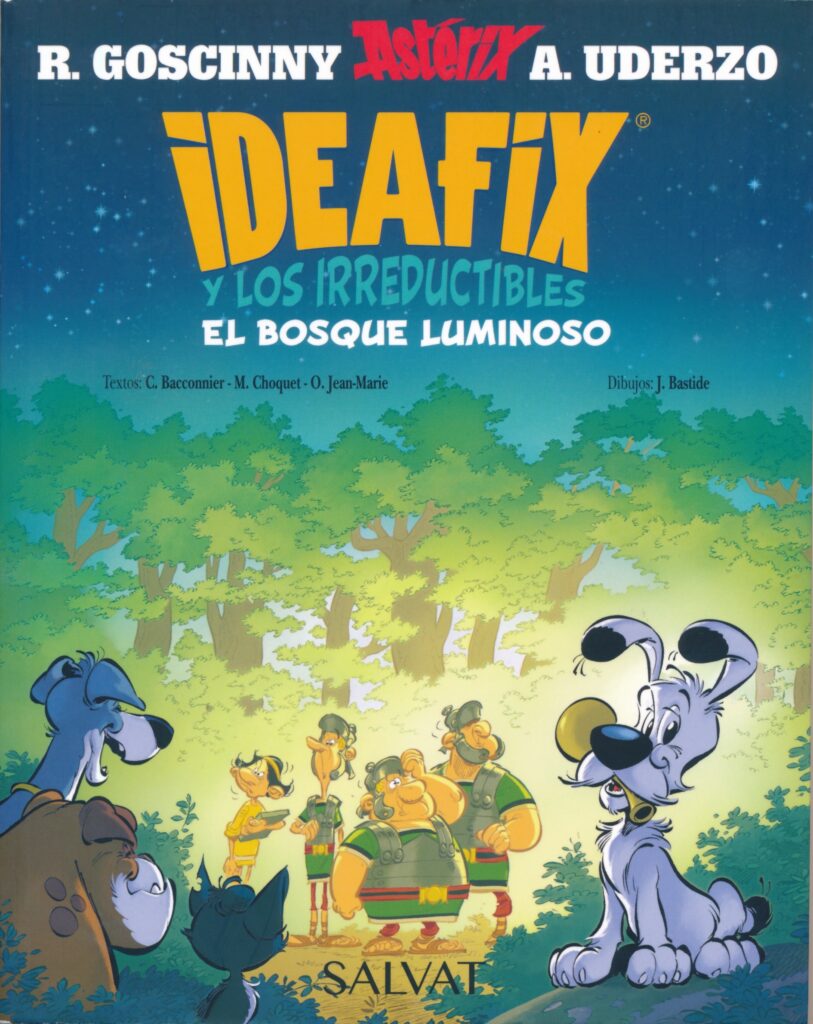
Dogmatix and the Indomitables series is available in Spanish as well. In Spain is name is Ideafix, which is closer to his original French name; Idéfix. The Spanish releases usually follow the French released quite fast. Since the albums are aimed mostly at younger children, they can be a great learning tool for those that want to learn Spanish. They are also released in the same, smaller, format as the French albums.