Hungarian
Hungary is a landlocked country in Central Europe, bordered by Austria, Slovakia, Ukraine, Romania, Serbia, Croatia, and Slovenia. It has a rich history that dates back to the Kingdom of Hungary, a medieval state that was a key player in European politics. The capital city, Budapest, is known for its stunning architecture, thermal baths, and vibrant cultural scene. Hungary is famous for its unique cuisine, with dishes like goulash and paprika-based recipes. The country also has a long tradition of music, arts, and literature.
The Hungarian Language
Hungarian, or Magyar, is the official language of Hungary and belongs to the Uralic language family, specifically the Finno-Ugric branch. This makes it fundamentally different from most of its European neighbors, which speak Indo-European languages. Its closest relatives are Mansi and Khanty, spoken in western Siberia, although these languages are geographically distant and mutually unintelligible with Hungarian today.
History and Distribution
Hungarian has been spoken in the Carpathian Basin for over a thousand years. The Magyars migrated to this region around the late 9th century, bringing their language with them. Over centuries, Hungarian absorbed loanwords from Slavic, German, Turkish, Latin, and more recently English, reflecting trade, political influence, and cultural contact. Today, Hungarian is spoken by around 13–15 million people, primarily in Hungary, with sizable Hungarian-speaking communities in Romania (Transylvania), Slovakia, Serbia, and Ukraine.
Writing System
Hungarian uses the Latin alphabet with a few additional letters and diacritics to represent its vowel-rich system. These include á, é, í, ó, ö, ő, ú, ü, ű. The language is highly phonetic, meaning words are generally pronounced as they are written, which makes reading straightforward once the diacritics are mastered.
Grammar and Vocabulary
Hungarian grammar is agglutinative, meaning that words are often formed by attaching multiple suffixes and prefixes to a root to express case, possession, number, tense, or mood. It has 18 grammatical cases, including for location, direction, possession, and instrument. Hungarian nouns do not have grammatical gender, unlike most European languages. Verbs conjugate according to person, number, tense, mood, and definiteness of the object. Word order is relatively flexible, though it is typically subject–verb–object, and emphasis is often indicated by word placement.
The vocabulary of Hungarian is largely native Finno-Ugric in origin, but thousands of loanwords exist from Slavic, German, Latin, Turkish, and English, reflecting the country’s long and diverse history of cultural contact.
Modern Role
Hungarian serves as the national language of Hungary, used in government, education, media, and literature. Its unique structure and vocabulary make it notably distinct from neighboring languages, yet it remains a vital, living language with a strong literary and cultural tradition. Hungarian-language media and literature flourish both within Hungary and in the surrounding regions where ethnic Hungarians reside, helping preserve linguistic and cultural identity.
Asterix in Hungarian
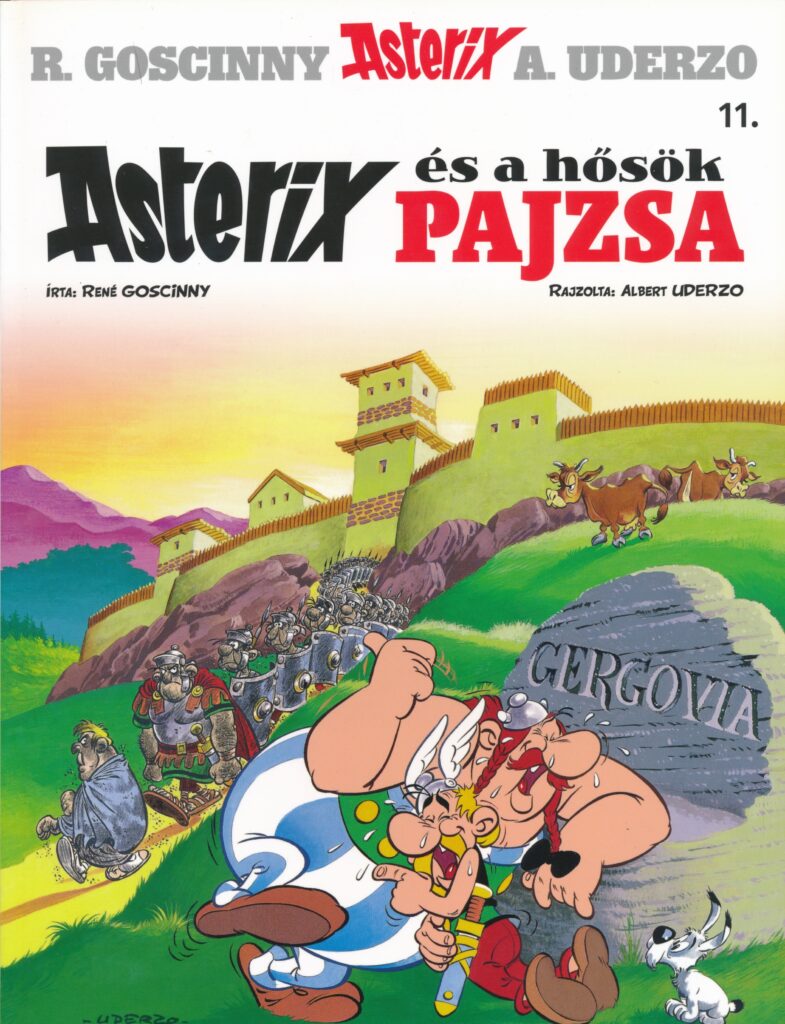
The Asterix series has been translated into Hungarian, with the first translation appearing in the 1970s. The Hungarian editions were initially published by the Yugoslav publisher Nip Forum, before being taken over by the Hungarian publisher Egmont Pannonia and later Móra Könyvkiadó. Over the years, most Asterix albums have been released in Hungary,