When Asterix in Corsica (Astérix en Corse) appeared in 1973, it was more than another adventure for the famous Gauls. It marked the end of an important chapter in the history of the series, took Asterix and Obelix to a politically sensitive destination, and introduced some of René Goscinny’s most entertaining references to French history and popular culture.
It was also a particularly personal album for Goscinny and Uderzo. For the first time, the two creators traveled to the location of an adventure specifically to prepare their story. What they discovered in Corsica changed their perception of the island and helped shape an album filled with affection, caricature, and unmistakably Corsican landscapes.
But there is much more to Asterix in Corsica than its familiar jokes about sleeping villagers, family feuds, and explosive cheese. Behind the story are references to Napoleon, French popular music, contemporary politics, and even the publishing history of Asterix itself.
A Special Place in the Asterix Series
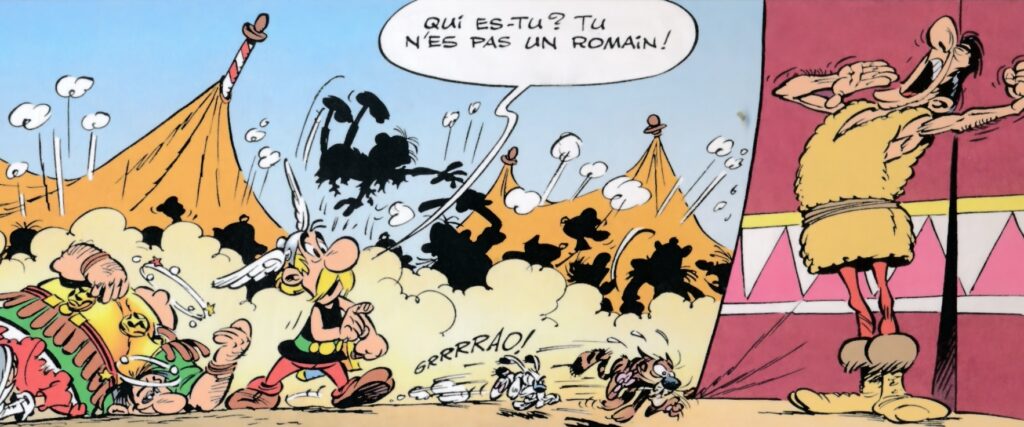
Corsica occupies an unusual position in the world of Asterix. Although the island is part of modern France, the album treats it much like the foreign countries visited in earlier adventures. This is already apparent from its title. Adventures beginning with Asterix in… generally take the heroes beyond Gaul, to places such as Britain, Spain, or Switzerland. Corsica receives the same treatment, despite being a French region.
There is another unusual detail. Instead of the familiar map of Gaul that normally introduces the adventures, readers are presented with a map of Corsica. It is a small change, but one that immediately gives the island a special status. The album also opens with something rarely seen in an Asterix adventure: a preface from the creators themselves.
Goscinny and Uderzo acknowledge that Corsicans have a reputation for being particularly sensitive about how their island is portrayed. Their introduction makes it clear that the story is intended as an affectionate caricature rather than an insult. This was not an entirely unnecessary precaution, as Corsica was experiencing considerable political tension when the album was being prepared.
The End of an Era for Pilote
For fourteen years, Asterix had been closely associated with the French comics magazine Pilote. The first adventure, Asterix the Gaul, began appearing in the magazine’s inaugural issue on 29 October 1959. From that moment, the little Gaul became one of its most recognizable characters, and the magazine remained the original home of the series throughout the 1960s and early 1970s.
Asterix in Corsica would become the final adventure to be serialized in Pilote before the series moved away from magazine serialization. Goscinny and Uderzo marked the occasion in an unusual way: instead of waiting until the final page for the traditional village banquet, they placed a large celebration at the beginning of the adventure.
And this was no ordinary banquet. Numerous characters from earlier albums return as guests, bringing together familiar faces from across the series. For longtime readers, the opening becomes a reunion with characters they had not seen for years. It is also a fitting farewell to the magazine where everything began.
The decision came at a time when producing Asterix had become increasingly demanding. Uderzo’s detailed artwork required an enormous amount of work, and the regular serialization schedule left little room for a break. Moving away from Pilote would eventually give the creators greater freedom over the production of future adventures.
Goscinny and Uderzo Discover Corsica

Before working on Asterix in Corsica, Goscinny and Uderzo had already sent their heroes to numerous countries. Yet they had generally relied on research, familiar cultural images, and their own imagination when creating these destinations. Corsica was different, as the two men decided to visit the island together before beginning work on the album.
Uderzo later recalled that their knowledge of Corsica had initially been rather limited. Like many people on the French mainland, they associated the island with proud inhabitants, quick tempers, and long-running family feuds. Their visit gave them a very different impression, and both creators were struck by the beauty of the island and the hospitality of the people they met.
The journey helped turn what could have been a simple collection of regional stereotypes into a much more affectionate portrait. Its influence is particularly noticeable in Uderzo’s drawings, where Corsica’s mountains, forests, rivers, and rocky landscapes receive an unusual amount of attention. The scenery is not merely a background for the characters but helps establish the atmosphere of the entire adventure.
Corsica in the Politically Troubled 1970s
When Asterix in Corsica began appearing in January 1973, the island was experiencing growing political unrest. Corsican regionalist and autonomist movements had become increasingly active during the preceding years. Some groups demanded greater recognition of Corsican identity and more control over local affairs, while others resorted to violence. Bomb attacks and political confrontations were already part of the island’s recent history.
Against this background, producing a comic adventure filled with jokes about Corsican customs was potentially controversial. Goscinny and Uderzo nevertheless chose to embrace familiar stereotypes rather than avoid them. The Corsicans in the album are proud, suspicious of outsiders, devoted to their families, and remarkably reluctant to interrupt their afternoon naps.
Their conversations can turn into arguments over matters that outsiders might consider trivial. Family rivalries seem capable of lasting indefinitely, while disputes are sometimes settled with rather more enthusiasm than diplomacy. Yet the Corsicans are never presented simply as fools. They are also courageous, independent, loyal to their communities, and determined to resist Roman authority. In that respect, they have quite a lot in common with the inhabitants of the little Gaulish village.
Elections and Ballot Boxes
One of the album’s political jokes concerns ballot boxes ending up in the sea. The gag plays on allegations of electoral fraud in Corsican politics, where accusations of ballot stuffing and manipulation had become part of the island’s political reputation. Goscinny transforms this sensitive subject into a visual joke that would have been especially recognizable to French readers familiar with the political controversies surrounding Corsica.
The Explosive Corsican Cheese
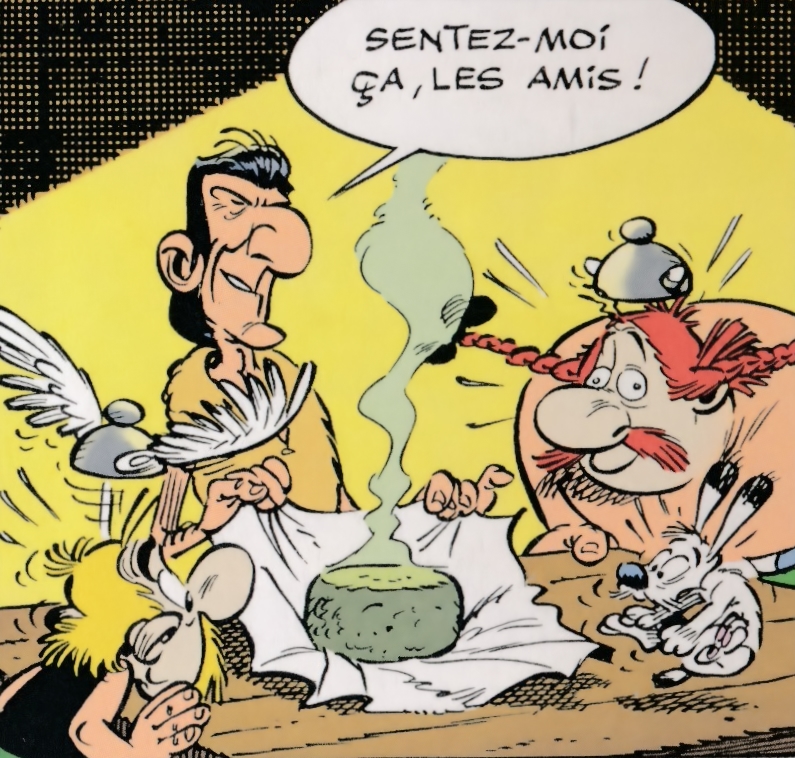
Another memorable joke involves the unfortunate pirates, whose ship is destroyed after they encounter an exceptionally powerful Corsican cheese. The joke works perfectly well without any historical background. Corsican cheeses have a reputation for strong smells, and the idea of one being powerful enough to destroy a ship is exactly the sort of exaggeration readers expect from Asterix. But in the political atmosphere of the early 1970s, an explosion aboard a ship also carried an additional association, giving the otherwise absurd explosion a possible contemporary resonance.
The Art of Doing Nothing
Perhaps the most persistent stereotype in the album concerns the Corsicans’ supposed love of rest. Goscinny takes this idea to ridiculous extremes, even allowing it to influence the local druid’s approach to his work. Rather than climbing a tree to collect mistletoe, he prefers to wait beneath it until the plant falls within reach. The joke is not simply that the Corsicans are lazy; their leisurely approach to life becomes almost a philosophy, particularly when contrasted with the Romans, who are constantly trying to organize, command, and control everything around them.
Napoleon Is Everywhere
One of the richest sources of humor in Asterix in Corsica is Napoleon Bonaparte. Born in Ajaccio in 1769, Napoleon remains the island’s most internationally famous historical figure, and Goscinny and Uderzo make sure that readers familiar with French history will recognize several references to him.
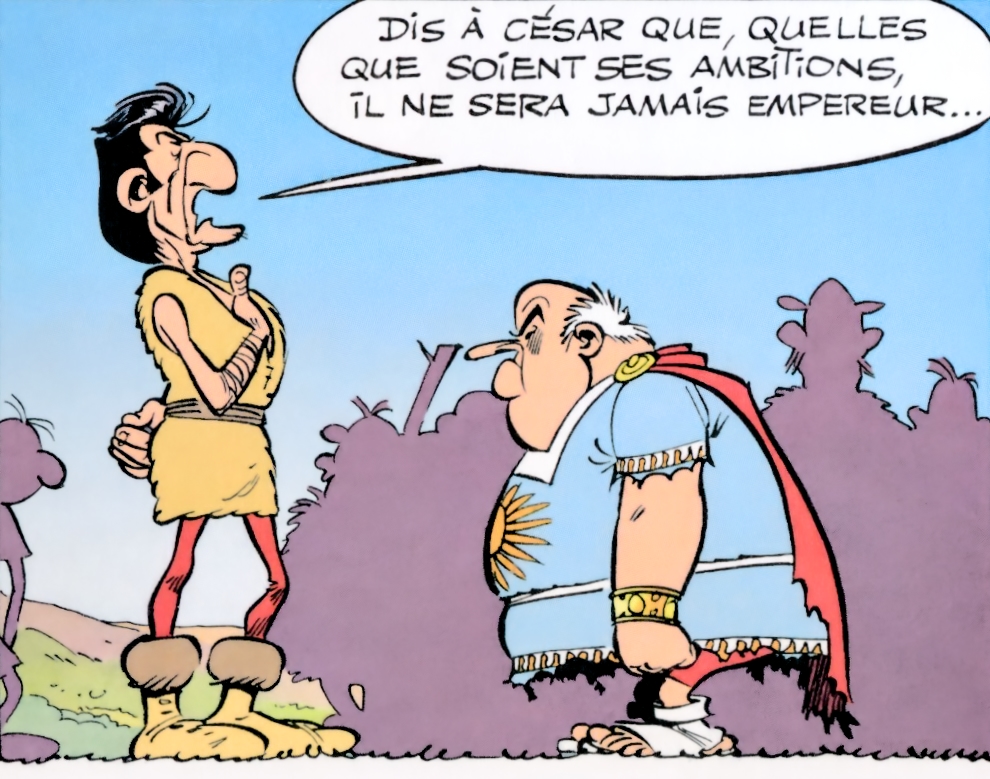
The most obvious is the appearance of the Corsican chieftain, Ocatarinetabellatchitchix. He is occasionally shown standing with one hand tucked inside his clothing, recalling the famous portraits of Napoleon. The gesture has become so closely associated with the emperor that it immediately suggests Napoleon, even though the story takes place more than eighteen centuries before his birth.
The Sleep of Osterlix
One particularly clever joke involves the expression le sommeil d’Osterlix. To understand it, readers need to recognize the French phrase le soleil d’Austerlitz, meaning “the sun of Austerlitz”. Austerlitz was the site of Napoleon’s celebrated victory over the Austrian and Russian armies on 2 December 1805. The expression became associated with Napoleon’s military success and entered French historical memory. Goscinny replaces the famous sun with sleep, an activity that the Corsicans in the album take extremely seriously.
Napoleon’s Grumbling Soldiers
Another Napoleonic reference appears in the description of the Corsican fighters as grognards. The French word grognardliterally refers to someone who grumbles or complains, but it was also the famous nickname given to the veteran soldiers of Napoleon’s Imperial Guard. Calling the Corsican warriors grognards works on two levels: they are certainly capable of grumbling, but the word also turns them into a miniature version of Napoleon’s legendary soldiers.
The Secret Behind Ocatarinetabellatchitchix
The Corsican chieftain has one of the longest and most entertaining names in the entire series, but Ocatarinetabellatchitchix is not simply a collection of amusing syllables. His name comes from a popular song associated with the Corsican singer Tino Rossi.
Rossi, born in Ajaccio in 1907, became one of France’s best-known singers during the twentieth century. One of the songs associated with him was Tchi-Tchi, which contains the words Ô Catarinetta bella, tchi-tchi. Goscinny transformed this musical phrase into the name of his Corsican chieftain. Throughout the adventure, Asterix struggles to remember the chieftain’s extraordinary name, at one point addressing him as Omarinella, another reference to a song associated with Tino Rossi.
These mistakes are not random. They form a running musical joke built around a singer whose name was closely connected with Corsica. This is also why the humor can be difficult to reproduce in translation. A reader who has never heard of Tino Rossi is unlikely to recognize the references, even if the translated names preserve their original sounds.
Pierre Tchernia Makes an Appearance
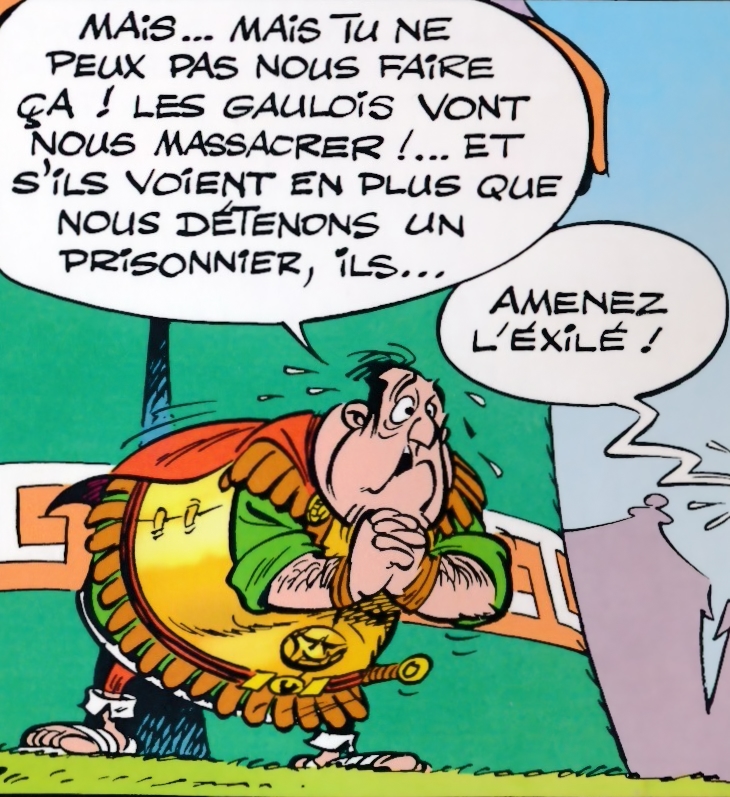
Another detail worth looking for is the appearance of French television personality Pierre Tchernia. Tchernia was a close friend of Goscinny and Uderzo and became a familiar presence in the world of Asterix. In Asterix in Corsica, he appears in the guise of a Roman centurion. For readers who recognize his face, the cameo adds another joke to a scene that is already amusing in its own right, and serves as a reminder of how closely connected the world of Asterix was to French television and cinema during the 1960s and 1970s.
Why Asterix in Corsica Is Worth Revisiting
Asterix in Corsica is an adventure that rewards a second reading. On the surface, it is a familiar story about Asterix and Obelix helping a proud people resist the Romans. But the album also reflects a particular moment in French history. It appeared during a period of political unrest in Corsica, marked the end of the series’ long association with Pilote, and drew inspiration from a journey that left a lasting impression on its creators. Its original French text also contains references that are not always apparent in translation, particularly the jokes involving Napoleon and Tino Rossi.
None of this is essential to enjoying the adventure, as the story works perfectly well without knowing the historical background. But recognizing these details reveals just how much Goscinny and Uderzo managed to fit into a single album.


When Asterix in Corsica (Astérix en Corse) appeared in 1973, it was more than another adventure for the famous Gauls. It marked the end of an important chapter in the history of the series, took Asterix and Obelix to a politically sensitive destination, and introduced some of René Goscinny’s most entertaining references to French history and popular culture.
It was also a particularly personal album for Goscinny and Uderzo. For the first time, the two creators traveled to the location of an adventure specifically to prepare their story. What they discovered in Corsica changed their perception of the island and helped shape an album filled with affection, caricature, and unmistakably Corsican landscapes.
But there is much more to Asterix in Corsica than its familiar jokes about sleeping villagers, family feuds, and explosive cheese. Behind the story are references to Napoleon, French popular music, contemporary politics, and even the publishing history of Asterix itself.
A Special Place in the Asterix Series
Corsica occupies an unusual position in the world of Asterix. Although the island is part of modern France, the album treats it much like the foreign countries visited in earlier adventures. This is already apparent from its title. Adventures beginning with Asterix in… generally take the heroes beyond Gaul, to places such as Britain, Spain, or Switzerland. Corsica receives the same treatment, despite being a French region.
There is another unusual detail. Instead of the familiar map of Gaul that normally introduces the adventures, readers are presented with a map of Corsica. It is a small change, but one that immediately gives the island a special status. The album also opens with something rarely seen in an Asterix adventure: a preface from the creators themselves.
Goscinny and Uderzo acknowledge that Corsicans have a reputation for being particularly sensitive about how their island is portrayed. Their introduction makes it clear that the story is intended as an affectionate caricature rather than an insult. This was not an entirely unnecessary precaution, as Corsica was experiencing considerable political tension when the album was being prepared.
The End of an Era for Pilote
For fourteen years, Asterix had been closely associated with the French comics magazine Pilote. The first adventure, Asterix the Gaul, began appearing in the magazine’s inaugural issue on 29 October 1959. From that moment, the little Gaul became one of its most recognizable characters, and the magazine remained the original home of the series throughout the 1960s and early 1970s.
Asterix in Corsica would become the final adventure to be serialized in Pilote before the series moved away from magazine serialization. Goscinny and Uderzo marked the occasion in an unusual way: instead of waiting until the final page for the traditional village banquet, they placed a large celebration at the beginning of the adventure.
And this was no ordinary banquet. Numerous characters from earlier albums return as guests, bringing together familiar faces from across the series. For longtime readers, the opening becomes a reunion with characters they had not seen for years. It is also a fitting farewell to the magazine where everything began.
The decision came at a time when producing Asterix had become increasingly demanding. Uderzo’s detailed artwork required an enormous amount of work, and the regular serialization schedule left little room for a break. Moving away from Pilote would eventually give the creators greater freedom over the production of future adventures.
Goscinny and Uderzo Discover Corsica
Before working on Asterix in Corsica, Goscinny and Uderzo had already sent their heroes to numerous countries. Yet they had generally relied on research, familiar cultural images, and their own imagination when creating these destinations. Corsica was different, as the two men decided to visit the island together before beginning work on the album.
Uderzo later recalled that their knowledge of Corsica had initially been rather limited. Like many people on the French mainland, they associated the island with proud inhabitants, quick tempers, and long-running family feuds. Their visit gave them a very different impression, and both creators were struck by the beauty of the island and the hospitality of the people they met.
The journey helped turn what could have been a simple collection of regional stereotypes into a much more affectionate portrait. Its influence is particularly noticeable in Uderzo’s drawings, where Corsica’s mountains, forests, rivers, and rocky landscapes receive an unusual amount of attention. The scenery is not merely a background for the characters but helps establish the atmosphere of the entire adventure.
Corsica in the Politically Troubled 1970s
When Asterix in Corsica began appearing in January 1973, the island was experiencing growing political unrest. Corsican regionalist and autonomist movements had become increasingly active during the preceding years. Some groups demanded greater recognition of Corsican identity and more control over local affairs, while others resorted to violence. Bomb attacks and political confrontations were already part of the island’s recent history.
Against this background, producing a comic adventure filled with jokes about Corsican customs was potentially controversial. Goscinny and Uderzo nevertheless chose to embrace familiar stereotypes rather than avoid them. The Corsicans in the album are proud, suspicious of outsiders, devoted to their families, and remarkably reluctant to interrupt their afternoon naps.
Their conversations can turn into arguments over matters that outsiders might consider trivial. Family rivalries seem capable of lasting indefinitely, while disputes are sometimes settled with rather more enthusiasm than diplomacy. Yet the Corsicans are never presented simply as fools. They are also courageous, independent, loyal to their communities, and determined to resist Roman authority. In that respect, they have quite a lot in common with the inhabitants of the little Gaulish village.
Elections and Ballot Boxes
One of the album’s political jokes concerns ballot boxes ending up in the sea. The gag plays on allegations of electoral fraud in Corsican politics, where accusations of ballot stuffing and manipulation had become part of the island’s political reputation. Goscinny transforms this sensitive subject into a visual joke that would have been especially recognizable to French readers familiar with the political controversies surrounding Corsica.
The Explosive Corsican Cheese
Another memorable joke involves the unfortunate pirates, whose ship is destroyed after they encounter an exceptionally powerful Corsican cheese. The joke works perfectly well without any historical background. Corsican cheeses have a reputation for strong smells, and the idea of one being powerful enough to destroy a ship is exactly the sort of exaggeration readers expect from Asterix. But in the political atmosphere of the early 1970s, an explosion aboard a ship also carried an additional association, giving the otherwise absurd explosion a possible contemporary resonance.
The Art of Doing Nothing
Perhaps the most persistent stereotype in the album concerns the Corsicans’ supposed love of rest. Goscinny takes this idea to ridiculous extremes, even allowing it to influence the local druid’s approach to his work. Rather than climbing a tree to collect mistletoe, he prefers to wait beneath it until the plant falls within reach. The joke is not simply that the Corsicans are lazy; their leisurely approach to life becomes almost a philosophy, particularly when contrasted with the Romans, who are constantly trying to organize, command, and control everything around them.
Napoleon Is Everywhere
One of the richest sources of humor in Asterix in Corsica is Napoleon Bonaparte. Born in Ajaccio in 1769, Napoleon remains the island’s most internationally famous historical figure, and Goscinny and Uderzo make sure that readers familiar with French history will recognize several references to him.
The most obvious is the appearance of the Corsican chieftain, Ocatarinetabellatchitchix. He is occasionally shown standing with one hand tucked inside his clothing, recalling the famous portraits of Napoleon. The gesture has become so closely associated with the emperor that it immediately suggests Napoleon, even though the story takes place more than eighteen centuries before his birth.
The Sleep of Osterlix
One particularly clever joke involves the expression le sommeil d’Osterlix. To understand it, readers need to recognize the French phrase le soleil d’Austerlitz, meaning “the sun of Austerlitz”. Austerlitz was the site of Napoleon’s celebrated victory over the Austrian and Russian armies on 2 December 1805. The expression became associated with Napoleon’s military success and entered French historical memory. Goscinny replaces the famous sun with sleep, an activity that the Corsicans in the album take extremely seriously.
Napoleon’s Grumbling Soldiers
Another Napoleonic reference appears in the description of the Corsican fighters as grognards. The French word grognardliterally refers to someone who grumbles or complains, but it was also the famous nickname given to the veteran soldiers of Napoleon’s Imperial Guard. Calling the Corsican warriors grognards works on two levels: they are certainly capable of grumbling, but the word also turns them into a miniature version of Napoleon’s legendary soldiers.
The Secret Behind Ocatarinetabellatchitchix
The Corsican chieftain has one of the longest and most entertaining names in the entire series, but Ocatarinetabellatchitchix is not simply a collection of amusing syllables. His name comes from a popular song associated with the Corsican singer Tino Rossi.
Rossi, born in Ajaccio in 1907, became one of France’s best-known singers during the twentieth century. One of the songs associated with him was Tchi-Tchi, which contains the words Ô Catarinetta bella, tchi-tchi. Goscinny transformed this musical phrase into the name of his Corsican chieftain. Throughout the adventure, Asterix struggles to remember the chieftain’s extraordinary name, at one point addressing him as Omarinella, another reference to a song associated with Tino Rossi.
These mistakes are not random. They form a running musical joke built around a singer whose name was closely connected with Corsica. This is also why the humor can be difficult to reproduce in translation. A reader who has never heard of Tino Rossi is unlikely to recognize the references, even if the translated names preserve their original sounds.
Pierre Tchernia Makes an Appearance
Another detail worth looking for is the appearance of French television personality Pierre Tchernia. Tchernia was a close friend of Goscinny and Uderzo and became a familiar presence in the world of Asterix. In Asterix in Corsica, he appears in the guise of a Roman centurion. For readers who recognize his face, the cameo adds another joke to a scene that is already amusing in its own right, and serves as a reminder of how closely connected the world of Asterix was to French television and cinema during the 1960s and 1970s.
Why Asterix in Corsica Is Worth Revisiting
Asterix in Corsica is an adventure that rewards a second reading. On the surface, it is a familiar story about Asterix and Obelix helping a proud people resist the Romans. But the album also reflects a particular moment in French history. It appeared during a period of political unrest in Corsica, marked the end of the series’ long association with Pilote, and drew inspiration from a journey that left a lasting impression on its creators. Its original French text also contains references that are not always apparent in translation, particularly the jokes involving Napoleon and Tino Rossi.
None of this is essential to enjoying the adventure, as the story works perfectly well without knowing the historical background. But recognizing these details reveals just how much Goscinny and Uderzo managed to fit into a single album.