Le Devin (The Soothsayer) turns a simple comic premise into a satire of human credulity. Published in 1972 after its serialization in Pilote, the nineteenth adventure follows Prolix, a fraudulent soothsayer. He discovers that the easiest way to manipulate people is not to predict the future, but to tell them what they want to believe.
Reading the Audience and the Art of Superstition
Prolix operates as an observant confidence trickster. He identifies Obelix’s vanity and Mrs. Geriatrix’s desire for excitement and romantic attention. By exploiting the fear generated by a violent storm, he finds an unusually receptive audience, demonstrating how readily people embrace deception when it offers them comfort and validation.
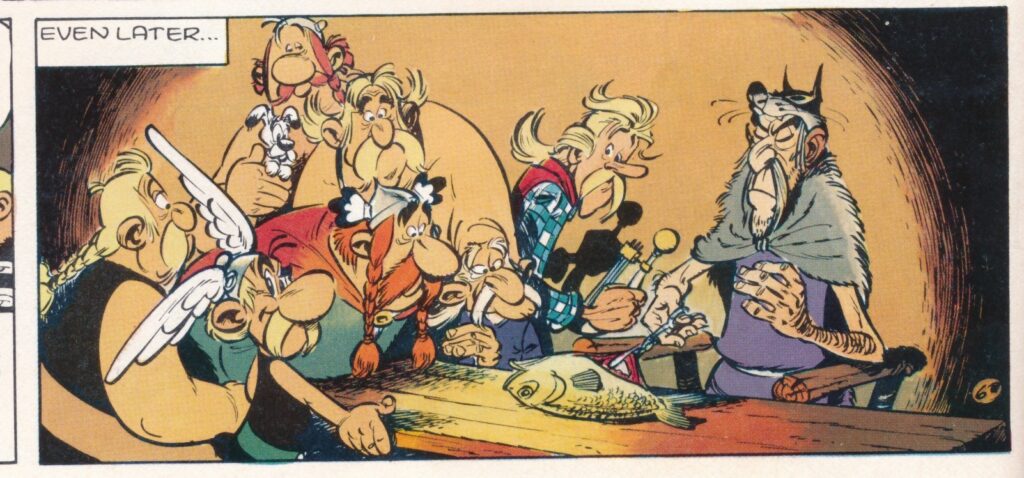
This credulity reaches its visual peak on page 10. The scene is a parody of Rembrandt’s 1632 masterpiece, The Anatomy Lesson of Dr. Nicolaes Tulp, an allusion that has been noted by both the official Astérix site and the Cité internationale de la bande dessinée. Where Rembrandt’s painting depicts an expert examining a physical body to produce rational scientific knowledge, Uderzo transforms the scene into a charlatan examining fish entrails to perform the theater of superstition.
René Goscinny’s script reinforces the theme of “reading” through layers of sophisticated linguistic humor that conflate ancient divination with modern print media.
A Note on Translation: The following examples are based on the original French text; some of this intricate wordplay is necessarily altered or lost in international translations.
- La Lecture (Reading): Purchasing fish for “de la lecture” jokes about the mid-20th-century practice of fishmongers wrapping goods in newspapers, placing Prolix in a scene where he reads entrails while the Gauls read the “news.”
- Frais (Fresh): Expanding on the fishmonger joke, the Gauls complain that the fish isn’t frais (fresh). This immediately prompts a double entendre about the prophecies and information in the village not being of the “utmost freshness” (recent news).
- Tirée (Drawn/Printed): When asked if he can read the future in ale, Prolix says it is highly legible if it is “bien tirée.” The phrase evokes beer being properly drawn from the barrel while also playing on the language of printing and tirage. In context, Prolix’s claim that the resulting ‘text’ is easy to read extends the joke from pulling a drink to producing readable print.
- Dévorer (To Devour): Obelix claims he doesn’t read; instead, he “devours” (dévore). Goscinny subverts a common literary metaphor—to “devour” a book avidly—by having Obelix apply it with literal, gastronomic gluttony.
- Les Farces (Stuffing/Comedy): Upon finding a prepared goose devoid of entrails, Prolix notes he enjoys reading “les farces”—capitalizing on the French word meaning culinary stuffing, a practical joke, and a comedic theatrical play.
- Plauter (To Flirt Theatrically): When Obelix develops a crush, Asterix reprimands him by inventing the verb plauter. This literate nod to the Roman comedic playwright Plautus parodies the real French verb marivauder (to engage in delicate, theatrical flirtation).
- Grands Airs (Grand Airs / The Letter ‘R’): In a brilliant phonetic pun, the pirate Baba—who famously has a speech impediment that prevents him from pronouncing the letter ‘R’—is told to “laisse tomber tes grands airs” (drop your grand airs). In French, “airs” is pronounced identically to the letter “R,” which Baba has literally dropped from his vocabulary.
Mustard?
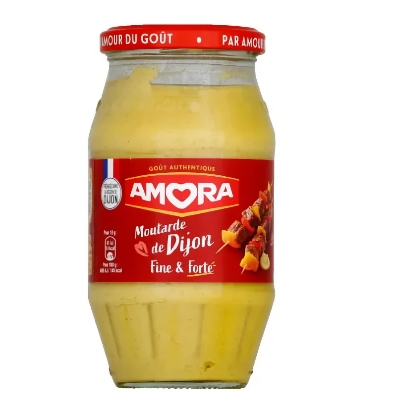
The French original of Le Devin features a clever reference to a fictitious deity named Amora, the “goddess of mustard”. This modern consumer reference nods to what was then a highly recognizable French mustard brand. Goscinny invented this specific goddess to set up a classic French idiom, noting that she “rose to the noses of the other gods”. This is a literal play on the phrase la moutarde lui monte au nez, which translates to losing one’s temper or becoming angry. Goscinny then layers the joke further by expanding on the verb monter (to rise), having Asterix quip about people doing anything to “get higher up”. Because this humor relies so heavily on a French idiom and a domestic brand, it presents a unique challenge for international editions.
The Dutch translation retains the name Amora but alters her domain to the “goddess of foam,” playing on the imagery of having foam on the lips in a fit of rage.
Meanwhile, the German version takes a highly inventive approach by introducing a completely different fictional deity: “Peperona,” the goddess of pepper, who has “irritated” the other gods.
Women, Marriage, and a Changing France

Le Devin appeared at a moment when the legal and social position of French women was changing rapidly. The 1965 reform of matrimonial law had allowed married women to work without permission, open bank accounts, and exercise greater control over their own property. Against this background, the portrayal of the female characters can be read as part of a broader contemporary conversation about women’s autonomy.
Impedimenta’s dissatisfaction recalls the literary type of the frustrated provincial bourgeois woman familiar from nineteenth-century French fiction, most obviously Flaubert’s Madame Bovary. The album culminates in a comic reversal of its gender hierarchy: the women partake in the magic potion and gain the same extraordinary physical strength as the men, becoming active participants in the village’s counterattack.
A Modern World Disguised as Ancient Gaul
The comic weaves in contemporary pop culture, including a parallel goddess named Amora, whose name evokes the French mustard brand Amora and the expression la moutarde lui monte au nez (‘the mustard rises to his nose’), meaning that someone is becoming angry. Furthermore, a visual representation of the “future” on page 17 reportedly features a drawing of the country house Uderzo had recently built. Ultimately, Le Devin works because Prolix never needs genuine supernatural powers. His real ability is observation.


Le Devin (The Soothsayer) turns a simple comic premise into a satire of human credulity. Published in 1972 after its serialization in Pilote, the nineteenth adventure follows Prolix, a fraudulent soothsayer. He discovers that the easiest way to manipulate people is not to predict the future, but to tell them what they want to believe.
Reading the Audience and the Art of Superstition
Prolix operates as an observant confidence trickster. He identifies Obelix’s vanity and Mrs. Geriatrix’s desire for excitement and romantic attention. By exploiting the fear generated by a violent storm, he finds an unusually receptive audience, demonstrating how readily people embrace deception when it offers them comfort and validation.
This credulity reaches its visual peak on page 10. The scene is a parody of Rembrandt’s 1632 masterpiece, The Anatomy Lesson of Dr. Nicolaes Tulp, an allusion that has been noted by both the official Astérix site and the Cité internationale de la bande dessinée. Where Rembrandt’s painting depicts an expert examining a physical body to produce rational scientific knowledge, Uderzo transforms the scene into a charlatan examining fish entrails to perform the theater of superstition.
René Goscinny’s script reinforces the theme of “reading” through layers of sophisticated linguistic humor that conflate ancient divination with modern print media.
A Note on Translation: The following examples are based on the original French text; some of this intricate wordplay is necessarily altered or lost in international translations.
- La Lecture (Reading): Purchasing fish for “de la lecture” jokes about the mid-20th-century practice of fishmongers wrapping goods in newspapers, placing Prolix in a scene where he reads entrails while the Gauls read the “news.”
- Frais (Fresh): Expanding on the fishmonger joke, the Gauls complain that the fish isn’t frais (fresh). This immediately prompts a double entendre about the prophecies and information in the village not being of the “utmost freshness” (recent news).
- Tirée (Drawn/Printed): When asked if he can read the future in ale, Prolix says it is highly legible if it is “bien tirée.” The phrase evokes beer being properly drawn from the barrel while also playing on the language of printing and tirage. In context, Prolix’s claim that the resulting ‘text’ is easy to read extends the joke from pulling a drink to producing readable print.
- Dévorer (To Devour): Obelix claims he doesn’t read; instead, he “devours” (dévore). Goscinny subverts a common literary metaphor—to “devour” a book avidly—by having Obelix apply it with literal, gastronomic gluttony.
- Les Farces (Stuffing/Comedy): Upon finding a prepared goose devoid of entrails, Prolix notes he enjoys reading “les farces”—capitalizing on the French word meaning culinary stuffing, a practical joke, and a comedic theatrical play.
- Plauter (To Flirt Theatrically): When Obelix develops a crush, Asterix reprimands him by inventing the verb plauter. This literate nod to the Roman comedic playwright Plautus parodies the real French verb marivauder (to engage in delicate, theatrical flirtation).
- Grands Airs (Grand Airs / The Letter ‘R’): In a brilliant phonetic pun, the pirate Baba—who famously has a speech impediment that prevents him from pronouncing the letter ‘R’—is told to “laisse tomber tes grands airs” (drop your grand airs). In French, “airs” is pronounced identically to the letter “R,” which Baba has literally dropped from his vocabulary.
Mustard?
The French original of Le Devin features a clever reference to a fictitious deity named Amora, the “goddess of mustard”. This modern consumer reference nods to what was then a highly recognizable French mustard brand. Goscinny invented this specific goddess to set up a classic French idiom, noting that she “rose to the noses of the other gods”. This is a literal play on the phrase la moutarde lui monte au nez, which translates to losing one’s temper or becoming angry. Goscinny then layers the joke further by expanding on the verb monter (to rise), having Asterix quip about people doing anything to “get higher up”. Because this humor relies so heavily on a French idiom and a domestic brand, it presents a unique challenge for international editions.
The Dutch translation retains the name Amora but alters her domain to the “goddess of foam,” playing on the imagery of having foam on the lips in a fit of rage.
Meanwhile, the German version takes a highly inventive approach by introducing a completely different fictional deity: “Peperona,” the goddess of pepper, who has “irritated” the other gods.
Women, Marriage, and a Changing France
Le Devin appeared at a moment when the legal and social position of French women was changing rapidly. The 1965 reform of matrimonial law had allowed married women to work without permission, open bank accounts, and exercise greater control over their own property. Against this background, the portrayal of the female characters can be read as part of a broader contemporary conversation about women’s autonomy.
Impedimenta’s dissatisfaction recalls the literary type of the frustrated provincial bourgeois woman familiar from nineteenth-century French fiction, most obviously Flaubert’s Madame Bovary. The album culminates in a comic reversal of its gender hierarchy: the women partake in the magic potion and gain the same extraordinary physical strength as the men, becoming active participants in the village’s counterattack.
A Modern World Disguised as Ancient Gaul
The comic weaves in contemporary pop culture, including a parallel goddess named Amora, whose name evokes the French mustard brand Amora and the expression la moutarde lui monte au nez (‘the mustard rises to his nose’), meaning that someone is becoming angry. Furthermore, a visual representation of the “future” on page 17 reportedly features a drawing of the country house Uderzo had recently built. Ultimately, Le Devin works because Prolix never needs genuine supernatural powers. His real ability is observation.