Published in 1972, Asterix and the Laurel Wreath (Les Lauriers de César) is the 18th Asterix album and one of the series’ most entertaining journeys into Roman society.
The story begins with a drunken boast. After a particularly heavy drinking session, Abraracourcix (Vitalstatistix) gets into an argument with his brother-in-law Homéopatix (Homeopathix), a wealthy and rather smug businessman from Lutetia. In a moment of misplaced confidence, the village chief promises that he can serve Homéopatix a meal seasoned with Julius Caesar’s own laurel wreath.
There is just one small problem: the wreath is in Rome.
So Asterix and Obelix are sent on a mission to steal it.
What follows is much more than another trip to the Roman capital. Goscinny and Uderzo fill the album with jokes about modern life, from traffic jams and changing family relationships to consumerism, social climbing and the frustrations of everyday bureaucracy. As usual, much of the humour becomes even more interesting when you look at what is happening behind the drawings and the English translation.
Rome: Ancient City, Modern Problems
The Rome of Asterix and the Laurel Wreath looks remarkably familiar.
One of the most obvious jokes is the city’s traffic. Ancient Rome is presented as a place suffering from congestion, crowded roads and too many vehicles. This was hardly an accidental choice in a comic published in 1972.
France in the 1960s and early 1970s was experiencing a rapid expansion of car ownership, while Paris was being reshaped around the automobile. President Georges Pompidou was famously enthusiastic about making the capital more suitable for cars. Goscinny therefore had a very contemporary target available to him: simply put modern traffic problems into ancient Rome.
The joke works because Uderzo does not need to explain it. Roman chariots take the place of modern cars, but the frustration is instantly recognisable.
And that is one of the recurring tricks of the Asterix series. The Romans may be wearing togas and travelling by chariot, but they often behave exactly like people living in modern France.
The Roman Family
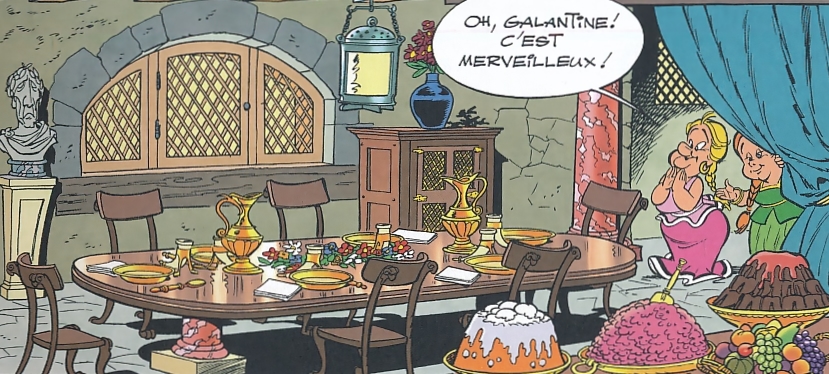
Another particularly modern element appears in the Roman household of Claudius Quiquilfus and his son Gracchus.
The younger generation is presented as rebellious, carefree and rather less interested in following the rules than his father would like. The joke fits neatly into the generational tensions that had become increasingly visible in France during the 1960s, particularly around the events of May 1968.
The album even contains a wonderfully recognisable piece of revolutionary graffiti:
interdit d’interdire — “it is forbidden to forbid.”
The phrase had become one of the best-known slogans associated with the events of May 1968. Putting it on a Roman wall turns a very recent political slogan into an apparently ancient piece of graffiti.
This is typical Goscinny. The joke is not simply that the Romans are behaving like modern people. The humour comes from taking something unmistakably contemporary and pretending that it has always existed.
Homéopatix and the Rise of the Beauf
Homéopatix is another character who feels distinctly modern.
Abraracourcix’s brother-in-law is wealthy, successful and very proud of it. His possessions and social position are important to him, and he has little hesitation in reminding everyone else of his success.
Through Homéopatix, Goscinny pokes fun at the nouveaux riches: people whose newly acquired wealth becomes a source of social status and personal pride.
The character also fits into a broader stereotype that became increasingly familiar in French popular culture: the beauf. The word is difficult to translate precisely, but it describes a stereotypically vulgar, smug or socially pretentious middle-class man who takes considerable pride in his material success.
The joke becomes even better because Homéopatix is not merely rich. He is rich in a way that irritates Abraracourcix.
That gives the story its central motivation. The quest for Caesar’s laurel wreath is essentially the result of one man’s inability to admit that his brother-in-law might have something he does not.
Uderzo’s Rome
The album also gives Albert Uderzo an excellent opportunity to draw Rome.
The journey takes the characters through very different parts of the city, from impressive public buildings and wealthy Roman interiors to the less glamorous world of taverns, slave markets and underground passages.
Uderzo was particularly good at turning a historically inspired setting into a playground for visual jokes. His Rome looks sufficiently monumental to evoke the ancient capital, but it is also packed with recognisable details and exaggerated characters.
The drawings were not created in a historical vacuum. Goscinny and Uderzo regularly consulted historical material when constructing the Roman world of Asterix, and the work of French historian Jérôme Carcopino was among the sources used for details of Roman daily life.
The result is not intended to be a historically accurate reconstruction of Rome. Instead, Uderzo takes genuine Roman features and combines them with modern visual references.
That mixture is precisely what makes the setting work.
Uderzo’s Recycled Panels
There is another detail that is easy to miss when reading the album casually: Uderzo sometimes reused drawings.
This was not unusual in comics, where artists had to work under considerable production pressure, but Uderzo’s reuse can also become part of the visual humour.
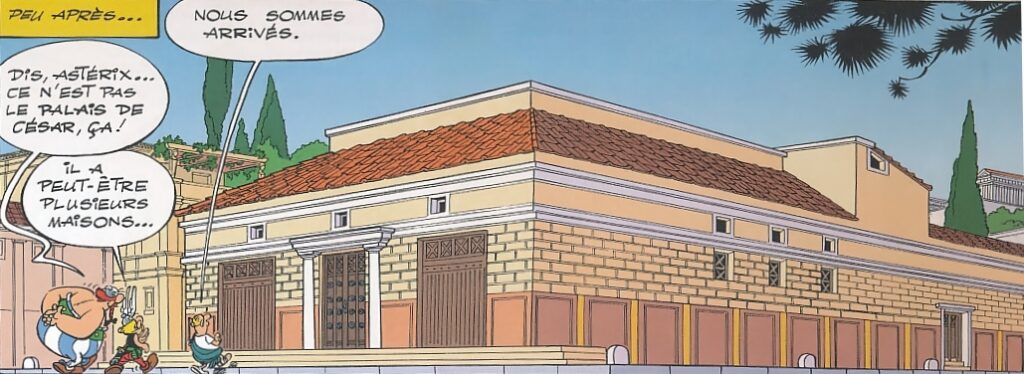
For example, the establishing view of Caesar’s palace first appears early in the story and is subsequently reused. The Roman domus introduced later in the album also appears again, with changes to the surroundings and inking helping to establish a different moment.
One of the most obvious examples comes during the hangover sequence.
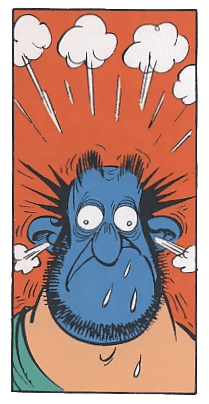
A single drawing of a character suffering the effects of Asterix’s extraordinarily powerful remedy is repeated several times. Rather than creating an entirely new drawing for every panel, Uderzo changes the colouring of the face to make the character look progressively worse.
The repetition itself becomes part of the joke.
This is worth looking out for throughout the Asterix albums. Uderzo’s artwork can be extraordinarily detailed, but that does not mean every panel was drawn completely from scratch. Reusing artwork was one of the practical techniques that allowed him to produce such visually rich albums.
Farpaitement: A Word Is Born
For readers of the original French edition, one of the most memorable jokes in the album comes from Abraracourcix’s drinking.
When the chief is drunk, he has trouble pronouncing parfaitement, meaning “perfectly” or “absolutely”. His slurred version, farpaitement, became one of the memorable linguistic jokes associated with the album.
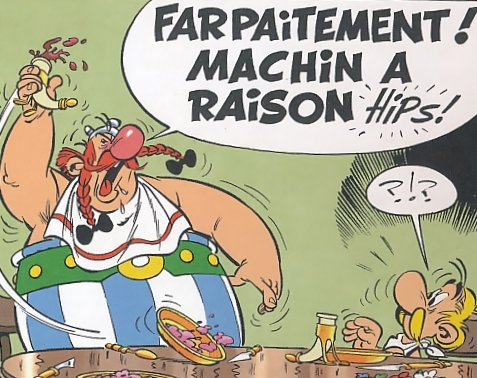
And there is an interesting twist: farpaitement did not necessarily remain confined to the pages of Asterix. The expression entered French popular usage as a humorous way of imitating drunken or deliberately distorted speech.
The English translators had an equally difficult problem. How do you translate a joke based on the sound of a French word?
Their solution was not to translate farpaitement literally, but to create an equivalent joke: “Zigackly”, a drunken corruption of “exactly.”
That is a good example of why translating Asterix is so difficult. The translator is not simply translating what a character says. They often have to invent a new joke that produces the same effect in another language.
When the Chains Become a Pun
Goscinny also likes to build jokes around French expressions.
At one point, the slave trade provides the opportunity for a particularly dark piece of wordplay. A slave trader describes his business as something other than travail à la chaîne — literally “chain work” or assembly-line work.
The expression normally refers to repetitive industrial labour. But in the world of Roman slavery, chaîne can suddenly acquire a much more literal meaning: the enslaved people are actually wearing chains.
Another joke comes when Asterix declares that they will vendre chèrement leur vie — literally “sell their lives dearly”, a French expression meaning that they will fight fiercely rather than surrender.
Obelix, however, is not impressed by the metaphor.
As slaves who have already been bought and sold, their lives have, quite literally, already been sold.
It is the sort of joke that is easy to lose in translation because the humour depends on the double meaning of an established French expression.
Boars, Pigs and Cochonneries
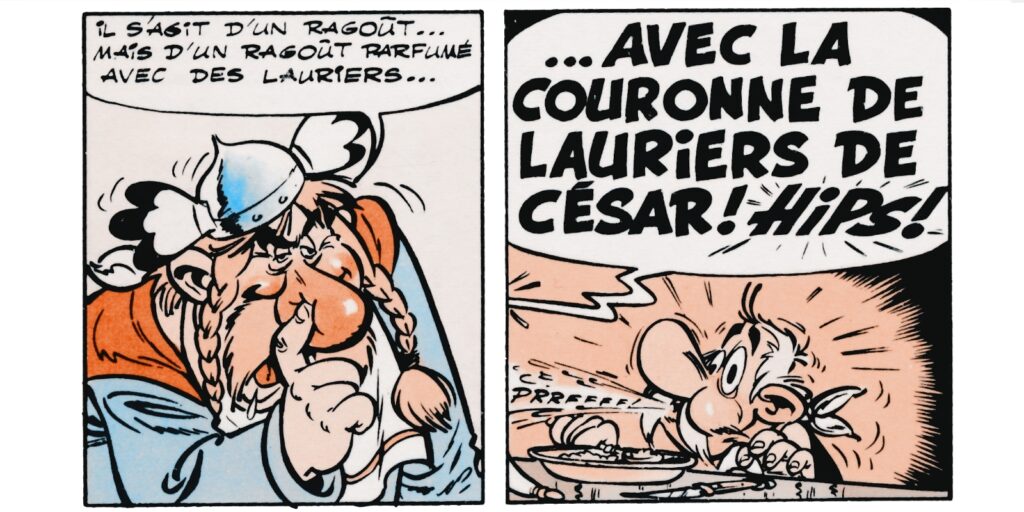
Food provides another opportunity for Goscinny to play with language.
A sanglier is a wild boar, while a cochon is a pig. The distinction becomes useful when Goscinny adapts expressions involving pigs to the Gauls’ favourite food.
The French expression c’est bon pour les cochons can be used dismissively to suggest that something is suitable only for pigs or people with uncultivated tastes. In the Asterix universe, however, the wording can be redirected toward boars.
The joke fits the characters perfectly. For Asterix and Obelix, wild boar is not an insult or a sign of bad taste.
It is dinner.
Goscinny can then push the joke further with cochonnerie, a word that can mean something like “junk”, “rubbish” or “nasty stuff”. Roman goods that are cheap or poor quality therefore become another opportunity to bring pigs and boars back into the conversation.
Ancient Romans Speaking Modern French
Perhaps the most characteristic technique in the album is the way Goscinny takes modern French expressions and places them in an ancient Roman setting.
While hiding in the catacombs, for example, a character can refer to the place as somewhere to faire de vieux os — literally “make old bones”. In ordinary French, the expression means to live somewhere for a long time.
Inside an underground burial complex, however, the expression suddenly acquires a much more sinister literal meaning.
Another character is described as being in such a terrible state that he needs to be ramassé à la petite cuillère — literally, to be scraped up with a teaspoon. The expression normally describes someone who is completely exhausted or physically devastated.
Goscinny adapts the idea to the Roman setting by referring to a cochléa, a small Roman spoon.
Again, the joke depends on making a modern expression look as though it belongs naturally in antiquity.
Why Asterix and the Laurel Wreath Works So Well

The brilliance of Asterix and the Laurel Wreath is not simply that it contains a lot of jokes.
It operates on several levels at once.
For a young reader, it is an adventure in which Asterix and Obelix have to travel to Rome and somehow get hold of Caesar’s laurel wreath.
For an adult French reader in 1972, Rome could also look suspiciously like contemporary Paris. There are traffic jams, social climbers, rebellious young people, changing family relationships and fashionable political slogans.
And for readers of the original French, the dialogue contains another entire layer of humour based on idioms, wordplay and deliberately distorted language.
Uderzo’s drawings add yet another layer. Repeated backgrounds, recycled panels, exaggerated expressions and carefully constructed Roman architecture turn the artwork itself into part of the joke.
That combination is one of the reasons the Asterix albums reward rereading. The basic story may remain the same, but the more closely you look, the more hidden jokes you begin to notice.
And sometimes the smallest detail — a piece of graffiti, a reused drawing or a deliberately mangled French word — tells you more about how Goscinny and Uderzo actually constructed their world than the main plot does.


Published in 1972, Asterix and the Laurel Wreath (Les Lauriers de César) is the 18th Asterix album and one of the series’ most entertaining journeys into Roman society.
The story begins with a drunken boast. After a particularly heavy drinking session, Abraracourcix (Vitalstatistix) gets into an argument with his brother-in-law Homéopatix (Homeopathix), a wealthy and rather smug businessman from Lutetia. In a moment of misplaced confidence, the village chief promises that he can serve Homéopatix a meal seasoned with Julius Caesar’s own laurel wreath.
There is just one small problem: the wreath is in Rome.
So Asterix and Obelix are sent on a mission to steal it.
What follows is much more than another trip to the Roman capital. Goscinny and Uderzo fill the album with jokes about modern life, from traffic jams and changing family relationships to consumerism, social climbing and the frustrations of everyday bureaucracy. As usual, much of the humour becomes even more interesting when you look at what is happening behind the drawings and the English translation.
Rome: Ancient City, Modern Problems
The Rome of Asterix and the Laurel Wreath looks remarkably familiar.
One of the most obvious jokes is the city’s traffic. Ancient Rome is presented as a place suffering from congestion, crowded roads and too many vehicles. This was hardly an accidental choice in a comic published in 1972.
France in the 1960s and early 1970s was experiencing a rapid expansion of car ownership, while Paris was being reshaped around the automobile. President Georges Pompidou was famously enthusiastic about making the capital more suitable for cars. Goscinny therefore had a very contemporary target available to him: simply put modern traffic problems into ancient Rome.
The joke works because Uderzo does not need to explain it. Roman chariots take the place of modern cars, but the frustration is instantly recognisable.
And that is one of the recurring tricks of the Asterix series. The Romans may be wearing togas and travelling by chariot, but they often behave exactly like people living in modern France.
The Roman Family
Another particularly modern element appears in the Roman household of Claudius Quiquilfus and his son Gracchus.
The younger generation is presented as rebellious, carefree and rather less interested in following the rules than his father would like. The joke fits neatly into the generational tensions that had become increasingly visible in France during the 1960s, particularly around the events of May 1968.
The album even contains a wonderfully recognisable piece of revolutionary graffiti:
interdit d’interdire — “it is forbidden to forbid.”
The phrase had become one of the best-known slogans associated with the events of May 1968. Putting it on a Roman wall turns a very recent political slogan into an apparently ancient piece of graffiti.
This is typical Goscinny. The joke is not simply that the Romans are behaving like modern people. The humour comes from taking something unmistakably contemporary and pretending that it has always existed.
Homéopatix and the Rise of the Beauf
Homéopatix is another character who feels distinctly modern.
Abraracourcix’s brother-in-law is wealthy, successful and very proud of it. His possessions and social position are important to him, and he has little hesitation in reminding everyone else of his success.
Through Homéopatix, Goscinny pokes fun at the nouveaux riches: people whose newly acquired wealth becomes a source of social status and personal pride.
The character also fits into a broader stereotype that became increasingly familiar in French popular culture: the beauf. The word is difficult to translate precisely, but it describes a stereotypically vulgar, smug or socially pretentious middle-class man who takes considerable pride in his material success.
The joke becomes even better because Homéopatix is not merely rich. He is rich in a way that irritates Abraracourcix.
That gives the story its central motivation. The quest for Caesar’s laurel wreath is essentially the result of one man’s inability to admit that his brother-in-law might have something he does not.
Uderzo’s Rome
The album also gives Albert Uderzo an excellent opportunity to draw Rome.
The journey takes the characters through very different parts of the city, from impressive public buildings and wealthy Roman interiors to the less glamorous world of taverns, slave markets and underground passages.
Uderzo was particularly good at turning a historically inspired setting into a playground for visual jokes. His Rome looks sufficiently monumental to evoke the ancient capital, but it is also packed with recognisable details and exaggerated characters.
The drawings were not created in a historical vacuum. Goscinny and Uderzo regularly consulted historical material when constructing the Roman world of Asterix, and the work of French historian Jérôme Carcopino was among the sources used for details of Roman daily life.
The result is not intended to be a historically accurate reconstruction of Rome. Instead, Uderzo takes genuine Roman features and combines them with modern visual references.
That mixture is precisely what makes the setting work.
Uderzo’s Recycled Panels
There is another detail that is easy to miss when reading the album casually: Uderzo sometimes reused drawings.
This was not unusual in comics, where artists had to work under considerable production pressure, but Uderzo’s reuse can also become part of the visual humour.
For example, the establishing view of Caesar’s palace first appears early in the story and is subsequently reused. The Roman domus introduced later in the album also appears again, with changes to the surroundings and inking helping to establish a different moment.
One of the most obvious examples comes during the hangover sequence.
A single drawing of a character suffering the effects of Asterix’s extraordinarily powerful remedy is repeated several times. Rather than creating an entirely new drawing for every panel, Uderzo changes the colouring of the face to make the character look progressively worse.
The repetition itself becomes part of the joke.
This is worth looking out for throughout the Asterix albums. Uderzo’s artwork can be extraordinarily detailed, but that does not mean every panel was drawn completely from scratch. Reusing artwork was one of the practical techniques that allowed him to produce such visually rich albums.
Farpaitement: A Word Is Born
For readers of the original French edition, one of the most memorable jokes in the album comes from Abraracourcix’s drinking.
When the chief is drunk, he has trouble pronouncing parfaitement, meaning “perfectly” or “absolutely”. His slurred version, farpaitement, became one of the memorable linguistic jokes associated with the album.
And there is an interesting twist: farpaitement did not necessarily remain confined to the pages of Asterix. The expression entered French popular usage as a humorous way of imitating drunken or deliberately distorted speech.
The English translators had an equally difficult problem. How do you translate a joke based on the sound of a French word?
Their solution was not to translate farpaitement literally, but to create an equivalent joke: “Zigackly”, a drunken corruption of “exactly.”
That is a good example of why translating Asterix is so difficult. The translator is not simply translating what a character says. They often have to invent a new joke that produces the same effect in another language.
When the Chains Become a Pun
Goscinny also likes to build jokes around French expressions.
At one point, the slave trade provides the opportunity for a particularly dark piece of wordplay. A slave trader describes his business as something other than travail à la chaîne — literally “chain work” or assembly-line work.
The expression normally refers to repetitive industrial labour. But in the world of Roman slavery, chaîne can suddenly acquire a much more literal meaning: the enslaved people are actually wearing chains.
Another joke comes when Asterix declares that they will vendre chèrement leur vie — literally “sell their lives dearly”, a French expression meaning that they will fight fiercely rather than surrender.
Obelix, however, is not impressed by the metaphor.
As slaves who have already been bought and sold, their lives have, quite literally, already been sold.
It is the sort of joke that is easy to lose in translation because the humour depends on the double meaning of an established French expression.
Boars, Pigs and Cochonneries
Food provides another opportunity for Goscinny to play with language.
A sanglier is a wild boar, while a cochon is a pig. The distinction becomes useful when Goscinny adapts expressions involving pigs to the Gauls’ favourite food.
The French expression c’est bon pour les cochons can be used dismissively to suggest that something is suitable only for pigs or people with uncultivated tastes. In the Asterix universe, however, the wording can be redirected toward boars.
The joke fits the characters perfectly. For Asterix and Obelix, wild boar is not an insult or a sign of bad taste.
It is dinner.
Goscinny can then push the joke further with cochonnerie, a word that can mean something like “junk”, “rubbish” or “nasty stuff”. Roman goods that are cheap or poor quality therefore become another opportunity to bring pigs and boars back into the conversation.
Ancient Romans Speaking Modern French
Perhaps the most characteristic technique in the album is the way Goscinny takes modern French expressions and places them in an ancient Roman setting.
While hiding in the catacombs, for example, a character can refer to the place as somewhere to faire de vieux os — literally “make old bones”. In ordinary French, the expression means to live somewhere for a long time.
Inside an underground burial complex, however, the expression suddenly acquires a much more sinister literal meaning.
Another character is described as being in such a terrible state that he needs to be ramassé à la petite cuillère — literally, to be scraped up with a teaspoon. The expression normally describes someone who is completely exhausted or physically devastated.
Goscinny adapts the idea to the Roman setting by referring to a cochléa, a small Roman spoon.
Again, the joke depends on making a modern expression look as though it belongs naturally in antiquity.
Why Asterix and the Laurel Wreath Works So Well
The brilliance of Asterix and the Laurel Wreath is not simply that it contains a lot of jokes.
It operates on several levels at once.
For a young reader, it is an adventure in which Asterix and Obelix have to travel to Rome and somehow get hold of Caesar’s laurel wreath.
For an adult French reader in 1972, Rome could also look suspiciously like contemporary Paris. There are traffic jams, social climbers, rebellious young people, changing family relationships and fashionable political slogans.
And for readers of the original French, the dialogue contains another entire layer of humour based on idioms, wordplay and deliberately distorted language.
Uderzo’s drawings add yet another layer. Repeated backgrounds, recycled panels, exaggerated expressions and carefully constructed Roman architecture turn the artwork itself into part of the joke.
That combination is one of the reasons the Asterix albums reward rereading. The basic story may remain the same, but the more closely you look, the more hidden jokes you begin to notice.
And sometimes the smallest detail — a piece of graffiti, a reused drawing or a deliberately mangled French word — tells you more about how Goscinny and Uderzo actually constructed their world than the main plot does.