When people think of Bordeaux , they usually picture deep, velvet-red wines. So when Asterix and Obelix arrive in Burdigala (The older name of the city) in Asterix and the Banquet (Le Tour de Gaule d’Astérix), you might expect them to pick up a fine bottle of red.
But René Goscinny and Albert Uderzo had other plans.
Instead of red wine, our heroes choose white wine and oysters — a decision that opens the door to a string of clever cultural jokes, linguistic wordplay, and visual gags typical of the series at its best.
The Plot: A Case of Mistaken Identity

The Burdigala episode begins with a setback. As we have seen in the previous article, two petty thieves, Plexus and Radius — named after the solar plexus and the forearm bone — steal Asterix and Obelix’s sack of provisions. Their triumph is short-lived, however, when a Roman patrol intercepts them. Seeing the famous sack, the Romans assume they have captured the real Gauls.
General Motus wastes no time preparing a public humiliation. The impostors are placed in the pillory in the city centre, while the general prepares a triumphant speech.
At that very moment, the real Asterix and Obelix arrive.
Rather than intimidating the townspeople, their appearance has the opposite effect. Inspired by the famous Gauls, the citizens of Burdigala revolt, and chaos quickly spreads through the streets.
In the confusion, Asterix and Obelix calmly retrieve their stolen sack and take the opportunity to shop for local specialties: white wine and oysters. With provisions secured, they head for the docks, where they escape aboard the ship of an Armorican captain named Changéledix (“change the disc”), who just happens to be transporting a cargo of menhirs.
Linguistic Wit and Cultural Jokes

As often in Asterix, the Burdigala episode is packed with linguistic humor and cultural references.
General Motus
The name “Motus” is itself a joke. In French, motus! is an interjection meaning “Silence!” or “Not a word!” The irony is obvious: General “Silence” is a long-winded speaker who loves making grand speeches — at least until a riot finally forces him into silence.
The Months with an “R”
Obelix happily eats oysters, even though it is not a month containing the letter “R.” This refers to an old French tradition that oysters should only be eaten between September and April. In warmer months, oysters were considered unsafe before modern refrigeration.
Seeing Thirty-Six Candles

In the final panels, a Roman counting the cargo is struck by a falling menhir. As he loses consciousness, he sees a circle of candles. This is a literal illustration of the French idiom voir trente-six chandelles — “to see thirty-six candles” — equivalent to the English expression “seeing stars.” We have written about this before.
The Quincunx Formation
General Motus also orders his troops into a quinconce (quincunx) formation. In a typically playful footnote, Goscinny humorously links this military formation to the origin of Bordeaux’s famous Place des Quinconces. In reality it gets its name from the “quinconce” pattern — a geometric arrangement of five objects like the five on dice, commonly used in French formal garden design. The square was originally planted with trees laid out in this staggered pattern when it was created in the early 19th century on the site of the demolished Château Trompette.
Regional Specialties Collected
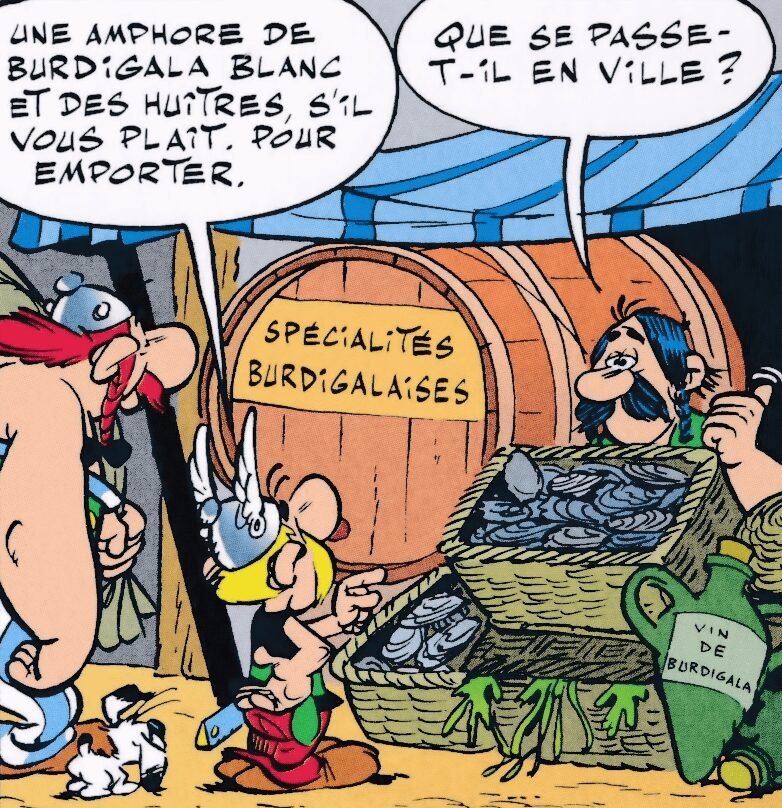
By the time they leave Burdigala, Asterix and Obelix have added two more regional specialties to their growing banquet: Burdigala Blanc (White Wine) Fresh Atlantic Oysters.
The Aftermath
The episode ends with General Motus, thoroughly defeated, shouting that he never wants to hear anything ever again — a fitting conclusion for a character named “Silence.”
Meanwhile, Asterix and Obelix sail toward their next destination, provisions safely secured. And while Bordeaux may be famous for its red wines, Goscinny and Uderzo prove that white wine and oysters make for a far better punchline.
Agen :Previous | Next: Le Conquet


When people think of Bordeaux , they usually picture deep, velvet-red wines. So when Asterix and Obelix arrive in Burdigala (The older name of the city) in Asterix and the Banquet (Le Tour de Gaule d’Astérix), you might expect them to pick up a fine bottle of red.
But René Goscinny and Albert Uderzo had other plans.
Instead of red wine, our heroes choose white wine and oysters — a decision that opens the door to a string of clever cultural jokes, linguistic wordplay, and visual gags typical of the series at its best.
The Plot: A Case of Mistaken Identity
The Burdigala episode begins with a setback. As we have seen in the previous article, two petty thieves, Plexus and Radius — named after the solar plexus and the forearm bone — steal Asterix and Obelix’s sack of provisions. Their triumph is short-lived, however, when a Roman patrol intercepts them. Seeing the famous sack, the Romans assume they have captured the real Gauls.
General Motus wastes no time preparing a public humiliation. The impostors are placed in the pillory in the city centre, while the general prepares a triumphant speech.
At that very moment, the real Asterix and Obelix arrive.
Rather than intimidating the townspeople, their appearance has the opposite effect. Inspired by the famous Gauls, the citizens of Burdigala revolt, and chaos quickly spreads through the streets.
In the confusion, Asterix and Obelix calmly retrieve their stolen sack and take the opportunity to shop for local specialties: white wine and oysters. With provisions secured, they head for the docks, where they escape aboard the ship of an Armorican captain named Changéledix (“change the disc”), who just happens to be transporting a cargo of menhirs.
Linguistic Wit and Cultural Jokes
As often in Asterix, the Burdigala episode is packed with linguistic humor and cultural references.
General Motus
The name “Motus” is itself a joke. In French, motus! is an interjection meaning “Silence!” or “Not a word!” The irony is obvious: General “Silence” is a long-winded speaker who loves making grand speeches — at least until a riot finally forces him into silence.
The Months with an “R”
Obelix happily eats oysters, even though it is not a month containing the letter “R.” This refers to an old French tradition that oysters should only be eaten between September and April. In warmer months, oysters were considered unsafe before modern refrigeration.
Seeing Thirty-Six Candles
In the final panels, a Roman counting the cargo is struck by a falling menhir. As he loses consciousness, he sees a circle of candles. This is a literal illustration of the French idiom voir trente-six chandelles — “to see thirty-six candles” — equivalent to the English expression “seeing stars.” We have written about this before.
The Quincunx Formation
General Motus also orders his troops into a quinconce (quincunx) formation. In a typically playful footnote, Goscinny humorously links this military formation to the origin of Bordeaux’s famous Place des Quinconces. In reality it gets its name from the “quinconce” pattern — a geometric arrangement of five objects like the five on dice, commonly used in French formal garden design. The square was originally planted with trees laid out in this staggered pattern when it was created in the early 19th century on the site of the demolished Château Trompette.
Regional Specialties Collected
By the time they leave Burdigala, Asterix and Obelix have added two more regional specialties to their growing banquet: Burdigala Blanc (White Wine) Fresh Atlantic Oysters.
The Aftermath
The episode ends with General Motus, thoroughly defeated, shouting that he never wants to hear anything ever again — a fitting conclusion for a character named “Silence.”
Meanwhile, Asterix and Obelix sail toward their next destination, provisions safely secured. And while Bordeaux may be famous for its red wines, Goscinny and Uderzo prove that white wine and oysters make for a far better punchline.
Agen :Previous | Next: Le Conquet