First published in Pilote between February and July 1968, Asterix at the Olympic Games is the twelfth album by René Goscinny and Albert Uderzo. It is one of the most layered albums in the series, combining topical satire, classical references, and intricate wordplay with a carefully researched historical backdrop.
By this stage, the series had become a cultural phenomenon. Critics and journalists were beginning to analyse it with increasing seriousness, prompting Goscinny to joke that “exegetes” were dissecting his Gauls as if they were museum pieces. Despite this, the authors remained clear about their intentions: “se marrer, et faire marrer les gens” [to have a laugh and make people laugh]. Their creative partnership was at its peak during this album.
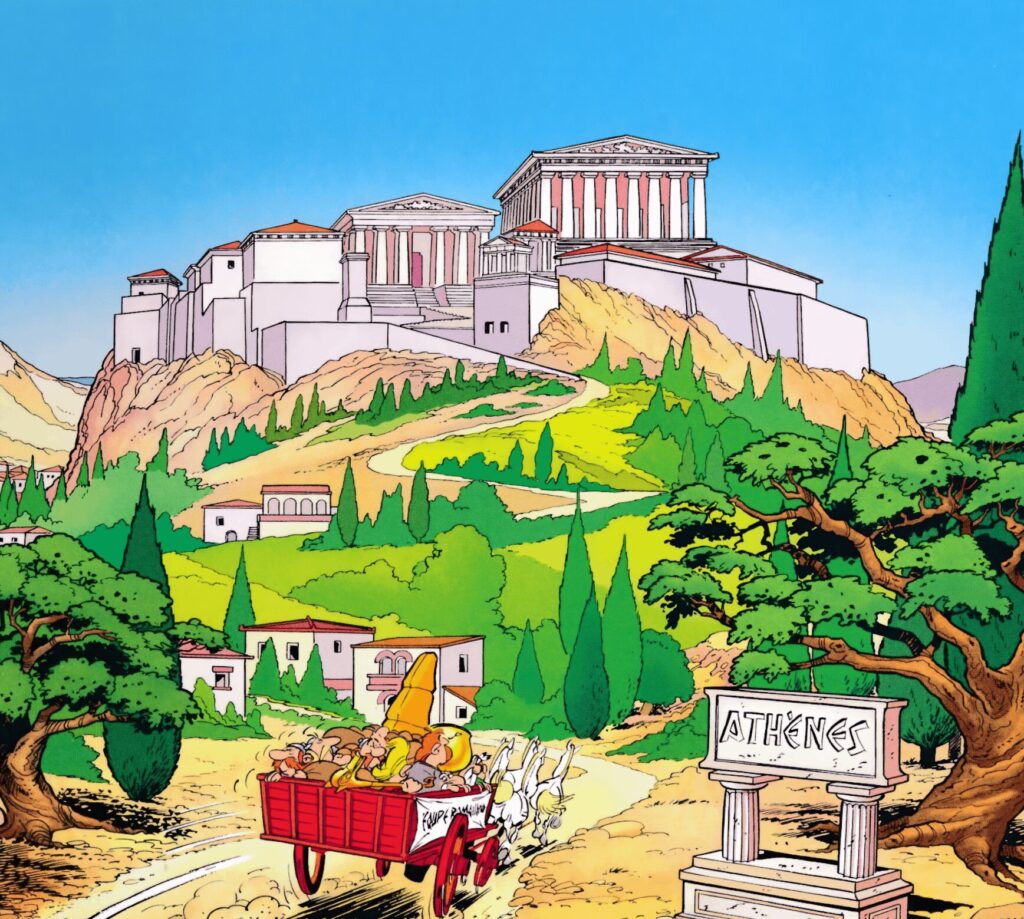
Uderzo supported the visual side with detailed research, notably drawing on works such as Jean Miliadis’ Ancient Athensto render Greek architecture with surprising accuracy. Goscinny, meanwhile, built the narrative around contemporary themes, including exaggerated national pride in sport and the growing culture of mass tourism—parodied in the familiar attitude of the traveller who looks at the Acropolis and remarks that it is “not bad, if you like columns.”
A Story of Its Time
The timing of the album is no coincidence. 1968 was an Olympic year, with the Winter Games in Grenoble and the Summer Games in Mexico City. France, in particular, was caught up in sporting enthusiasm, not least through the success of skier Jean-Claude Killy, whom Goscinny and Uderzo met during the Grenoble Games.

More subtly, the album reflects a major shift in sporting culture. The International Olympic Committee introduced its first formal anti-doping controls in 1968. In the story, the prohibition of the magic potion functions as a direct parallel. The Gauls, usually unbeatable thanks to Getafix’s brew, are suddenly required to compete under the same constraints as everyone else.
The English translation, published in 1972, appeared alongside another Olympic year—the Munich Games—giving the album a renewed topical relevance for its British audience.
Early Anachronism
Already on the first page , the English translation introduces a musical anachronism. A yell from the Roman camp alludes to “You’ll Never Walk Alone”, the song made famous by Liverpool FC.
Mushrooms and Champions
A seemingly incidental scene early in the album establishes the central theme through wordplay. The gathering of mushrooms (champignons [mushrooms]) by Geriatrix (who finally receives his name in this album) echoes the word champions [champions], anticipating the competition to come.
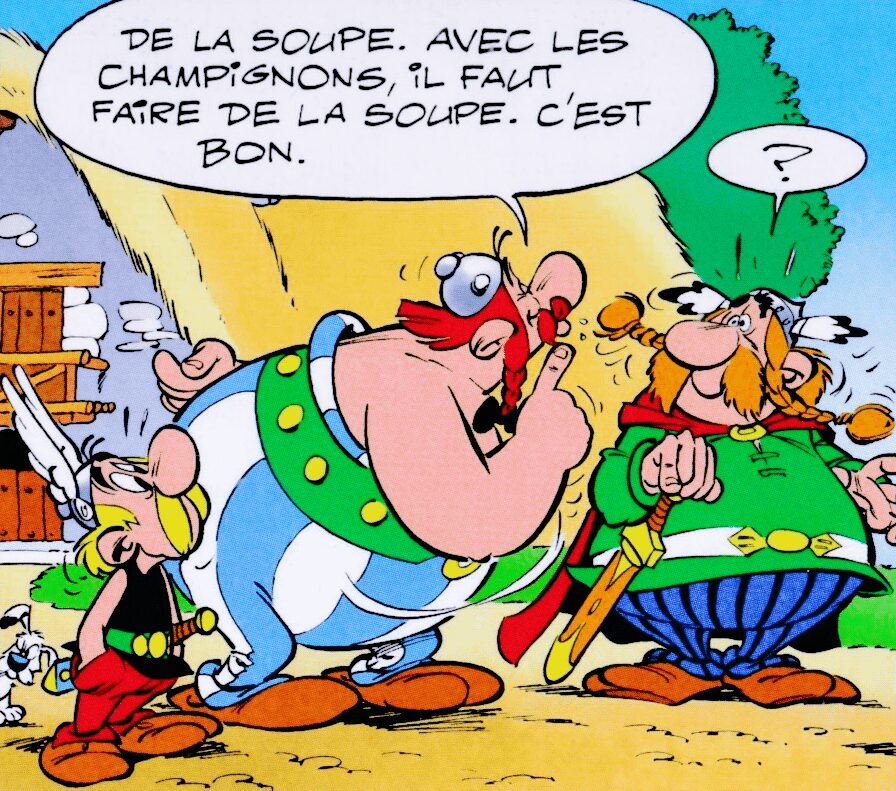
Geriatrix for example suggests eating them “en salade” [as a salad / raw], reinforcing the culinary framing of the scene. Getafix’s instruction, “Il faut les faire sauter !” [They must be sautéed! / They must be knocked out!], is a classic double entendre. In culinary terms, it means to sauté the mushrooms. In colloquial French, however, faire sauter [to make jump / to knock out] can also mean to eliminate or “blow away” opponents. The joke neatly foreshadows the Olympic contests.
The English translators, Bell and Hockridge, could not reproduce this phonetic link and instead opted for “Let them stew in their own juice.” While different in wording, it preserves the underlying idea: the Romans will ultimately be undone by their own actions.
Latin, Music and Breaking the Fourth Wall

The album frequently shifts register for comic effect, moving from elevated language to slapstick within a single scene.
The Roman centurion quotes “Et nunc reges, intelligite; erudimini, qui judicatis terram” (Now therefore, O kings, be wise; be instructed, you who judge the earth), from Psalm 2:10.
Music provides another layer of wordplay. Cacofonix proudly announces an “Olympic march” (marche [march / step]). When he is promptly knocked flat, Asterix remarks that he has raté une marche [missed a step]. The joke plays on both the musical sense (losing the rhythm) and the literal sense of stumbling. The English version abandons the pun and substitutes the more accessible “I think he’s singing flat.”
The album also briefly acknowledges its own structure. As the men depart for Greece, Impedimenta observes that the village suddenly seems empty of men, a meta-comment on the narrative shift away from its usual setting.
Songs and Localisation
Music is one of the areas where the differences between the French original and the English translation are most striking.

In the French version, the Gauls sing recognisable popular songs. One example is Nini peau d’chien [Nini “dog-skin” (a slangy, slightly cheeky nickname)], a well-known Parisian chanson associated with Aristide Bruant. For French readers, this evokes a very specific atmosphere: cabaret culture, urban humour, and a slightly irreverent tone.
In the English version, this is replaced with “When Father Papered the Parlour” (sometimes humorously adapted to “Parthenon” in keeping with the Greek setting). This is a British music hall song, chosen because it fills a similar cultural role: familiar, comic, and rooted in popular entertainment.
The Roman drinking songs are likewise adapted. The English text uses songs such as “There is a Tavern in the Town” and “A-Roving.” The latter becomes “A-Roming”, a bilingual pun combining “Roman” with the structure of the original title.
The Olympic Games
Once in Greece, the album continues to balance parody, scholarship, and contemporary references.
On page 27, the inn named Invinoveritas transforms the Latin proverb in vino veritas [in wine, there is truth] into a place name. It is here that Geriatrix’s age is confirmed as ninety-three, prompting Asterix to observe dryly that “feeling ten years younger” still leaves him well into his eighties.

Goscinny and Uderzo also insert themselves into the story on page 29 as figures in a carved relief, playfully assigning themselves mock-authoritarian titles.
A Greek athlete demands steak Burdigalais [steak from Burdigala (Bordeaux)], a geographical joke linking the ancient and the contemporary. The English version simplifies this to “mammoth steak.”
On page 35 we find another anachronism. Geriatrix enthusiastically yells, “Comme en 52, les gars” [Here we go again like in 52, lads], adapts the familiar expression “C’est reparti comme en 40” [Here we go again like in 1940]. Strictly speaking, the original expression was “C’est reparti comme en 14” [Here we go again like in 1914], referring to the outbreak of the First World War. The album humorously projects this kind of saying back into 52 BCE. Of course Gauls living in 50 BCE wouldn’t know about CE and BCE anyway.

The athletic contests themselves repeatedly undermine the Olympic ideal. A battered boxer from Rhodos we on page 40 mutters “Mens sana in corpore sano” [A sound mind in a sound body], immediately contradicted by his condition.
On page 44 the rooster crows using lettering styled in a distinctly “Greek” font. It is a purely visual gag, but entirely in keeping with the album’s playful immersion in its Hellenic setting.
The concluding banquet departs slightly from tradition. Cacofonix is present but not tied up, although his wary expression suggests that he’s not comfortable with it. In the context of the Olympic truce, even the bard is temporarily spared.
From Synopsis to Final Album
Goscinny’s working synopsis reveals how carefully the story was refined.
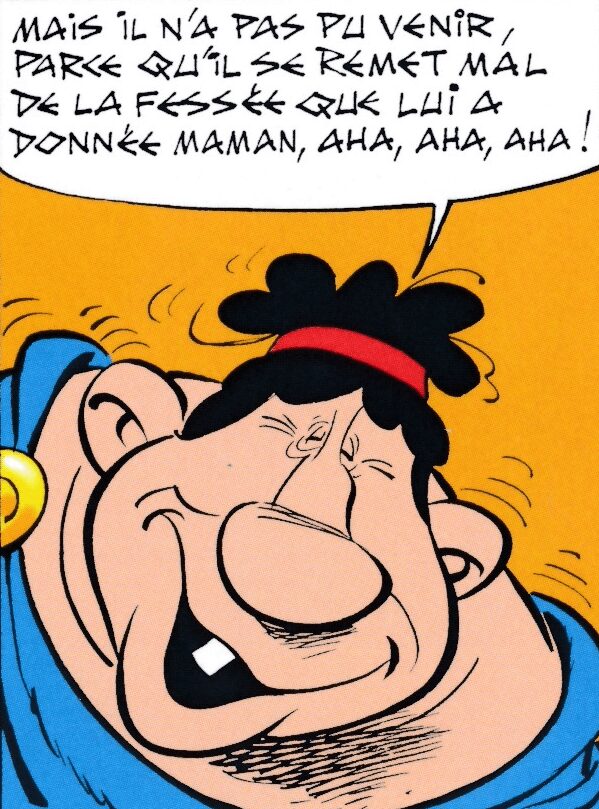
A Roman camp named “Postscriptum” was originally planned for this album but later reused in Asterix in Corsica. A gag involving coconuts was removed when the authors realised that such knowledge would be implausible for the Gauls. The character of Okéibos also changed: in the final version, his mother administers punishment instead of his father, a small adjustment that strengthens the comic effect.
These revisions illustrate the precision with which the authors balanced humour, plausibility, and pacing.
A Lasting Achievement
Asterix at the Olympic Games stands out for the density of its humour. From puns and Latin quotations to cultural references that span antiquity and the 20th century, the album rewards close reading.
Like the best entries in the series, it uses the ancient world not as a distant setting, but as a mirror for contemporary life—where even the Olympic ideal is subject to satire.


First published in Pilote between February and July 1968, Asterix at the Olympic Games is the twelfth album by René Goscinny and Albert Uderzo. It is one of the most layered albums in the series, combining topical satire, classical references, and intricate wordplay with a carefully researched historical backdrop.
By this stage, the series had become a cultural phenomenon. Critics and journalists were beginning to analyse it with increasing seriousness, prompting Goscinny to joke that “exegetes” were dissecting his Gauls as if they were museum pieces. Despite this, the authors remained clear about their intentions: “se marrer, et faire marrer les gens” [to have a laugh and make people laugh]. Their creative partnership was at its peak during this album.
Uderzo supported the visual side with detailed research, notably drawing on works such as Jean Miliadis’ Ancient Athensto render Greek architecture with surprising accuracy. Goscinny, meanwhile, built the narrative around contemporary themes, including exaggerated national pride in sport and the growing culture of mass tourism—parodied in the familiar attitude of the traveller who looks at the Acropolis and remarks that it is “not bad, if you like columns.”
A Story of Its Time
The timing of the album is no coincidence. 1968 was an Olympic year, with the Winter Games in Grenoble and the Summer Games in Mexico City. France, in particular, was caught up in sporting enthusiasm, not least through the success of skier Jean-Claude Killy, whom Goscinny and Uderzo met during the Grenoble Games.
More subtly, the album reflects a major shift in sporting culture. The International Olympic Committee introduced its first formal anti-doping controls in 1968. In the story, the prohibition of the magic potion functions as a direct parallel. The Gauls, usually unbeatable thanks to Getafix’s brew, are suddenly required to compete under the same constraints as everyone else.
The English translation, published in 1972, appeared alongside another Olympic year—the Munich Games—giving the album a renewed topical relevance for its British audience.
Early Anachronism
Already on the first page , the English translation introduces a musical anachronism. A yell from the Roman camp alludes to “You’ll Never Walk Alone”, the song made famous by Liverpool FC.
Mushrooms and Champions
A seemingly incidental scene early in the album establishes the central theme through wordplay. The gathering of mushrooms (champignons [mushrooms]) by Geriatrix (who finally receives his name in this album) echoes the word champions [champions], anticipating the competition to come.
Geriatrix for example suggests eating them “en salade” [as a salad / raw], reinforcing the culinary framing of the scene. Getafix’s instruction, “Il faut les faire sauter !” [They must be sautéed! / They must be knocked out!], is a classic double entendre. In culinary terms, it means to sauté the mushrooms. In colloquial French, however, faire sauter [to make jump / to knock out] can also mean to eliminate or “blow away” opponents. The joke neatly foreshadows the Olympic contests.
The English translators, Bell and Hockridge, could not reproduce this phonetic link and instead opted for “Let them stew in their own juice.” While different in wording, it preserves the underlying idea: the Romans will ultimately be undone by their own actions.
Latin, Music and Breaking the Fourth Wall
The album frequently shifts register for comic effect, moving from elevated language to slapstick within a single scene.
The Roman centurion quotes “Et nunc reges, intelligite; erudimini, qui judicatis terram” (Now therefore, O kings, be wise; be instructed, you who judge the earth), from Psalm 2:10.
Music provides another layer of wordplay. Cacofonix proudly announces an “Olympic march” (marche [march / step]). When he is promptly knocked flat, Asterix remarks that he has raté une marche [missed a step]. The joke plays on both the musical sense (losing the rhythm) and the literal sense of stumbling. The English version abandons the pun and substitutes the more accessible “I think he’s singing flat.”
The album also briefly acknowledges its own structure. As the men depart for Greece, Impedimenta observes that the village suddenly seems empty of men, a meta-comment on the narrative shift away from its usual setting.
Songs and Localisation
Music is one of the areas where the differences between the French original and the English translation are most striking.
In the French version, the Gauls sing recognisable popular songs. One example is Nini peau d’chien [Nini “dog-skin” (a slangy, slightly cheeky nickname)], a well-known Parisian chanson associated with Aristide Bruant. For French readers, this evokes a very specific atmosphere: cabaret culture, urban humour, and a slightly irreverent tone.
In the English version, this is replaced with “When Father Papered the Parlour” (sometimes humorously adapted to “Parthenon” in keeping with the Greek setting). This is a British music hall song, chosen because it fills a similar cultural role: familiar, comic, and rooted in popular entertainment.
The Roman drinking songs are likewise adapted. The English text uses songs such as “There is a Tavern in the Town” and “A-Roving.” The latter becomes “A-Roming”, a bilingual pun combining “Roman” with the structure of the original title.
The Olympic Games
Once in Greece, the album continues to balance parody, scholarship, and contemporary references.
On page 27, the inn named Invinoveritas transforms the Latin proverb in vino veritas [in wine, there is truth] into a place name. It is here that Geriatrix’s age is confirmed as ninety-three, prompting Asterix to observe dryly that “feeling ten years younger” still leaves him well into his eighties.
Goscinny and Uderzo also insert themselves into the story on page 29 as figures in a carved relief, playfully assigning themselves mock-authoritarian titles.
A Greek athlete demands steak Burdigalais [steak from Burdigala (Bordeaux)], a geographical joke linking the ancient and the contemporary. The English version simplifies this to “mammoth steak.”
On page 35 we find another anachronism. Geriatrix enthusiastically yells, “Comme en 52, les gars” [Here we go again like in 52, lads], adapts the familiar expression “C’est reparti comme en 40” [Here we go again like in 1940]. Strictly speaking, the original expression was “C’est reparti comme en 14” [Here we go again like in 1914], referring to the outbreak of the First World War. The album humorously projects this kind of saying back into 52 BCE. Of course Gauls living in 50 BCE wouldn’t know about CE and BCE anyway.
The athletic contests themselves repeatedly undermine the Olympic ideal. A battered boxer from Rhodos we on page 40 mutters “Mens sana in corpore sano” [A sound mind in a sound body], immediately contradicted by his condition.
On page 44 the rooster crows using lettering styled in a distinctly “Greek” font. It is a purely visual gag, but entirely in keeping with the album’s playful immersion in its Hellenic setting.
The concluding banquet departs slightly from tradition. Cacofonix is present but not tied up, although his wary expression suggests that he’s not comfortable with it. In the context of the Olympic truce, even the bard is temporarily spared.
From Synopsis to Final Album
Goscinny’s working synopsis reveals how carefully the story was refined.
A Roman camp named “Postscriptum” was originally planned for this album but later reused in Asterix in Corsica. A gag involving coconuts was removed when the authors realised that such knowledge would be implausible for the Gauls. The character of Okéibos also changed: in the final version, his mother administers punishment instead of his father, a small adjustment that strengthens the comic effect.
These revisions illustrate the precision with which the authors balanced humour, plausibility, and pacing.
A Lasting Achievement
Asterix at the Olympic Games stands out for the density of its humour. From puns and Latin quotations to cultural references that span antiquity and the 20th century, the album rewards close reading.
Like the best entries in the series, it uses the ancient world not as a distant setting, but as a mirror for contemporary life—where even the Olympic ideal is subject to satire.