Mongolian
Mongolia is a landlocked country in East Asia, bordered by Russia to the north and China to the south. The region is historically significant as the birthplace of the Mongol Empire, founded by Genghis Khan in the 13th century, which expanded to become the largest contiguous land empire in recorded history. Geographically, Mongolia features a highly diverse landscape, ranging from the arid expanses of the Gobi Desert in the south to the mountainous steppes and temperate forests in the north and west. It is recognized as one of the most sparsely populated sovereign states in the world, characterized by vast, open terrains. The capital and largest city, Ulaanbaatar, is home to approximately half of the country’s population and serves as its primary cultural, political, and economic center. In 1990, the nation underwent a peaceful democratic revolution, transitioning from a socialist state to a multi-party democracy with a developing market economy. Today, the Mongolian economy is largely driven by agriculture and the extensive mining of mineral resources such as copper, coal, and gold. Despite rapid urbanization, a significant portion of the population continues to practice a traditional semi-nomadic pastoral lifestyle, maintaining a profound cultural connection to the natural environment.
The Mongolian Language
Mongolian is the official and most widely spoken language of Mongolia, serving as the primary medium for government, education, and daily communication. It is the best-known member of the Mongolic language family. While historically categorized by some scholars under the proposed Altaic macro-family alongside Turkic and Tungusic languages, modern linguistic consensus generally views the Mongolic family as an independent genetic grouping.
Grammar and Vocabulary
Mongolian is an agglutinative language, meaning that grammatical functions such as case, tense, and mood are indicated by adding suffixes to root words. The language strictly follows a Subject-Object-Verb (SOV) sentence structure and relies heavily on vowel harmony, a phonetic system where vowels within a single word must belong to the same articulatory class. The vocabulary is predominantly Mongolic in origin; however, centuries of historical contact have introduced loanwords from Old Turkic, Tibetan, and Sanskrit, primarily relating to religion and administration. More recently, Russian and English loanwords have been integrated into modern Mongolian, particularly within the domains of technology and global commerce.
History and Writing System
The traditional Mongolian script, written vertically from top to bottom, was adapted from the Old Uyghur alphabet during the early development of the Mongol Empire. This script was utilized for centuries to record historical texts, literature, and administrative decrees. In 1941, the official writing system was changed to a modified Cyrillic alphabet, a transition that reflected the geopolitical alignments of the mid-20th century. Today, Mongolian Cyrillic remains the standard everyday script in the country, although there are ongoing, state-supported efforts to revitalize the traditional vertical script for educational and official capacities.
Asterix in Mongolian
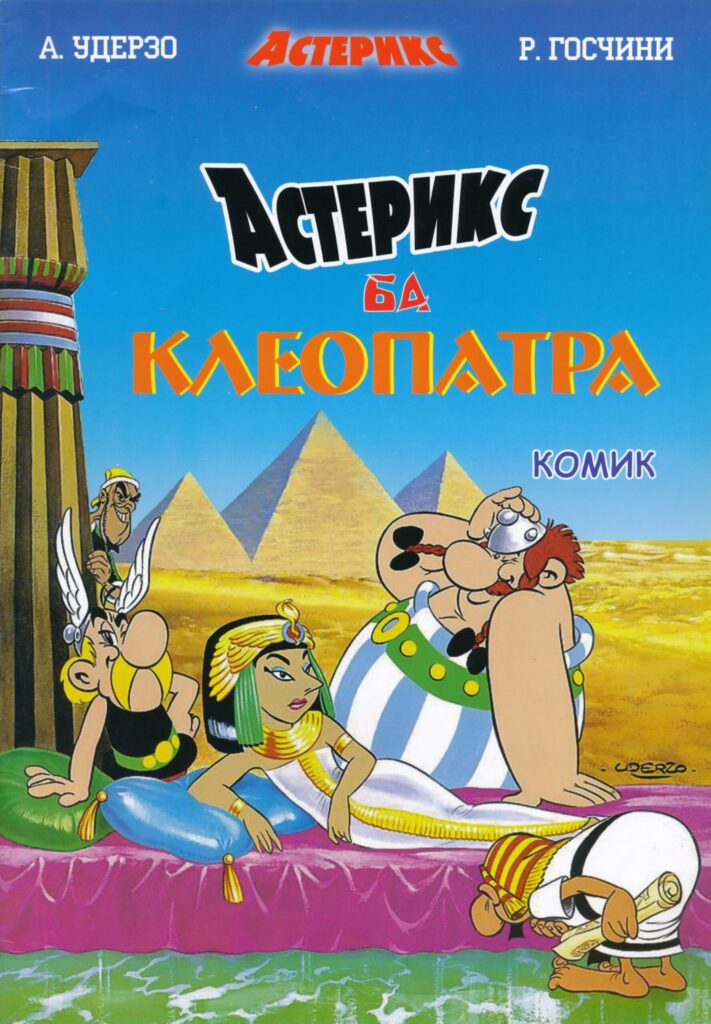
The adventures of Asterix the Gaul have also found their way to the steppes of Central Asia. To date, only two albums from the series have been translated and published in Mongolian. The first album to be introduced was Asterix the Gaul (АСТЕРИКС ГАҮЛЫН), which was translated and released in 2010 by local publisher Төгс огторгуй ХХК (Tugs Ogtorgui LLC). Following this initial release, a second album, Asterix and Cleopatra (Астериск ба клеопатра), was published by Соёмбо Принтинг ХХК (Soyombo Printing LLC).
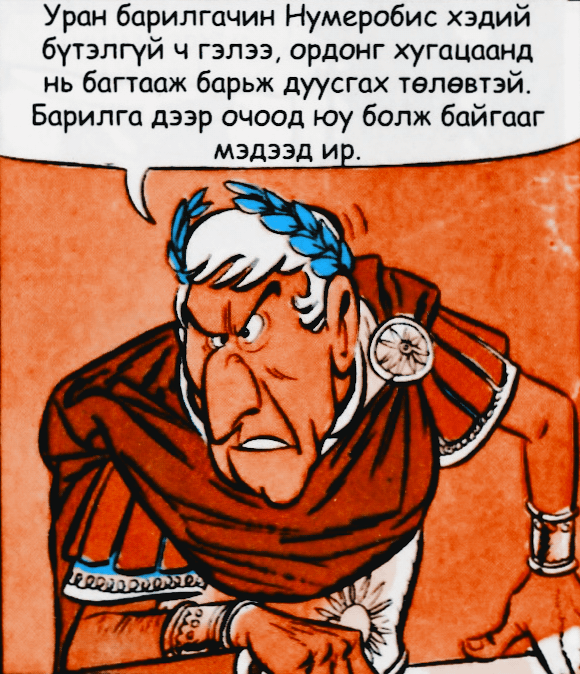
Consistent with the modern orthographic standards of the country, the text in both of these albums is printed entirely using the Mongolian Cyrillic script. For Asterix collectors and comic enthusiasts, these Mongolian editions represent a rare and fascinating addition to the global catalog. The Mongolian translations aren’t easy to find nowadays.