Lower Bavarian
Lower Bavaria (Niederbayern) forms the eastern heartland of the German state of Bavaria. Its landscape stretches from the picturesque Bavarian Forest (Bayerischer Wald) along the Czech border to the fertile agricultural plains of the Gäuboden along the Danube, as well as the rolling hop fields of the Hallertau. The region’s historical roots run deep, featuring Roman outposts along the Danube and a key political turning point in 1255, when the brothers Louis II and Henry XIII divided the Duchy of Bavaria, making Henry the first Duke of Lower Bavaria with Landshut as his residence. Over the centuries, Lower Bavarians developed a strong cultural identity marked by rich traditions, such as the renowned glassmaking art of the Forest, major regional festivals like the Gäubodenvolksfest in Straubing, and the famous quadrennial historical pageant, the Landshuter Hochzeit.
The Lower Bavarian Dialect
The Lower Bavarian dialect (Niederbairisch) serves as the linguistic reflection of this distinct regional character. Linguistically part of the Central Bavarian group (Mittelbairisch), it distinguishes itself from Upper Bavarian through specific vowel shifts—such as the characteristic use of broader aa sounds (for instance, aafe instead of the Upper Bavarian auffe)—and a more conservative vocabulary that can vary significantly from village to village. Compared to Standard German (Hochdeutsch), Lower Bavarian operates as a fully fledged language system with its own grammatical structures: the genitive case is absent, sentences are reinforced using double negatives, and the past tense is formed almost exclusively using the present perfect. Because there is no official standardized spelling, authors writing in the dialect usually write phonetically, which in practice often results in a variety of diacritical marks used to capture darkened vowels (such as the typical å sound) and omitted vowels.
The First Asterix Translation in Lower Bavarian
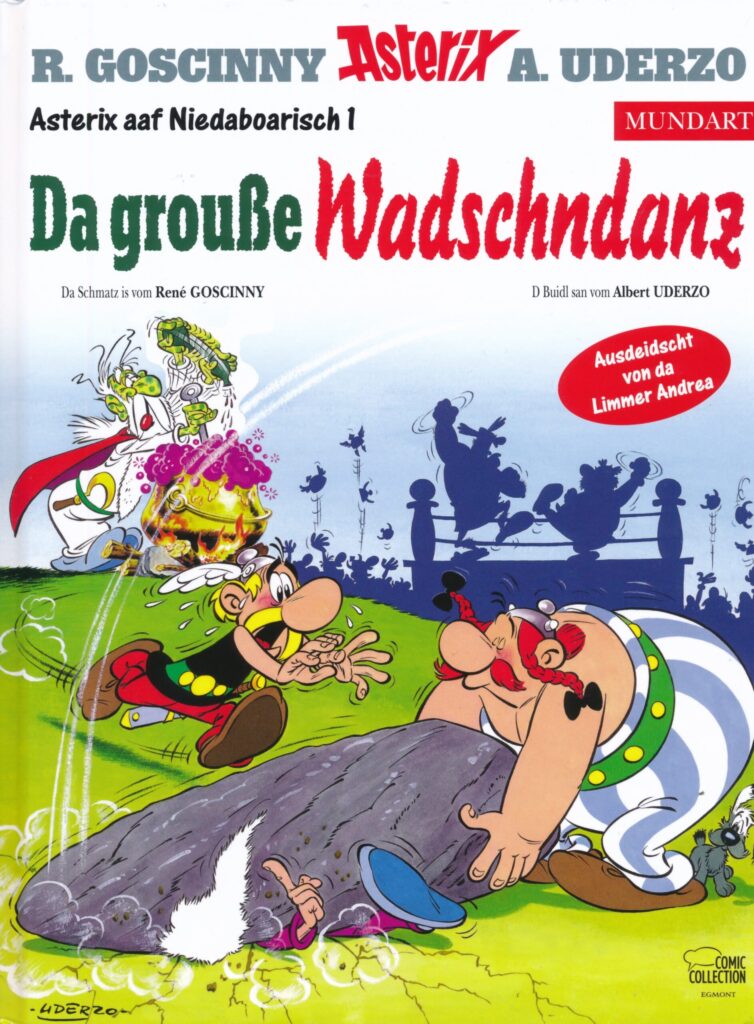
This unique linguistic tradition recently gained a special milestone with the publication of the very first Asterix translation in Lower Bavarian, titled “Asterix Aaf Niedaboarisch” (featuring the album title “Da Grousse Wads chndanz”, an adaptation of the classic album The Big Fight / Le Combat des Chefs). The translation was crafted by the Lower Bavarian cabaret artist and author Andrea Limmer. To ensure the comic remains accessible and easy to read for a broad audience, Limmer made the deliberate choice to forgo complex punctuation, apostrophes, and special accents, operating under the belief that not every reader has studied linguistics. With plenty of humor, she seamlessly matches the distinctive Lower Bavarian folk character—stubborn, a bit defiant, yet full of authentic zest for life—with the invincible Gauls. The result is a colorful adaptation in which the magic potion is fittingly renamed “Gallibock”.