Breton

Brittany (Bretagne in French, Breizh in Breton) is a picturesque region in northwestern France, forming a peninsula bordered by the English Channel to the north and the Bay of Biscay to the south. Covering approximately 34,030 square kilometers, it boasts over 2,860 kilometers of rugged coastline, characterized by cliffs, rias, and capes. The region’s terrain is hilly, with its highest point at Roc’h Ruz in the Monts d’Arrée, standing at 385 meters. Brittany’s climate is maritime, offering mild temperatures and regular rainfall, making it ideal for agriculture and outdoor activities. The region is renowned for its rich cultural heritage, including traditional music, dance, and festivals that celebrate its Celtic roots.
Brezhoneg
The Breton language (Brezhoneg) is a fascinating member of the Insular Celtic family’s Brythonic branch, closely related to Welsh and Cornish. Its origin is unique on the continent, as it does not descend from ancient Gaulish but was re-imported to Armorica (modern Brittany) by Celtic-speaking migrants from Great Britain fleeing Anglo-Saxon invasions between the 3rd and 9th centuries AD. Grammatically, Breton maintains distinctive Celtic features, most notably the Verb-Subject-Object (VSO) word order and a system of initial consonant mutations where the first letter of a word systematically changes based on the preceding word. The language is traditionally divided into four main dialects—Leoneg, Tregerieg, Kerneneweg, and the more divergent Gwenedeg—and its vocabulary, while fundamentally Celtic, contains significant layers of Latin and French loanwords due to historical contact.
Despite a severe decline in speaker numbers over the last century, Breton remains an integral part of Brittany’s identity, and significant revitalization efforts are underway. Its structural features include nouns categorized by masculine and feminine gender and a complex verbal system that frequently uses auxiliary verbs (bezañ – to be, kaout – to have) alongside verbal nouns to express tense. These linguistic traits firmly anchor Brezhoneg within the pan-Celtic cultural sphere, reflecting the region’s strong ties to other Celtic nations. Today, the language is promoted through cultural initiatives and taught in schools like the immersive Diwan network, showcasing its resilience and importance as a living cultural heritage.
Asterix speaks Breton
Asterix comic series has been translated into Breton, allowing native speakers to enjoy the adventures in their own language. Only three Asterix albums have been translated into Breton:
- Asteriks e Breizh (1976) – Asterix in Britain
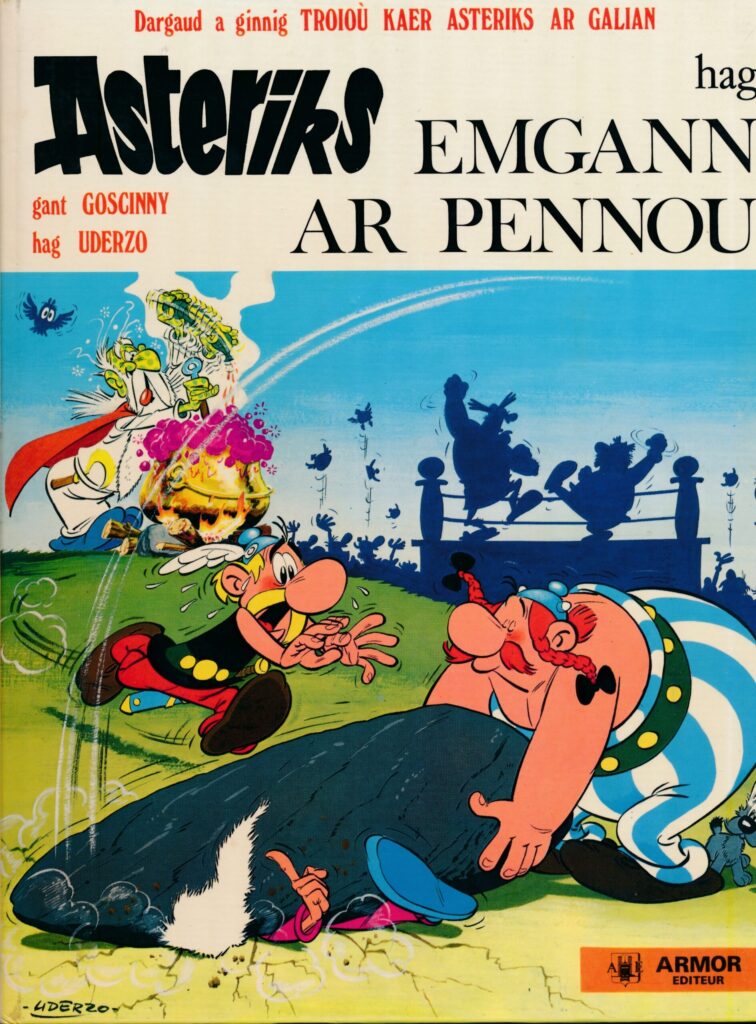
- Asteriks hag Emgann ar Pennoù (1977) – Asterix and the Big Fight
- Astérix hag an distro (2004) – Asterix and the Class Act
These translations not only make the stories accessible to Breton speakers but also contribute to the preservation and promotion of the Breton language, showcasing the region’s commitment to maintaining its linguistic heritage.
Asterix and the Class Act has been translated to several local languages in France.