Alemannic
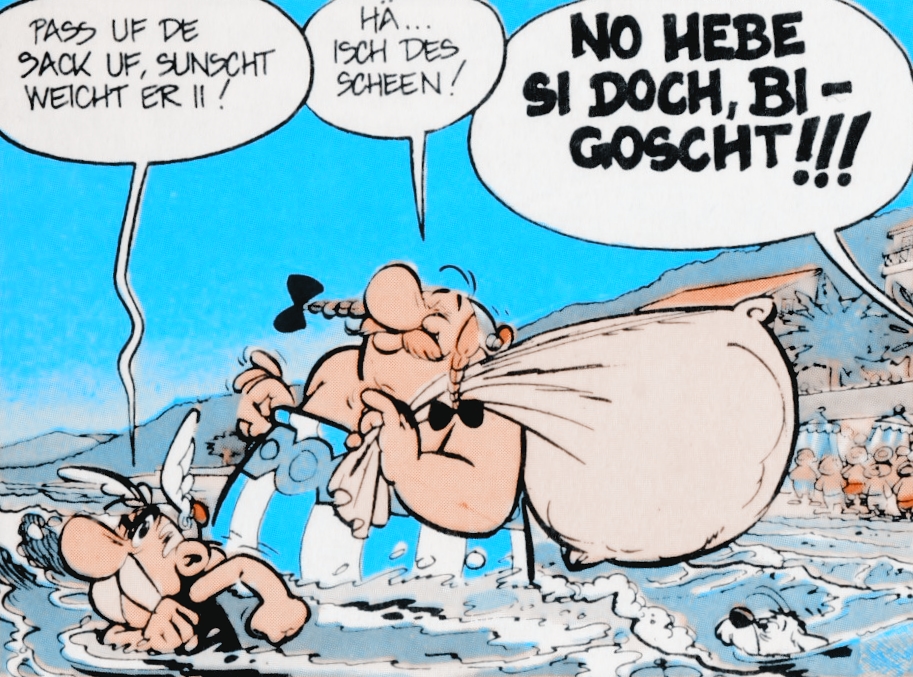
Alemannic is not a single standardized language, but a group of closely related Upper German dialects spoken across parts of southwestern Germany, Alsace, German-speaking Switzerland, Liechtenstein and Vorarlberg. The varieties can differ considerably from one another, but they share a number of characteristic features that distinguish them from Standard German.
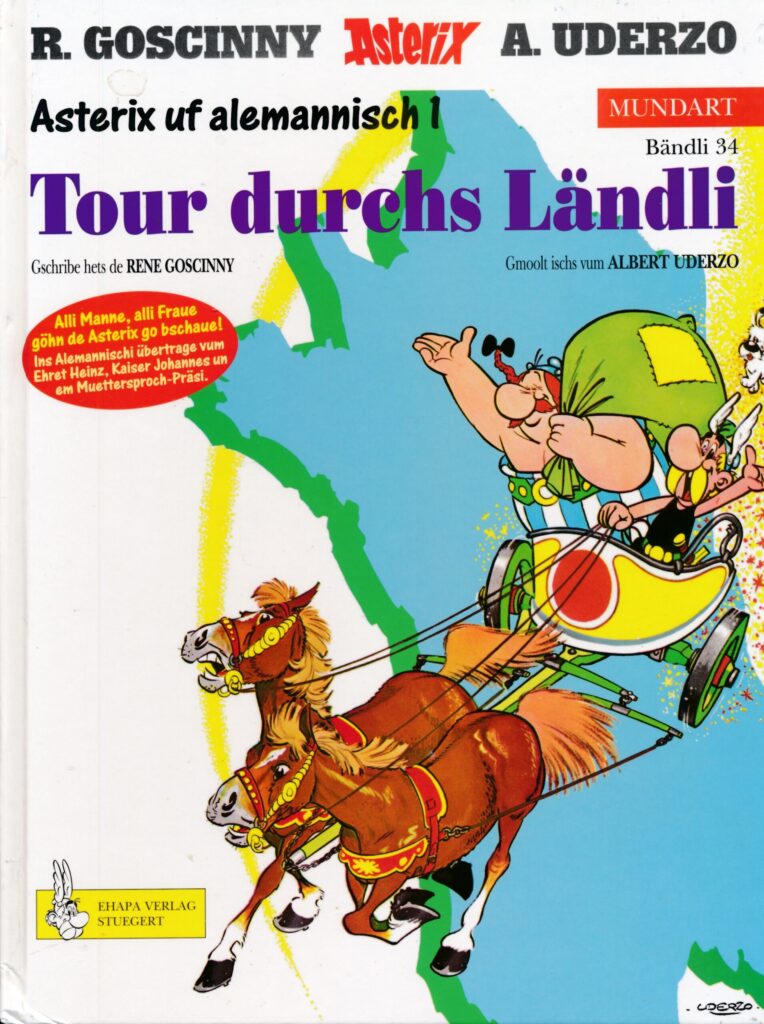
For Asterix, this linguistic diversity produced two official Mundart editions from Ehapa: Tour durchs Ländli in 2000 and Dä Hüslibau in 2001. Both were translated by Heinz Ehret, Johannes Kaiser and Klaus Poppen.
Alemannic: More Than One Dialect
Alemannic belongs to the Upper German branch of the West Germanic language family. It is better understood as a dialect group or continuum than as one uniform language. The varieties spoken around the Upper Rhine, in Switzerland and in Austria are not identical, and the boundary between Alemannic and neighbouring dialect groups such as Swabian is not always clear-cut.
One characteristic of spoken Alemannic, as with many southern German dialects, is its strong preference for the perfect tense rather than the preterite in everyday speech. Vocabulary and pronunciation can also differ substantially from Standard German.
For Asterix readers, however, the most interesting feature is not the grammar. It is what happens when the comic’s wordplay is moved into a regional language.
Asterix Comes to the Upper Rhine
The first Alemannic Asterix was Tour durchs Ländli, published by Ehapa in July 2000 as Mundart volume 34. It is based on Le Tour de Gaule d’Astérix, the sixth Asterix album.
Its publication was particularly appropriate for the region. The 2000 Tour de France passed through Freiburg im Breisgau and Mulhouse, and the Alemannic Asterix was released in that context. The translation had been selected through an Asterix translation competition, with Heinz Ehret, Klaus Poppen and Johannes Kaiser chosen as the winning team.
The result was not simply Standard German with different spellings. The translators used the dialect to create new jokes and local associations.
One of the best examples is the names of the four Roman camps surrounding the Gaulish village. In the Alemannic edition they become:
Dertnum, Sorum, Hintenum and Vornerum.
The names are playful constructions meaning roughly “around there,” “around this way,” “around the back” and “around the front.” They preserve the absurdity of the original Roman camp names while making the joke work naturally in Alemannic.
Even Petitbonum, one of the best-known Roman camp names in the series, receives local treatment. A documented example gives Dertnum, while another Alemannic version apparently played with the name Kleingutach, referring to the real village of Gutach in the Black Forest.
Romans Like Rhine Mosquitoes
The opening of Tour durchs Ländli provides an even clearer example of the translation’s approach.
Instead of simply reproducing the familiar description of the Roman occupation, the Alemannic text compares the Romans to Rhiischnooge — Rhine mosquitoes. The dialect text begins by describing the Romans as being all over Gaul “like the Rhiischnooge.”
This is more than a dialect translation. It is a regional joke. Rhine mosquitoes are a familiar nuisance along the Upper Rhine, and Rhiischnooge is also strongly associated with local Alemannic culture. The name, for example, is used by the traditional carnival association D’Rhiischnooge in Neuenburg am Rhein.
That kind of localization is one of the things that makes the Mundart editions of Asterix so interesting. The translators were not only trying to make the dialogue sound like local speech. They were looking for ways in which the jokes could become local jokes. Some fans of Asterix however disagree, they feel that the translation should stay more faithfull to Goscinny’s original.
The Second Alemannic Asterix
The second Alemannic edition followed in 2001: Dä Hüslibau, Mundart volume 43. It is the Alemannic adaptation of Le Domaine des Dieux, known in German as Die Trabantenstadt. Again, the translation was produced by Heinz Ehret, Johannes Kaiser and Klaus Poppen.
The title itself is a good example of the freedom given to the dialect translators. Rather than attempting to reproduce the French title literally, Dä Hüslibau gives the album a distinctly Alemannic identity.
Together, the two editions form a small but particularly interesting part of the Asterix Mundart series. They show how Goscinny’s wordplay could be adapted not merely into another language, but into a particular regional way of speaking and thinking.
Asterix in Alemannic
Only two Alemannic albums were published in the main Ehapa Mundart series: Tour durchs Ländli and Dä Hüslibau.
For collectors, they are therefore more than two regional editions of Asterix. They are examples of how far the German Mundart project was willing to take localization. The original French jokes remain recognizable, but the language, place names and cultural references were reshaped for readers of the Upper Rhine region.
And that is perhaps the most interesting thing about Tour durchs Ländli: the Gauls may still be in ancient Gaul, but once the Romans start looking like Rhiischnooge, you know that this particular Gaul has moved unmistakably into Alemannic territory.