Published in 1974, Asterix and Caesar’s Gift (Le Cadeau de César) is the twenty-first adventure in the Asterix series and one of René Goscinny and Albert Uderzo’s most entertaining satires of contemporary French society. Having previously explored tourism, consumerism, urban development and social ambition, the authors now turned their attention to political campaigning, elections and the sometimes questionable motivations of voters. The album appeared during a particularly eventful year in French politics and marked an important turning point in the publishing history of Asterix.
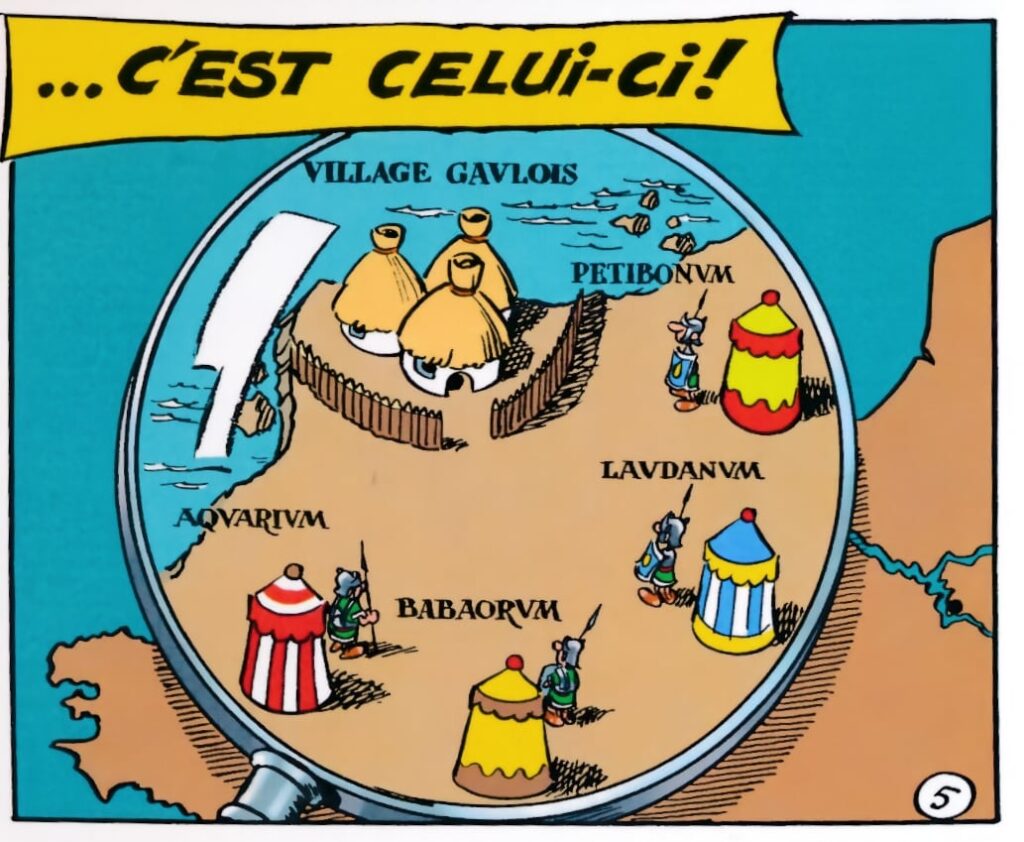
Behind the seemingly straightforward story of a drunken Roman, an ambitious innkeeper and a disputed title deed lies a fascinating mixture of Roman military history, French political satire, biblical quotations, literary references and popular culture. Some of these jokes remain recognizable in the English translation, while others are almost impossible to appreciate without examining the original French.
From Pilote to Le Monde
Since his first appearance on 29 October 1959, Asterix had been closely associated with the French comics magazine Pilote. That relationship came to an end with Asterix in Corsica in 1973. On 10 July 1974, the French daily newspaper Le Monde announced that it would publish the new adventure throughout the summer, with serialization beginning the following day. The transition from a comics magazine originally aimed at younger readers to one of France’s most respected national newspapers illustrates how much the status of Asterix had changed in fifteen years.
Published by Dargaud in July 1974, Le Cadeau de César had an initial print run of 1,400,000 copies. By comparison, the first Asterix album had been printed in just 5,500 copies in 1961. The English translation by Anthea Bell and Derek Hockridge followed in 1977. Given the political nature of the adventure, Le Monde proved a particularly appropriate publication in which to introduce the story.
Honesta Missio: The Historical Roots of Caesar’s Gift
Although much of the album satirizes modern French society, its opening sequence is firmly rooted in Roman military history. The ceremony during which Julius Caesar rewards his retiring legionaries reflects the Roman practice of honesta missio, literally meaning ‘honourable discharge’. Veterans who had completed their military service could receive retirement benefits, known as praemia militiae, which included financial compensation or grants of land.
The distribution of land to veterans was particularly important during the late Roman Republic. Military commanders used land grants to reward their soldiers, secure their loyalty and establish settlements in strategically important territories. Under Augustus, these arrangements became more institutionalized, with the establishment of the aerarium militare, a military treasury intended to finance veterans’ retirement benefits. The standardized twenty-year period of military service mentioned in the album more closely reflects arrangements that developed under the Roman Empire than those of Caesar’s time.
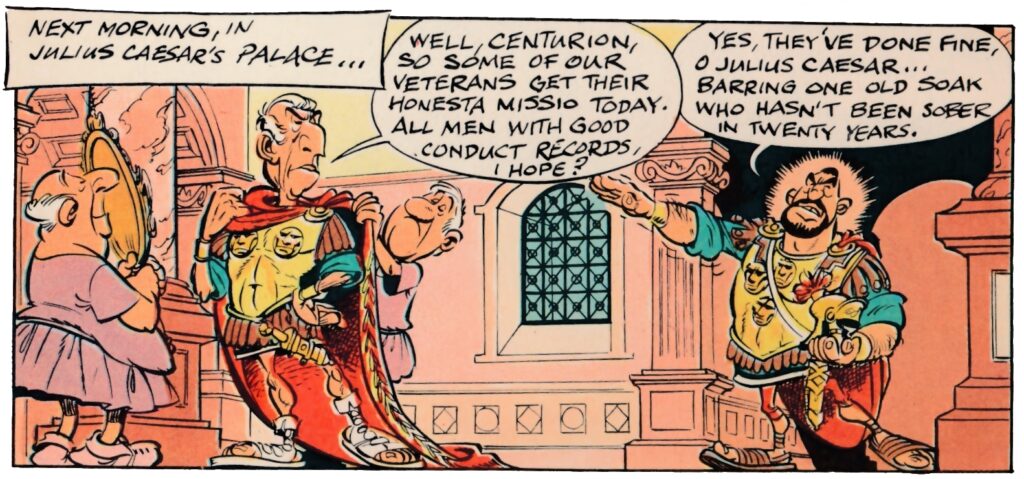
Goscinny takes this historical practice and gives it an absurd twist. While the other retiring legionaries receive valuable plots of land, the troublesome Roméomontaigus (Tremensdelirius) is rewarded with the only village in Gaul that Caesar has failed to conquer. The distinction between receiving a title deed and actually possessing the land becomes the foundation of the entire adventure.
We explored the historical background to this opening sequence in greater detail in our earlier article, Honesta Missio: The Historical Roots of Caesar’s Gift.
The French Presidential Election of 1974
On 2 April 1974, French President Georges Pompidou died in office, forcing France to organize an early presidential election. Interestingly, it had been Pompidou who suggested to Goscinny and Uderzo that they send Asterix to Switzerland. The election ultimately came down to François Mitterrand, representing the left, and Valéry Giscard d’Estaing, representing the centre-right. On 10 May, the two men participated in the first televised debate between the finalists of a French presidential election. Millions of viewers watched the confrontation, which established a tradition that would become a familiar part of French political life. Giscard d’Estaing narrowly won the election on 19 May.
Against this background, the debate between Abraracourcix (Vitalstatistix) and Orthopédix (Orthopaedix) becomes considerably more interesting. The candidates sit behind a table, Assurancetourix (Cacofonix) acts as moderator and an hourglass regulates speaking time, while members of the audience interrupt and express their political preferences. The scene parodies political television programmes that had become increasingly popular in France, including À armes égales and Face à face, both associated with television producer Armand Jammot. Cétautomatix (Fulliautomatix) makes an explicit reference to the latter programme.
Goscinny also mocks the use of statistics in political debates. When figures are presented as evidence of economic progress, the opposing candidate questions their reliability, arguing that statistics can be made to say whatever one wants. Abraracourcix subsequently threatens the moderator when he approaches the hourglass, turning the supposedly civilized debate into something considerably closer to a traditional Gaulish argument. The scene captures the confrontational nature of political television, which would become particularly associated with French Communist politician Georges Marchais and his exchanges with journalists.
Although it is tempting to see the album as a direct parody of the presidential election of 1974, its production would have started well before the election took place. The similarities are better understood against the broader background of political television and electoral campaigning in France during the preceding years. The events of 1974 made the satire especially timely.
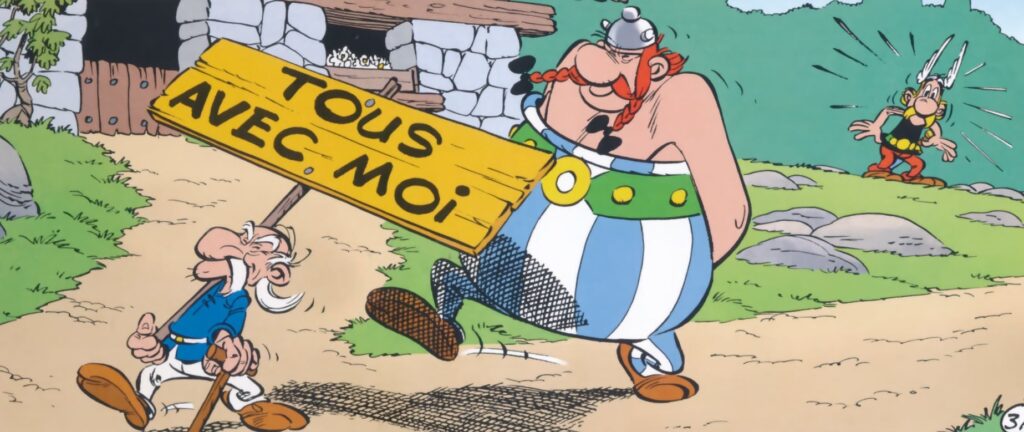
Were Goscinny and Uderzo Political?
Despite their frequent political satire, Goscinny and Uderzo consistently denied that Asterix promoted any particular political ideology. The appearance of a heroic Gaul in 1959, shortly after Charles de Gaulle returned to power, nevertheless led some commentators to associate the series with Gaullism. During the political unrest of 1968, the authors and their characters were again associated with defenders of the established order. Paradoxically, their political neutrality allowed readers from different political backgrounds to interpret the adventures according to their own convictions.
In his interviews with Numa Sadoul, published as Astérix & Cie, Entretiens avec Uderzo, Uderzo explained that, despite their close friendship, he and Goscinny had never seriously discussed their political allegiances. He did not even know whether Goscinny considered himself left-wing or right-wing. In 1998, when activists associated with the French RPR party used an illustration of fighting Gauls in a political poster, Uderzo immediately protested against the appropriation of his characters. The poster was withdrawn, and Nicolas Sarkozy, then mayor of Neuilly, personally apologized to him.
This political independence is particularly apparent in Asterix and Caesar’s Gift. Both candidates resort to flattery, questionable promises and attempts to buy the loyalty of their fellow villagers, yet it is remarkably difficult to identify which represents the political left and which represents the right. Goscinny and Uderzo are interested in the behaviour of politicians rather than their political programmes, an approach Uderzo would employ again in Asterix and the Great Divide.
A France of Property Owners
The election is not the album’s only reference to contemporary French society. During the 1960s and 1970s, home ownership became an increasingly important aspiration among French families, and politicians frequently promoted access to private property. Uderzo later explained that the album touched upon the deeply rooted French desire to own a house in the countryside or by the sea. Caesar’s title deed represents a symbolic attempt to annex the Gaulish village administratively, even though his legions have been unable to conquer it militarily.
Had Roméomontaigus presented himself directly at the village gates, the matter would probably have been settled with a few well-placed punches. By transferring the title deed to Orthopédix, an unsuspecting fellow Gaul, Goscinny creates a much more complicated situation. Panoramix (Getafix) refuses to allow his magic potion to be used in a conflict between Gauls, forcing the villagers to find another way of resolving their differences. The very thing that normally guarantees their independence is suddenly of little use to them.
An Election Campaign in Ancient Gaul
Much of the humour comes from placing recognizable modern electoral practices in an ancient setting. Both candidates discover that generosity can be a useful political instrument, particularly when directed at villagers whose support they hope to obtain. Angine (Angina) purchases considerable quantities of fish from Ordralfabétix (Unhygienix), while Bonemine (Impedimenta) and Abraracourcix order a dozen anvils from Cétautomatix. The chief can subsequently present increased anvil production as evidence of the village’s industrial progress. The economic growth he celebrates is therefore the direct result of his own electoral manoeuvring.
Assurancetourix and Ordralfabétix are among the villagers attracted to the newcomers. Both occupy somewhat marginalized positions within the community, one because of his questionable musical abilities and the other because of the equally questionable freshness of his fish. Orthopédix offers them the recognition they rarely receive from their fellow villagers. Personal grievances, wounded pride and the desire to be appreciated prove considerably more important than political convictions.
Lady Macbeth in the Gaulish Village
Although Abraracourcix and Orthopédix are the official candidates, much of the rivalry is driven by their wives. Bonemine can be seen as a comic version of Lady Macbeth, encouraging her somewhat reluctant husband to defend his position. She lacks the cruelty of Shakespeare’s character but shares her determination to preserve the political and social status that comes with her husband’s authority. Angine, meanwhile, sees the position of village chief as an opportunity to improve her family’s circumstances.
The similarities between the two families become apparent when Orthopédix complains about his wealthy brother-in-law, Dithyrambix. Abraracourcix has exactly the same problem with Homéopatix (Homeopathix), whom readers had already encountered in Asterix and the Laurel Wreath. Bonemine and Angine are driven by similar frustrations and ambitions, which explains why they suddenly discover how much they have in common once Orthopédix decides to leave and their rivalry disappears.
The portrayal of women as ambitious and vindictive, and their husbands as comparatively passive, contributed to accusations of misogyny that occasionally surrounded the series. However, the men are hardly portrayed more favourably. The election campaign exposes the vanity, insecurity and susceptibility to flattery of almost everyone involved.
Foreigners Who Are Not From Here
Another interesting aspect of the album is the reaction of Agecanonix (Geriatrix) to the newcomers. Although Orthopédix and his family are Gauls, the elderly villager immediately regards them as foreigners simply because they come from somewhere else. His objections become increasingly absurd when it becomes clear that his understanding of foreigners extends to fellow Gauls who happen to live outside his village.
The joke may have had additional significance for French readers in 1974, when immigration was becoming an increasingly prominent political issue. The French government suspended most new labour immigration in July of that year, while questions concerning the integration of immigrant families would continue to generate political debate. Whether Goscinny deliberately intended a reference to these developments is uncertain, but the intolerance of Agecanonix contrasts sharply with the more open-minded attitudes of Astérix (Asterix) and Panoramix.
The French Character Names and Their Hidden Meanings
The names introduced in Asterix and Caesar’s Gift contain some particularly entertaining examples of Goscinny’s linguistic creativity. While Anthea Bell and Derek Hockridge managed to preserve several of these jokes, others were replaced with entirely new ones.
Roméomontaigus (Tremensdelirius). The name of the drunken Roman legionary comes from Roméo Montaigu, the French name of Romeo Montague, the passionate young lover in Shakespeare’s Romeo and Juliet. The humour lies in the contrast between the two characters: it is difficult to imagine anyone less like Shakespeare’s romantic hero than Goscinny’s frequently intoxicated veteran. The English translators abandoned the literary reference and instead reversed the elements of delirium tremens, a potentially serious condition associated with alcohol withdrawal. Roméomontaigus would eventually return in Asterix and the Actress in 2001.
Claudius Bouilleurdecrus (Egganlettus). A bouilleur de cru is someone who distils alcohol from agricultural produce, such as fruit grown on their own land. The name also carries a largely forgotten political reference. Certain French distillers enjoyed inherited privileges allowing them to produce a limited quantity of alcohol without paying the usual duties. A parliamentary controversy over these privileges in 1954 contributed to the political difficulties of Prime Minister Pierre Mendès-France, whose government fell in February 1955. For contemporary French readers, the name would therefore have suggested both alcohol and political controversy. The English name, a play on egg and lettuce, takes the joke in an entirely different culinary direction.
Orthopédix (Orthopaedix). The innkeeper’s name derives from orthopédie, the medical speciality concerned with bones, joints and the musculoskeletal system. The reference was easily preserved in English and establishes a medical naming convention that continues throughout his family.
Angine (Angina). In everyday French, an angine is an inflammation of the throat, frequently associated with tonsillitis. English readers are more likely to associate angina with chest pain caused by insufficient blood flow to the heart. Although the character’s name remains almost identical in both languages, its usual medical meaning is therefore somewhat different.
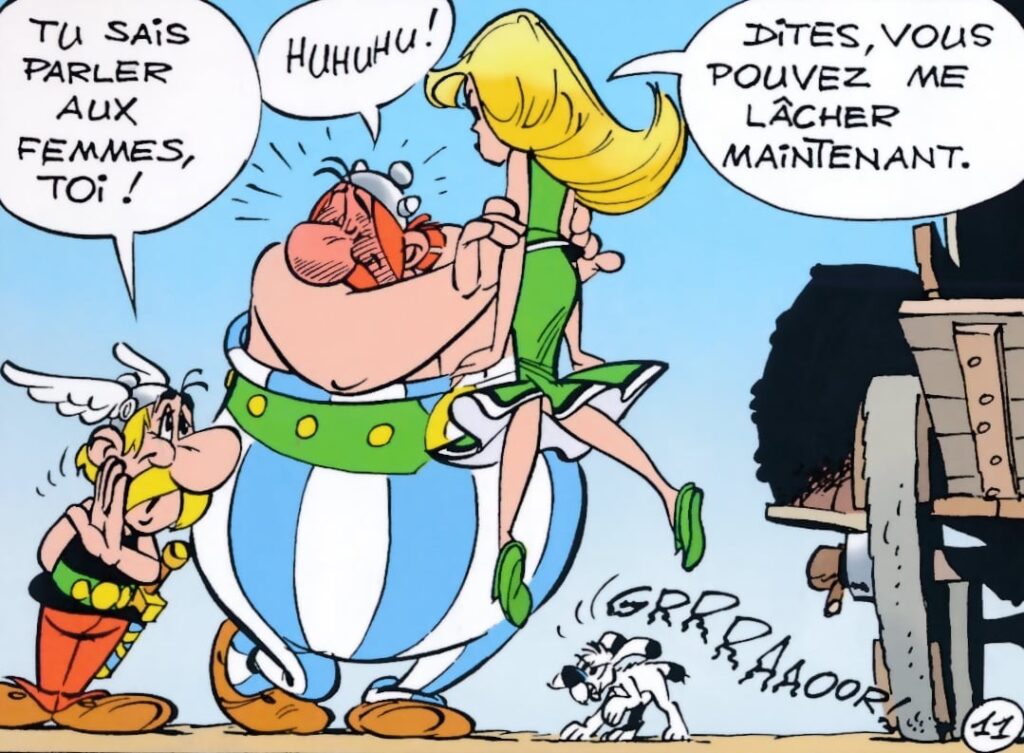
Coriza (Influenza). The daughter of Orthopédix and Angine takes her name from coryza, a medical term for inflammation of the nasal mucous membranes, commonly associated with the common cold. The English translators replaced this relatively unfamiliar term with the more recognizable Influenza. Her nickname, Zaza, was retained, allowing an important joke later in the story to survive.
Dithyrambix (Dithyrambix). Although he never actually appears in the album, Orthopédix’s successful brother-in-law receives a wonderfully elaborate name. A dithyrambe was originally an ancient Greek hymn associated with Dionysus. In modern French, the word refers to extravagant praise, while dithyrambique describes something excessively enthusiastic or laudatory. Dithyrambix occupies much the same position in Orthopédix’s life as Homéopatix does in that of Abraracourcix.
Tohubohus (Tonsillitus). The Roman centurion takes his name from the French expression tohu-bohu, meaning disorder, confusion or uproar. Its origins are surprisingly ancient, deriving from the Hebrew tohu va-vohu in Genesis 1:2, describing the unformed and empty state of the earth before the ordering of creation. Through its use in French biblical translations, the expression entered everyday French. In the English edition, the centurion becomes Tonsillitus, extending the album’s collection of medical names.
The Roman camp of Laudanum, meanwhile, takes its name from an alcoholic preparation containing opium, historically used as a painkiller and sedative. Considering the importance of alcohol in the opening pages and the medical names of the newcomers, the involvement of this particular Roman camp seems especially appropriate.
French Wordplay Hidden in the Dialogue
Some of the most entertaining jokes in the album are based on ordinary French expressions that acquire an unexpected literal meaning. Several examples have been identified by Stéphane Rivière in his detailed study of the original French album. The page numbers below follow the conventional album pagination, in which the first story page is page 5.
A salade niçoise (page 8). One of the retiring Roman legionaries receives a plot of land near Nicæ, modern-day Nice, where he intends to grow salad vegetables. The reference is to salade niçoise, the famous culinary speciality associated with the city. Goscinny provides a fictional ancient origin for a recognizable French dish, while the English name Egganlettus gives the scene an additional culinary dimension.
Pour une bouchée de pain (page 9). The French expression literally means ‘for a mouthful of bread’, but figuratively describes acquiring something for a ridiculously low price. Since the title deed to the village really has been exchanged for food and wine, Goscinny manages to use the expression in both its literal and figurative senses simultaneously.
Laisser tomber (page 10). One of Abraracourcix’s shield-bearers becomes increasingly irritated with his employer. The French expression laisser tomber can mean abandoning someone or giving up on something, but also physically dropping someone. For a man whose occupation consists of carrying another person on a shield, the expression has a particularly appropriate double meaning.
Giving someone your voice (page 21). When Orthopédix approaches Assurancetourix for political support, he asks for his voix. In French, the word means both a voice and an electoral vote. The bard responds by pointing out that Orthopédix, like everyone else in the village, does not particularly enjoy hearing his voice. The politician wants the bard’s vote, but nobody wants to hear him sing.
Cochonneries (page 26). The French word cochonnerie generally describes something dirty, unpleasant or worthless. It derives from cochon, meaning pig. When the expression is used in connection with unwanted wild boars that must be buried, the original meaning of the word suddenly becomes relevant again.
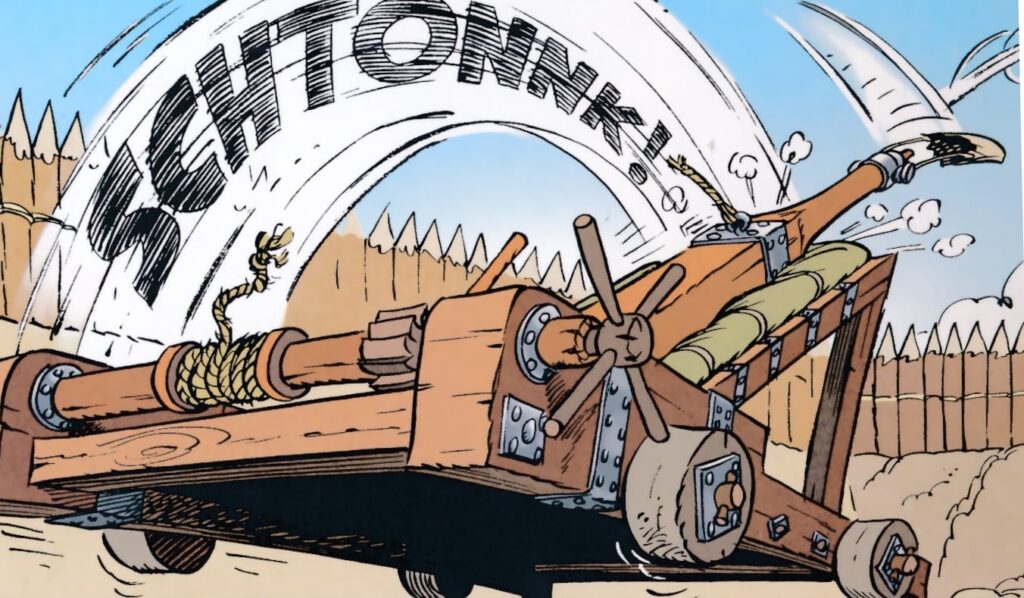
Catapulter (page 40). The French verb catapulter can be used figuratively to describe someone being forcibly propelled or thrown out of somewhere. With Roman siege engines now playing an important role in the adventure, the expression takes on a considerably more literal meaning.
Laisser tomber, again (page 42). Goscinny returns to the expression laisser tomber during the Roman attack on the village. Abraracourcix tells his wife, whom he affectionately calls Mimine in French, to drop the matter. With large stones falling into the village, the expression becomes a visual joke. The same French idiom has now produced two different jokes in the same adventure.
Asterix, Cyrano de Bergerac and the Three Musketeers
One of the album’s most memorable sequences takes place on pages 31 and 32, when Astérix confronts Roméomontaigus in the village inn. Unlike most encounters between Asterix and a Roman, the confrontation develops into a sword fight, drawing upon several literary and cinematic traditions. Roméomontaigus’s reference to the guards of the Grand Pontiff evokes the guards of Cardinal Richelieu, the traditional opponents of the heroes in Alexandre Dumas’s The Three Musketeers. The most important literary reference, however, is Edmond Rostand’s 1897 play Cyrano de Bergerac.
When Roméomontaigus insults Asterix’s large nose, the Gaul criticizes the unimaginative nature of the insult and demonstrates how it could have been delivered more effectively. In Rostand’s play, Cyrano famously compares his enormous nose to a series of increasingly large geographical features:
C’est un roc !… C’est un pic !… C’est un cap !
Que dis-je, c’est un cap ?… C’est une péninsule !
(It’s a rock! It’s a peak! It’s a cape! What am I saying, a cape? It’s a peninsula!)
Goscinny replaces these geographical features with monuments more appropriate to the world of Asterix:
C’est un menhir, que dis-je, un menhir ? C’est un dolmen !
The reference continues when Coriza congratulates Asterix on his clever response. Her expression, Ça, c’est envoyé !, meaning something like ‘That was well delivered!’, allows Asterix to introduce another famous line from Rostand’s play: À la fin de l’envoi, je touche ! In Cyrano’s famous duel, the hero composes a poem while fighting his opponent, promising to strike him at the end of its concluding stanza, known as the envoi. Goscinny thus combines a literary quotation with another example of French wordplay.
How Cyrano Became Hamlet
The sword fight presented a considerable challenge for Anthea Bell and Derek Hockridge. Although Cyrano de Bergerac is known in the English-speaking world, Rostand’s verses do not have the same cultural familiarity as they do in France. The translators therefore replaced the French literary references with quotations from Shakespeare’s Hamlet, drawing on the play’s famous speeches and its concluding sword fight. The result is an almost entirely different literary joke built around exactly the same drawings.
Anthea Bell later identified this passage as one of her favourite examples of translating Asterix. Rather than reproducing the literal meaning of Goscinny’s words, the translators recreated the experience of recognizing a familiar piece of literature in an unexpected setting. Interestingly, the original French name Roméomontaigus already referred to Shakespeare. Although that reference disappeared from the English character’s name, Shakespeare returned to the adventure through the dialogue.
The Mark of Zorro
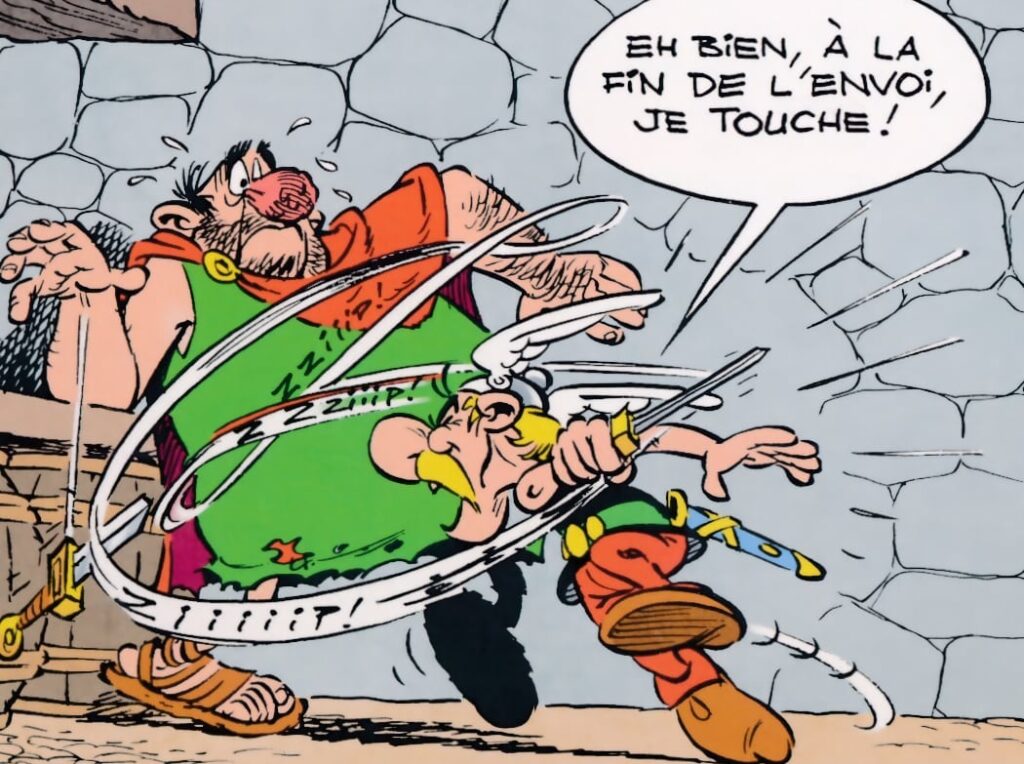
The sword fight concludes with another familiar literary and cinematic reference when Asterix uses his sword to cut the letter Z into the Roman’s clothing, imitating the signature of Zorro. Uderzo drew visual inspiration from The Mark of Zorro, the 1920 silent film starring Douglas Fairbanks, whose theatrical gestures and sword fights helped establish the visual language of the classic swashbuckling adventure. Coriza, however, interprets the letter quite differently. As her nickname is Zaza, she assumes that Asterix has performed the gesture especially for her.
Her exclamation Quel homme ! (What a man!) also recalls the world of Johnston McCulley, the creator of Zorro. The entire sequence demonstrates how effectively Goscinny and Uderzo combined different cultural references. In the space of just a few panels, French readers encounter Dumas, Rostand and Zorro, with Shakespeare joining them in the English translation.
Rivière also suggests a possible additional cinematic reference later in the adventure, when Asterix hopes that a tower is unguarded. The wording recalls the title of the French swashbuckling film La Tour, prends garde ! (1958), starring Jean Marais. This identification, however, is less certain than the references contained in the duel itself.
Popular Songs and Forgotten Military Traditions
The adventure opens in Rome with Roméomontaigus singing a drunken song celebrating the death of a military superior. Its melody and structure come from the traditional French bawdy song Vive la Bretagne, better known for its refrain about the round hats worn by the Bretons. In a version of the traditional song, the singer encounters his mother-in-law’s funeral and expresses his delight at the discovery. Goscinny substitutes a Roman decurion for the unfortunate mother-in-law and introduces an invocation of Jupiter.
Another musical reference appears on page 21, when Assurancetourix performs a song about young wild boars. The French word marcassins bears a phonetic resemblance to the English words ‘marching in’, allowing Goscinny to create a French parody of the famous gospel song When the Saints Go Marching In. The original French album even includes a footnote identifying the song. It is an unusual example of French wordplay originating in the sounds of an English-language song.
One of the more obscure cultural references appears in the expression Père MMMMMMD. The apparently ridiculous Roman numeral represents 6,500 and refers to the French military tradition known as Père Cent, also written percent or persan. During the era of compulsory military service, French conscripts celebrated the moment when they had only one hundred days of service remaining. Goscinny transfers the tradition to the Roman army, where a young legionary still has 6,500 days remaining before his retirement. The joke would have been immediately recognizable to generations of Frenchmen who had completed compulsory military service but is easily missed by modern readers.
The Latin Quotations: From the Bible to Ancient Rome
As usual, Goscinny introduces several Latin expressions into the adventure. Interestingly, two of the principal quotations originate in the Bible rather than in the writings of classical Roman authors. Both appear within the opening pages of the album, demonstrating that Goscinny’s use of Latin owes as much to the cultural and educational background of his readers as it does to ancient Rome.
Vinum et musica laetificant cor
Wine and music gladden the heart.
With these words, Goscinny introduces the opening scene in a Roman tavern. The quotation comes from Ecclesiasticus, also known as Sirach, 40:20 in the Latin Vulgate. The biblical verse continues by explaining that the love of wisdom is superior to both wine and music. Goscinny conveniently omits this concluding observation, which is hardly surprising given that wisdom is not the most obvious characteristic of the drunken legionary we are about to encounter.
The original Jewish wisdom text was composed in the second century BC, meaning that the underlying saying predates the fictional setting of Asterix, although its familiar Latin biblical wording belongs to a considerably later period. Wine and music are, of course, recurring elements throughout the series, although the inhabitants of the Gaulish village might disagree with the second half of the quotation whenever Assurancetourix starts singing.
We previously looked at this expression and the role of wine and music throughout the series in our article Vinum et musica laetificant cor.
Qui habet aures audiendi, audiat
He who has ears to hear, let him hear.
This expression appears in the three synoptic Gospels (Matthew 13:9, Mark 4:9 and Luke 8:8), concluding the Parable of the Sower. The precise wording used by Goscinny corresponds to the Latin Vulgate of Mark 4:9. Since the adventures of Asterix are set in 50 BC, the appearance of a quotation attributed to Jesus is an obvious anachronism.
What makes its use in the album particularly amusing is that a retiring Roman legionary recounts how he once addressed his optio, a subordinate officer, with these words. We are given the conclusion of his anecdote without being told what preceded it. The other soldiers apparently understand the significance of the remark, but Goscinny leaves his readers to imagine the circumstances for themselves.
There is also an interesting curiosity for collectors of different translations. In some Dutch editions, the word aures has been replaced by aurus, which is grammatically incorrect. The original French edition and several English and Italian editions preserve the correct Latin spelling. We examined this translation error and the biblical background of the quotation in He Who Has Ears to Hear: A Biblical Quote in Asterix.
De mortuis nil nisi bonum
Speak nothing but good of the dead.
English-speaking readers will also encounter this traditional expression in the opening sequence. The maxim is generally traced to Chilon of Sparta, one of the Seven Sages of Greece, through the writings of Diogenes Laertius. Its use is particularly ironic in connection with a drinking song celebrating the death of a military superior.
Legio expedita!
This Latin military command can be understood in the context of the adventure as an order for the legionaries to stand ready. Unlike the other Latin expressions, it serves a practical military purpose rather than providing a philosophical or literary observation. Its formal character contrasts amusingly with the decidedly unmilitary behaviour of Roméomontaigus during his final hours of service.
Familiar Faces Hidden in the Drawings
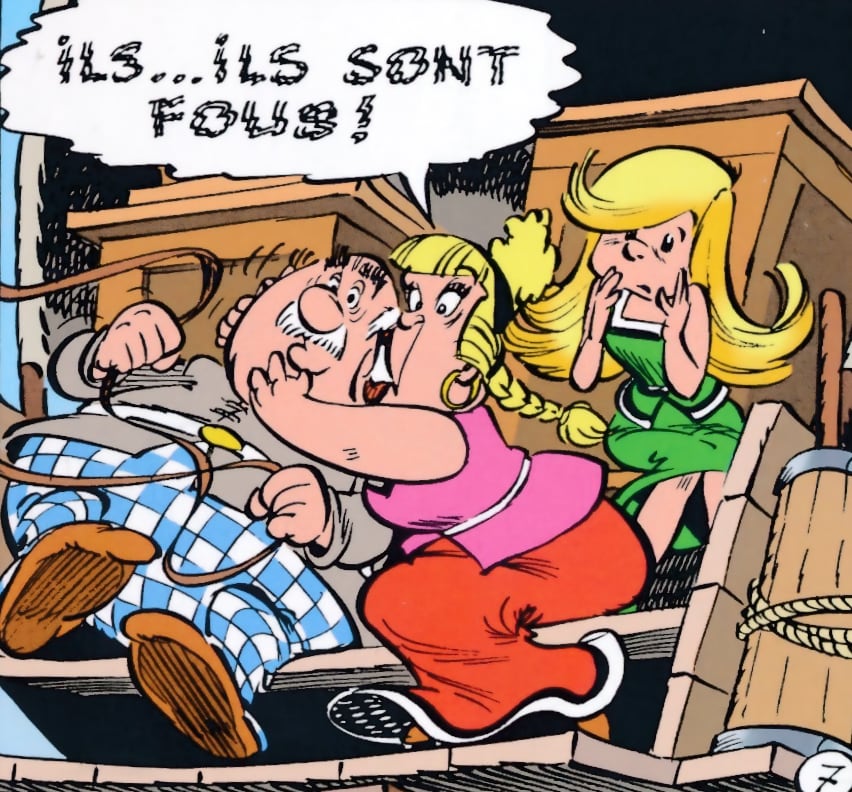
Albert Uderzo regularly used recognizable personalities as models for his characters. Orthopédix is a caricature of French actor André Alerme (1877–1960), whose substantial build and distinctive facial features made him an excellent model for the innkeeper. Angine has also been identified as a possible caricature of actress Françoise Rosay (1891–1974). Interestingly, the two actors appeared together in Jacques Feyder’s 1935 film Pension Mimosas, providing a possible cinematic connection between the two characters.
On page 6, the legionary standing on the left of the line of Roman veterans awaiting their retirement gifts is a caricature of French television presenter and filmmaker Pierre Tchernia. A close friend of Goscinny and Uderzo, Tchernia was one of the personalities most frequently caricatured in the Asterix albums. Readers can find him in several adventures, including Asterix the Legionary, Asterix in Corsica, Obelix and Co. and Asterix in Belgium.
For the appearance of Coriza, Uderzo reportedly drew inspiration from his own daughter, Sylvie. Goscinny’s original instructions described the character as reasonably attractive without being exceptionally beautiful. Her behaviour and fashionable short dress give her the unmistakable personality of a contemporary teenager temporarily stranded in a provincial village. In many respects, she is the female counterpart of Goudurix (Justforkix), whom readers had encountered in Asterix and the Normans.
Obelix and Of Mice and Men
Coriza’s arrival brings out a familiar side of Obélix (Obelix), who, as in Asterix the Legionary, becomes infatuated with a slender blonde woman. His attempts at romantic conversation are characteristically clumsy, and when holding Coriza, he compliments her by telling her that she is lighter than a menhir. There may be a deeper literary influence behind the illustration. Uderzo was profoundly impressed by John Steinbeck’s novel Of Mice and Men, particularly its portrayal of Lennie, a gentle giant possessing immense physical strength. Uderzo explained that he frequently thought of Lennie when drawing the tiny Idéfix (Dogmatix) in Obelix’s enormous hand.
The contrast between strength and tenderness is an important part of Obelix’s personality. His physical power makes him virtually invulnerable, yet emotionally he can be remarkably fragile. His jealousy when Coriza becomes interested in Asterix ultimately drives him into Orthopédix’s camp, bringing the political and romantic storylines together. Asterix, meanwhile, remains largely unaware of the young woman’s interest in him, concentrating instead on his responsibility to protect the village.
A Look at Goscinny’s Original Script
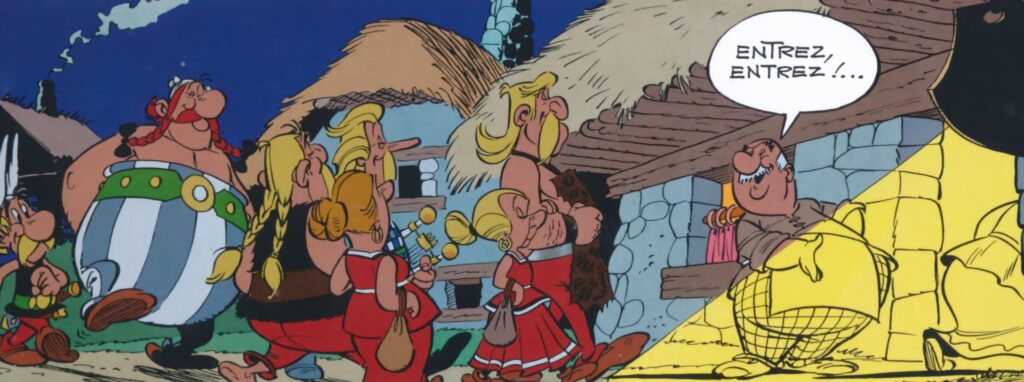
The surviving typewritten script for story page 7, preserved in the Anne Goscinny Archives, provides an interesting insight into the collaboration between Goscinny and Uderzo. When the family approaches the village, an enormous menhir suddenly lands in front of their horse. Obelix arrives and explains that he was simply trying to teach his dog to fetch. Goscinny specifically describes the frightened reactions of Angine and Coriza, contrasting them with the perfectly ordinary conversation between Asterix and Obelix.
For Asterix, the problem is that the menhir is too large. For Obelix, however, there are two equally plausible explanations: either his menhir is too large or his dog is too small. When Asterix warns him that he might eventually kill someone, Obelix dismisses the idea that a menhir could possibly be dangerous, although he acknowledges the potential danger of mushrooms. The humour depends as much on Uderzo’s illustrations as it does on Goscinny’s dialogue. What appears to be a life-threatening experience for the newcomers is an entirely routine disagreement between the two friends.
The Romans’ New Secret Weapon
The Roman attack introduces another contemporary subject: the development of increasingly sophisticated weapons. Roméomontaigus refers to the nouveaux armements, or new weaponry, an expression frequently encountered in French newspapers during the Cold War. During the 1970s, the development of nuclear weapons, including the neutron bomb, generated considerable public discussion. Goscinny translates these modern anxieties into ancient siege warfare, with the Romans employing catapults, ballistae, onagers and mobile siege towers.
There is also a visual parallel between the enormous stone interrupting the political debate and the menhir that nearly strikes the newcomers’ horse at the beginning of the adventure. Uderzo uses similarly exaggerated expressions of terror in both scenes, while the effectiveness of the Roman secret weapon is humorously contrasted with Obelix’s ability to produce much the same result with a single menhir. The menhir deliveryman apparently possesses his own weapon of mass destruction.
Caesar’s Most Successful Gift?
Perhaps the most interesting aspect of Asterix and Caesar’s Gift is that Caesar nearly succeeds in destroying the village without actually intending to do so. In Asterix and the Roman Agent, Caesar deliberately exploited the suspicion and jealousy of the Gauls. In Asterix and the Mansions of the Gods, he attempted to undermine their independence through urban development and economic integration. Here, however, a relatively simple practical joke produces consequences far beyond anything he anticipated. The greatest threat to the village comes not from the Roman army but from the ambitions, prejudices and personal insecurities of its inhabitants.
Two albums later, in Obelix and Co., Caesar would once again attempt to exploit the weaknesses of the Gauls, this time through economic prosperity. Asterix and Caesar’s Gift occupies an important place in this series of adventures: a political satire without a political allegiance, a parody of modern society disguised as ancient history, and a particularly rich example of the linguistic and cultural humour that made the collaboration between Goscinny and Uderzo so successful.
For more information about the album, its characters and international editions, visit our dedicated album page: Asterix and Caesar’s Gift.


Published in 1974, Asterix and Caesar’s Gift (Le Cadeau de César) is the twenty-first adventure in the Asterix series and one of René Goscinny and Albert Uderzo’s most entertaining satires of contemporary French society. Having previously explored tourism, consumerism, urban development and social ambition, the authors now turned their attention to political campaigning, elections and the sometimes questionable motivations of voters. The album appeared during a particularly eventful year in French politics and marked an important turning point in the publishing history of Asterix.
Behind the seemingly straightforward story of a drunken Roman, an ambitious innkeeper and a disputed title deed lies a fascinating mixture of Roman military history, French political satire, biblical quotations, literary references and popular culture. Some of these jokes remain recognizable in the English translation, while others are almost impossible to appreciate without examining the original French.
From Pilote to Le Monde
Since his first appearance on 29 October 1959, Asterix had been closely associated with the French comics magazine Pilote. That relationship came to an end with Asterix in Corsica in 1973. On 10 July 1974, the French daily newspaper Le Monde announced that it would publish the new adventure throughout the summer, with serialization beginning the following day. The transition from a comics magazine originally aimed at younger readers to one of France’s most respected national newspapers illustrates how much the status of Asterix had changed in fifteen years.
Published by Dargaud in July 1974, Le Cadeau de César had an initial print run of 1,400,000 copies. By comparison, the first Asterix album had been printed in just 5,500 copies in 1961. The English translation by Anthea Bell and Derek Hockridge followed in 1977. Given the political nature of the adventure, Le Monde proved a particularly appropriate publication in which to introduce the story.
Honesta Missio: The Historical Roots of Caesar’s Gift
Although much of the album satirizes modern French society, its opening sequence is firmly rooted in Roman military history. The ceremony during which Julius Caesar rewards his retiring legionaries reflects the Roman practice of honesta missio, literally meaning ‘honourable discharge’. Veterans who had completed their military service could receive retirement benefits, known as praemia militiae, which included financial compensation or grants of land.
The distribution of land to veterans was particularly important during the late Roman Republic. Military commanders used land grants to reward their soldiers, secure their loyalty and establish settlements in strategically important territories. Under Augustus, these arrangements became more institutionalized, with the establishment of the aerarium militare, a military treasury intended to finance veterans’ retirement benefits. The standardized twenty-year period of military service mentioned in the album more closely reflects arrangements that developed under the Roman Empire than those of Caesar’s time.
Goscinny takes this historical practice and gives it an absurd twist. While the other retiring legionaries receive valuable plots of land, the troublesome Roméomontaigus (Tremensdelirius) is rewarded with the only village in Gaul that Caesar has failed to conquer. The distinction between receiving a title deed and actually possessing the land becomes the foundation of the entire adventure.
We explored the historical background to this opening sequence in greater detail in our earlier article, Honesta Missio: The Historical Roots of Caesar’s Gift.
The French Presidential Election of 1974
On 2 April 1974, French President Georges Pompidou died in office, forcing France to organize an early presidential election. Interestingly, it had been Pompidou who suggested to Goscinny and Uderzo that they send Asterix to Switzerland. The election ultimately came down to François Mitterrand, representing the left, and Valéry Giscard d’Estaing, representing the centre-right. On 10 May, the two men participated in the first televised debate between the finalists of a French presidential election. Millions of viewers watched the confrontation, which established a tradition that would become a familiar part of French political life. Giscard d’Estaing narrowly won the election on 19 May.
Against this background, the debate between Abraracourcix (Vitalstatistix) and Orthopédix (Orthopaedix) becomes considerably more interesting. The candidates sit behind a table, Assurancetourix (Cacofonix) acts as moderator and an hourglass regulates speaking time, while members of the audience interrupt and express their political preferences. The scene parodies political television programmes that had become increasingly popular in France, including À armes égales and Face à face, both associated with television producer Armand Jammot. Cétautomatix (Fulliautomatix) makes an explicit reference to the latter programme.
Goscinny also mocks the use of statistics in political debates. When figures are presented as evidence of economic progress, the opposing candidate questions their reliability, arguing that statistics can be made to say whatever one wants. Abraracourcix subsequently threatens the moderator when he approaches the hourglass, turning the supposedly civilized debate into something considerably closer to a traditional Gaulish argument. The scene captures the confrontational nature of political television, which would become particularly associated with French Communist politician Georges Marchais and his exchanges with journalists.
Although it is tempting to see the album as a direct parody of the presidential election of 1974, its production would have started well before the election took place. The similarities are better understood against the broader background of political television and electoral campaigning in France during the preceding years. The events of 1974 made the satire especially timely.
Were Goscinny and Uderzo Political?
Despite their frequent political satire, Goscinny and Uderzo consistently denied that Asterix promoted any particular political ideology. The appearance of a heroic Gaul in 1959, shortly after Charles de Gaulle returned to power, nevertheless led some commentators to associate the series with Gaullism. During the political unrest of 1968, the authors and their characters were again associated with defenders of the established order. Paradoxically, their political neutrality allowed readers from different political backgrounds to interpret the adventures according to their own convictions.
In his interviews with Numa Sadoul, published as Astérix & Cie, Entretiens avec Uderzo, Uderzo explained that, despite their close friendship, he and Goscinny had never seriously discussed their political allegiances. He did not even know whether Goscinny considered himself left-wing or right-wing. In 1998, when activists associated with the French RPR party used an illustration of fighting Gauls in a political poster, Uderzo immediately protested against the appropriation of his characters. The poster was withdrawn, and Nicolas Sarkozy, then mayor of Neuilly, personally apologized to him.
This political independence is particularly apparent in Asterix and Caesar’s Gift. Both candidates resort to flattery, questionable promises and attempts to buy the loyalty of their fellow villagers, yet it is remarkably difficult to identify which represents the political left and which represents the right. Goscinny and Uderzo are interested in the behaviour of politicians rather than their political programmes, an approach Uderzo would employ again in Asterix and the Great Divide.
A France of Property Owners
The election is not the album’s only reference to contemporary French society. During the 1960s and 1970s, home ownership became an increasingly important aspiration among French families, and politicians frequently promoted access to private property. Uderzo later explained that the album touched upon the deeply rooted French desire to own a house in the countryside or by the sea. Caesar’s title deed represents a symbolic attempt to annex the Gaulish village administratively, even though his legions have been unable to conquer it militarily.
Had Roméomontaigus presented himself directly at the village gates, the matter would probably have been settled with a few well-placed punches. By transferring the title deed to Orthopédix, an unsuspecting fellow Gaul, Goscinny creates a much more complicated situation. Panoramix (Getafix) refuses to allow his magic potion to be used in a conflict between Gauls, forcing the villagers to find another way of resolving their differences. The very thing that normally guarantees their independence is suddenly of little use to them.
An Election Campaign in Ancient Gaul
Much of the humour comes from placing recognizable modern electoral practices in an ancient setting. Both candidates discover that generosity can be a useful political instrument, particularly when directed at villagers whose support they hope to obtain. Angine (Angina) purchases considerable quantities of fish from Ordralfabétix (Unhygienix), while Bonemine (Impedimenta) and Abraracourcix order a dozen anvils from Cétautomatix. The chief can subsequently present increased anvil production as evidence of the village’s industrial progress. The economic growth he celebrates is therefore the direct result of his own electoral manoeuvring.
Assurancetourix and Ordralfabétix are among the villagers attracted to the newcomers. Both occupy somewhat marginalized positions within the community, one because of his questionable musical abilities and the other because of the equally questionable freshness of his fish. Orthopédix offers them the recognition they rarely receive from their fellow villagers. Personal grievances, wounded pride and the desire to be appreciated prove considerably more important than political convictions.
Lady Macbeth in the Gaulish Village
Although Abraracourcix and Orthopédix are the official candidates, much of the rivalry is driven by their wives. Bonemine can be seen as a comic version of Lady Macbeth, encouraging her somewhat reluctant husband to defend his position. She lacks the cruelty of Shakespeare’s character but shares her determination to preserve the political and social status that comes with her husband’s authority. Angine, meanwhile, sees the position of village chief as an opportunity to improve her family’s circumstances.
The similarities between the two families become apparent when Orthopédix complains about his wealthy brother-in-law, Dithyrambix. Abraracourcix has exactly the same problem with Homéopatix (Homeopathix), whom readers had already encountered in Asterix and the Laurel Wreath. Bonemine and Angine are driven by similar frustrations and ambitions, which explains why they suddenly discover how much they have in common once Orthopédix decides to leave and their rivalry disappears.
The portrayal of women as ambitious and vindictive, and their husbands as comparatively passive, contributed to accusations of misogyny that occasionally surrounded the series. However, the men are hardly portrayed more favourably. The election campaign exposes the vanity, insecurity and susceptibility to flattery of almost everyone involved.
Foreigners Who Are Not From Here
Another interesting aspect of the album is the reaction of Agecanonix (Geriatrix) to the newcomers. Although Orthopédix and his family are Gauls, the elderly villager immediately regards them as foreigners simply because they come from somewhere else. His objections become increasingly absurd when it becomes clear that his understanding of foreigners extends to fellow Gauls who happen to live outside his village.
The joke may have had additional significance for French readers in 1974, when immigration was becoming an increasingly prominent political issue. The French government suspended most new labour immigration in July of that year, while questions concerning the integration of immigrant families would continue to generate political debate. Whether Goscinny deliberately intended a reference to these developments is uncertain, but the intolerance of Agecanonix contrasts sharply with the more open-minded attitudes of Astérix (Asterix) and Panoramix.
The French Character Names and Their Hidden Meanings
The names introduced in Asterix and Caesar’s Gift contain some particularly entertaining examples of Goscinny’s linguistic creativity. While Anthea Bell and Derek Hockridge managed to preserve several of these jokes, others were replaced with entirely new ones.
Roméomontaigus (Tremensdelirius). The name of the drunken Roman legionary comes from Roméo Montaigu, the French name of Romeo Montague, the passionate young lover in Shakespeare’s Romeo and Juliet. The humour lies in the contrast between the two characters: it is difficult to imagine anyone less like Shakespeare’s romantic hero than Goscinny’s frequently intoxicated veteran. The English translators abandoned the literary reference and instead reversed the elements of delirium tremens, a potentially serious condition associated with alcohol withdrawal. Roméomontaigus would eventually return in Asterix and the Actress in 2001.
Claudius Bouilleurdecrus (Egganlettus). A bouilleur de cru is someone who distils alcohol from agricultural produce, such as fruit grown on their own land. The name also carries a largely forgotten political reference. Certain French distillers enjoyed inherited privileges allowing them to produce a limited quantity of alcohol without paying the usual duties. A parliamentary controversy over these privileges in 1954 contributed to the political difficulties of Prime Minister Pierre Mendès-France, whose government fell in February 1955. For contemporary French readers, the name would therefore have suggested both alcohol and political controversy. The English name, a play on egg and lettuce, takes the joke in an entirely different culinary direction.
Orthopédix (Orthopaedix). The innkeeper’s name derives from orthopédie, the medical speciality concerned with bones, joints and the musculoskeletal system. The reference was easily preserved in English and establishes a medical naming convention that continues throughout his family.
Angine (Angina). In everyday French, an angine is an inflammation of the throat, frequently associated with tonsillitis. English readers are more likely to associate angina with chest pain caused by insufficient blood flow to the heart. Although the character’s name remains almost identical in both languages, its usual medical meaning is therefore somewhat different.
Coriza (Influenza). The daughter of Orthopédix and Angine takes her name from coryza, a medical term for inflammation of the nasal mucous membranes, commonly associated with the common cold. The English translators replaced this relatively unfamiliar term with the more recognizable Influenza. Her nickname, Zaza, was retained, allowing an important joke later in the story to survive.
Dithyrambix (Dithyrambix). Although he never actually appears in the album, Orthopédix’s successful brother-in-law receives a wonderfully elaborate name. A dithyrambe was originally an ancient Greek hymn associated with Dionysus. In modern French, the word refers to extravagant praise, while dithyrambique describes something excessively enthusiastic or laudatory. Dithyrambix occupies much the same position in Orthopédix’s life as Homéopatix does in that of Abraracourcix.
Tohubohus (Tonsillitus). The Roman centurion takes his name from the French expression tohu-bohu, meaning disorder, confusion or uproar. Its origins are surprisingly ancient, deriving from the Hebrew tohu va-vohu in Genesis 1:2, describing the unformed and empty state of the earth before the ordering of creation. Through its use in French biblical translations, the expression entered everyday French. In the English edition, the centurion becomes Tonsillitus, extending the album’s collection of medical names.
The Roman camp of Laudanum, meanwhile, takes its name from an alcoholic preparation containing opium, historically used as a painkiller and sedative. Considering the importance of alcohol in the opening pages and the medical names of the newcomers, the involvement of this particular Roman camp seems especially appropriate.
French Wordplay Hidden in the Dialogue
Some of the most entertaining jokes in the album are based on ordinary French expressions that acquire an unexpected literal meaning. Several examples have been identified by Stéphane Rivière in his detailed study of the original French album. The page numbers below follow the conventional album pagination, in which the first story page is page 5.
A salade niçoise (page 8). One of the retiring Roman legionaries receives a plot of land near Nicæ, modern-day Nice, where he intends to grow salad vegetables. The reference is to salade niçoise, the famous culinary speciality associated with the city. Goscinny provides a fictional ancient origin for a recognizable French dish, while the English name Egganlettus gives the scene an additional culinary dimension.
Pour une bouchée de pain (page 9). The French expression literally means ‘for a mouthful of bread’, but figuratively describes acquiring something for a ridiculously low price. Since the title deed to the village really has been exchanged for food and wine, Goscinny manages to use the expression in both its literal and figurative senses simultaneously.
Laisser tomber (page 10). One of Abraracourcix’s shield-bearers becomes increasingly irritated with his employer. The French expression laisser tomber can mean abandoning someone or giving up on something, but also physically dropping someone. For a man whose occupation consists of carrying another person on a shield, the expression has a particularly appropriate double meaning.
Giving someone your voice (page 21). When Orthopédix approaches Assurancetourix for political support, he asks for his voix. In French, the word means both a voice and an electoral vote. The bard responds by pointing out that Orthopédix, like everyone else in the village, does not particularly enjoy hearing his voice. The politician wants the bard’s vote, but nobody wants to hear him sing.
Cochonneries (page 26). The French word cochonnerie generally describes something dirty, unpleasant or worthless. It derives from cochon, meaning pig. When the expression is used in connection with unwanted wild boars that must be buried, the original meaning of the word suddenly becomes relevant again.
Catapulter (page 40). The French verb catapulter can be used figuratively to describe someone being forcibly propelled or thrown out of somewhere. With Roman siege engines now playing an important role in the adventure, the expression takes on a considerably more literal meaning.
Laisser tomber, again (page 42). Goscinny returns to the expression laisser tomber during the Roman attack on the village. Abraracourcix tells his wife, whom he affectionately calls Mimine in French, to drop the matter. With large stones falling into the village, the expression becomes a visual joke. The same French idiom has now produced two different jokes in the same adventure.
Asterix, Cyrano de Bergerac and the Three Musketeers
One of the album’s most memorable sequences takes place on pages 31 and 32, when Astérix confronts Roméomontaigus in the village inn. Unlike most encounters between Asterix and a Roman, the confrontation develops into a sword fight, drawing upon several literary and cinematic traditions. Roméomontaigus’s reference to the guards of the Grand Pontiff evokes the guards of Cardinal Richelieu, the traditional opponents of the heroes in Alexandre Dumas’s The Three Musketeers. The most important literary reference, however, is Edmond Rostand’s 1897 play Cyrano de Bergerac.
When Roméomontaigus insults Asterix’s large nose, the Gaul criticizes the unimaginative nature of the insult and demonstrates how it could have been delivered more effectively. In Rostand’s play, Cyrano famously compares his enormous nose to a series of increasingly large geographical features:
C’est un roc !… C’est un pic !… C’est un cap !
Que dis-je, c’est un cap ?… C’est une péninsule !
(It’s a rock! It’s a peak! It’s a cape! What am I saying, a cape? It’s a peninsula!)
Goscinny replaces these geographical features with monuments more appropriate to the world of Asterix:
C’est un menhir, que dis-je, un menhir ? C’est un dolmen !
The reference continues when Coriza congratulates Asterix on his clever response. Her expression, Ça, c’est envoyé !, meaning something like ‘That was well delivered!’, allows Asterix to introduce another famous line from Rostand’s play: À la fin de l’envoi, je touche ! In Cyrano’s famous duel, the hero composes a poem while fighting his opponent, promising to strike him at the end of its concluding stanza, known as the envoi. Goscinny thus combines a literary quotation with another example of French wordplay.
How Cyrano Became Hamlet
The sword fight presented a considerable challenge for Anthea Bell and Derek Hockridge. Although Cyrano de Bergerac is known in the English-speaking world, Rostand’s verses do not have the same cultural familiarity as they do in France. The translators therefore replaced the French literary references with quotations from Shakespeare’s Hamlet, drawing on the play’s famous speeches and its concluding sword fight. The result is an almost entirely different literary joke built around exactly the same drawings.
Anthea Bell later identified this passage as one of her favourite examples of translating Asterix. Rather than reproducing the literal meaning of Goscinny’s words, the translators recreated the experience of recognizing a familiar piece of literature in an unexpected setting. Interestingly, the original French name Roméomontaigus already referred to Shakespeare. Although that reference disappeared from the English character’s name, Shakespeare returned to the adventure through the dialogue.
The Mark of Zorro
The sword fight concludes with another familiar literary and cinematic reference when Asterix uses his sword to cut the letter Z into the Roman’s clothing, imitating the signature of Zorro. Uderzo drew visual inspiration from The Mark of Zorro, the 1920 silent film starring Douglas Fairbanks, whose theatrical gestures and sword fights helped establish the visual language of the classic swashbuckling adventure. Coriza, however, interprets the letter quite differently. As her nickname is Zaza, she assumes that Asterix has performed the gesture especially for her.
Her exclamation Quel homme ! (What a man!) also recalls the world of Johnston McCulley, the creator of Zorro. The entire sequence demonstrates how effectively Goscinny and Uderzo combined different cultural references. In the space of just a few panels, French readers encounter Dumas, Rostand and Zorro, with Shakespeare joining them in the English translation.
Rivière also suggests a possible additional cinematic reference later in the adventure, when Asterix hopes that a tower is unguarded. The wording recalls the title of the French swashbuckling film La Tour, prends garde ! (1958), starring Jean Marais. This identification, however, is less certain than the references contained in the duel itself.
Popular Songs and Forgotten Military Traditions
The adventure opens in Rome with Roméomontaigus singing a drunken song celebrating the death of a military superior. Its melody and structure come from the traditional French bawdy song Vive la Bretagne, better known for its refrain about the round hats worn by the Bretons. In a version of the traditional song, the singer encounters his mother-in-law’s funeral and expresses his delight at the discovery. Goscinny substitutes a Roman decurion for the unfortunate mother-in-law and introduces an invocation of Jupiter.
Another musical reference appears on page 21, when Assurancetourix performs a song about young wild boars. The French word marcassins bears a phonetic resemblance to the English words ‘marching in’, allowing Goscinny to create a French parody of the famous gospel song When the Saints Go Marching In. The original French album even includes a footnote identifying the song. It is an unusual example of French wordplay originating in the sounds of an English-language song.
One of the more obscure cultural references appears in the expression Père MMMMMMD. The apparently ridiculous Roman numeral represents 6,500 and refers to the French military tradition known as Père Cent, also written percent or persan. During the era of compulsory military service, French conscripts celebrated the moment when they had only one hundred days of service remaining. Goscinny transfers the tradition to the Roman army, where a young legionary still has 6,500 days remaining before his retirement. The joke would have been immediately recognizable to generations of Frenchmen who had completed compulsory military service but is easily missed by modern readers.
The Latin Quotations: From the Bible to Ancient Rome
As usual, Goscinny introduces several Latin expressions into the adventure. Interestingly, two of the principal quotations originate in the Bible rather than in the writings of classical Roman authors. Both appear within the opening pages of the album, demonstrating that Goscinny’s use of Latin owes as much to the cultural and educational background of his readers as it does to ancient Rome.
Vinum et musica laetificant cor
Wine and music gladden the heart.
With these words, Goscinny introduces the opening scene in a Roman tavern. The quotation comes from Ecclesiasticus, also known as Sirach, 40:20 in the Latin Vulgate. The biblical verse continues by explaining that the love of wisdom is superior to both wine and music. Goscinny conveniently omits this concluding observation, which is hardly surprising given that wisdom is not the most obvious characteristic of the drunken legionary we are about to encounter.
The original Jewish wisdom text was composed in the second century BC, meaning that the underlying saying predates the fictional setting of Asterix, although its familiar Latin biblical wording belongs to a considerably later period. Wine and music are, of course, recurring elements throughout the series, although the inhabitants of the Gaulish village might disagree with the second half of the quotation whenever Assurancetourix starts singing.
We previously looked at this expression and the role of wine and music throughout the series in our article Vinum et musica laetificant cor.
Qui habet aures audiendi, audiat
He who has ears to hear, let him hear.
This expression appears in the three synoptic Gospels (Matthew 13:9, Mark 4:9 and Luke 8:8), concluding the Parable of the Sower. The precise wording used by Goscinny corresponds to the Latin Vulgate of Mark 4:9. Since the adventures of Asterix are set in 50 BC, the appearance of a quotation attributed to Jesus is an obvious anachronism.
What makes its use in the album particularly amusing is that a retiring Roman legionary recounts how he once addressed his optio, a subordinate officer, with these words. We are given the conclusion of his anecdote without being told what preceded it. The other soldiers apparently understand the significance of the remark, but Goscinny leaves his readers to imagine the circumstances for themselves.
There is also an interesting curiosity for collectors of different translations. In some Dutch editions, the word aures has been replaced by aurus, which is grammatically incorrect. The original French edition and several English and Italian editions preserve the correct Latin spelling. We examined this translation error and the biblical background of the quotation in He Who Has Ears to Hear: A Biblical Quote in Asterix.
De mortuis nil nisi bonum
Speak nothing but good of the dead.
English-speaking readers will also encounter this traditional expression in the opening sequence. The maxim is generally traced to Chilon of Sparta, one of the Seven Sages of Greece, through the writings of Diogenes Laertius. Its use is particularly ironic in connection with a drinking song celebrating the death of a military superior.
Legio expedita!
This Latin military command can be understood in the context of the adventure as an order for the legionaries to stand ready. Unlike the other Latin expressions, it serves a practical military purpose rather than providing a philosophical or literary observation. Its formal character contrasts amusingly with the decidedly unmilitary behaviour of Roméomontaigus during his final hours of service.
Familiar Faces Hidden in the Drawings
Albert Uderzo regularly used recognizable personalities as models for his characters. Orthopédix is a caricature of French actor André Alerme (1877–1960), whose substantial build and distinctive facial features made him an excellent model for the innkeeper. Angine has also been identified as a possible caricature of actress Françoise Rosay (1891–1974). Interestingly, the two actors appeared together in Jacques Feyder’s 1935 film Pension Mimosas, providing a possible cinematic connection between the two characters.
On page 6, the legionary standing on the left of the line of Roman veterans awaiting their retirement gifts is a caricature of French television presenter and filmmaker Pierre Tchernia. A close friend of Goscinny and Uderzo, Tchernia was one of the personalities most frequently caricatured in the Asterix albums. Readers can find him in several adventures, including Asterix the Legionary, Asterix in Corsica, Obelix and Co. and Asterix in Belgium.
For the appearance of Coriza, Uderzo reportedly drew inspiration from his own daughter, Sylvie. Goscinny’s original instructions described the character as reasonably attractive without being exceptionally beautiful. Her behaviour and fashionable short dress give her the unmistakable personality of a contemporary teenager temporarily stranded in a provincial village. In many respects, she is the female counterpart of Goudurix (Justforkix), whom readers had encountered in Asterix and the Normans.
Obelix and Of Mice and Men
Coriza’s arrival brings out a familiar side of Obélix (Obelix), who, as in Asterix the Legionary, becomes infatuated with a slender blonde woman. His attempts at romantic conversation are characteristically clumsy, and when holding Coriza, he compliments her by telling her that she is lighter than a menhir. There may be a deeper literary influence behind the illustration. Uderzo was profoundly impressed by John Steinbeck’s novel Of Mice and Men, particularly its portrayal of Lennie, a gentle giant possessing immense physical strength. Uderzo explained that he frequently thought of Lennie when drawing the tiny Idéfix (Dogmatix) in Obelix’s enormous hand.
The contrast between strength and tenderness is an important part of Obelix’s personality. His physical power makes him virtually invulnerable, yet emotionally he can be remarkably fragile. His jealousy when Coriza becomes interested in Asterix ultimately drives him into Orthopédix’s camp, bringing the political and romantic storylines together. Asterix, meanwhile, remains largely unaware of the young woman’s interest in him, concentrating instead on his responsibility to protect the village.
A Look at Goscinny’s Original Script
The surviving typewritten script for story page 7, preserved in the Anne Goscinny Archives, provides an interesting insight into the collaboration between Goscinny and Uderzo. When the family approaches the village, an enormous menhir suddenly lands in front of their horse. Obelix arrives and explains that he was simply trying to teach his dog to fetch. Goscinny specifically describes the frightened reactions of Angine and Coriza, contrasting them with the perfectly ordinary conversation between Asterix and Obelix.
For Asterix, the problem is that the menhir is too large. For Obelix, however, there are two equally plausible explanations: either his menhir is too large or his dog is too small. When Asterix warns him that he might eventually kill someone, Obelix dismisses the idea that a menhir could possibly be dangerous, although he acknowledges the potential danger of mushrooms. The humour depends as much on Uderzo’s illustrations as it does on Goscinny’s dialogue. What appears to be a life-threatening experience for the newcomers is an entirely routine disagreement between the two friends.
The Romans’ New Secret Weapon
The Roman attack introduces another contemporary subject: the development of increasingly sophisticated weapons. Roméomontaigus refers to the nouveaux armements, or new weaponry, an expression frequently encountered in French newspapers during the Cold War. During the 1970s, the development of nuclear weapons, including the neutron bomb, generated considerable public discussion. Goscinny translates these modern anxieties into ancient siege warfare, with the Romans employing catapults, ballistae, onagers and mobile siege towers.
There is also a visual parallel between the enormous stone interrupting the political debate and the menhir that nearly strikes the newcomers’ horse at the beginning of the adventure. Uderzo uses similarly exaggerated expressions of terror in both scenes, while the effectiveness of the Roman secret weapon is humorously contrasted with Obelix’s ability to produce much the same result with a single menhir. The menhir deliveryman apparently possesses his own weapon of mass destruction.
Caesar’s Most Successful Gift?
Perhaps the most interesting aspect of Asterix and Caesar’s Gift is that Caesar nearly succeeds in destroying the village without actually intending to do so. In Asterix and the Roman Agent, Caesar deliberately exploited the suspicion and jealousy of the Gauls. In Asterix and the Mansions of the Gods, he attempted to undermine their independence through urban development and economic integration. Here, however, a relatively simple practical joke produces consequences far beyond anything he anticipated. The greatest threat to the village comes not from the Roman army but from the ambitions, prejudices and personal insecurities of its inhabitants.
Two albums later, in Obelix and Co., Caesar would once again attempt to exploit the weaknesses of the Gauls, this time through economic prosperity. Asterix and Caesar’s Gift occupies an important place in this series of adventures: a political satire without a political allegiance, a parody of modern society disguised as ancient history, and a particularly rich example of the linguistic and cultural humour that made the collaboration between Goscinny and Uderzo so successful.
For more information about the album, its characters and international editions, visit our dedicated album page: Asterix and Caesar’s Gift.