When Albert Uderzo published Asterix and the Actress (Astérix et Latraviata) in 2001, one of the album’s strangest moments came near the end of the story. Asterix finds himself stranded at sea, apparently without any way to escape. Then, in wonderfully improbable Asterix fashion, dolphins come to his rescue. At first glance, the scene can seem like a convenient deus ex machina. Many fans criticized this sequence, feeling it lacked the grounded narrative buildup typical of earlier Goscinny-era albums. Why dolphins? Why should they suddenly appear and save Asterix? There is, however, a much older tradition of stories about extraordinary encounters between humans and animals. The ancient Greeks even had a name for literature devoted to such remarkable stories: paradoxography.
What is Paradoxography in Ancient Greek Literature?
The word paradoxography comes from the Greek paradoxon, meaning something unexpected, extraordinary, or contrary to ordinary expectation, and graphein, meaning “to write.” Paradoxographical works collected accounts of remarkable things: strange natural phenomena, unusual animals, extraordinary customs, and events that seemed to challenge what people normally considered possible.
The genre became particularly prominent in the Hellenistic period, where writers such as Antigonus of Carystus compiled collections of paradoxa, bringing together reports of things that astonished their readers. These were not necessarily “miracles” in the later religious sense. The fascination was precisely that something unusual had happened and was worth recording. A strange animal, an unusual natural phenomenon, or an astonishing human experience could become a paradoxon simply because it was extraordinary, and dolphins provided some particularly memorable examples.
The Motif of the Dolphin Rescue in Ancient Texts
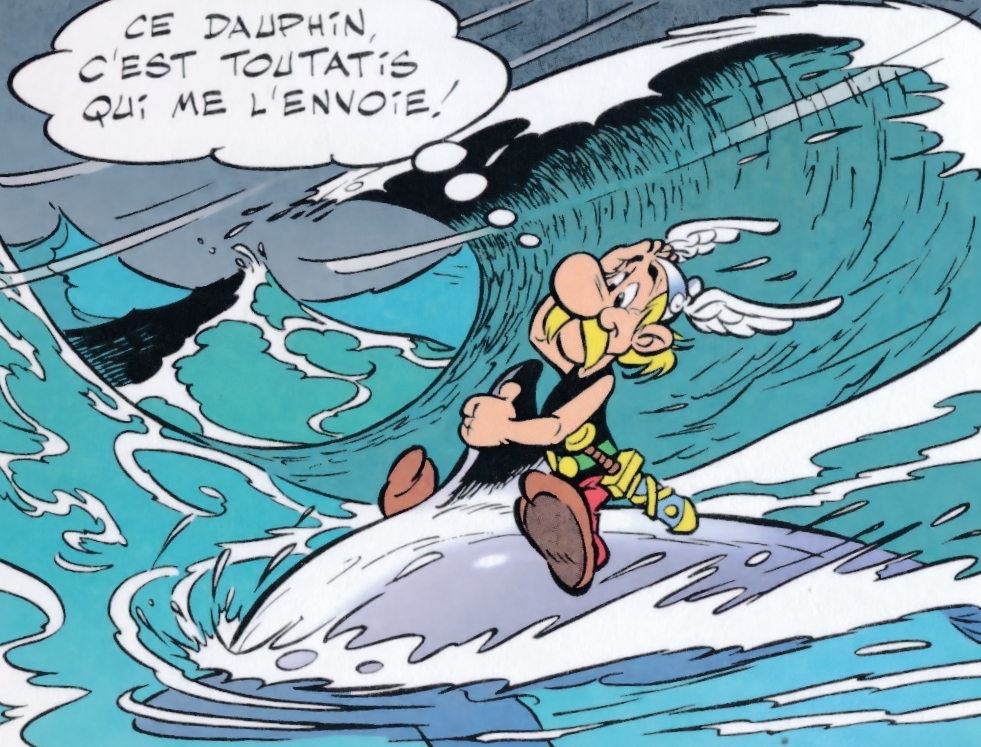
Antigonus of Carystus’s Historiae Mirabiles (“Wondrous Histories”) contains stories of remarkable encounters between humans and animals, including an account in which a man rides on the back of a dolphin. This is not an isolated curiosity in ancient literature. Dolphins repeatedly appear in Greek and Roman stories as unusually intelligent animals with a remarkable affinity for human beings. The famous story of Arion, preserved by Herodotus, tells of a musician who was thrown into the sea and carried safely to shore by a dolphin. To a modern reader, these stories can sound like fantasy. To ancient writers interested in paradoxa, however, precisely this kind of extraordinary event was worth collecting and discussing.
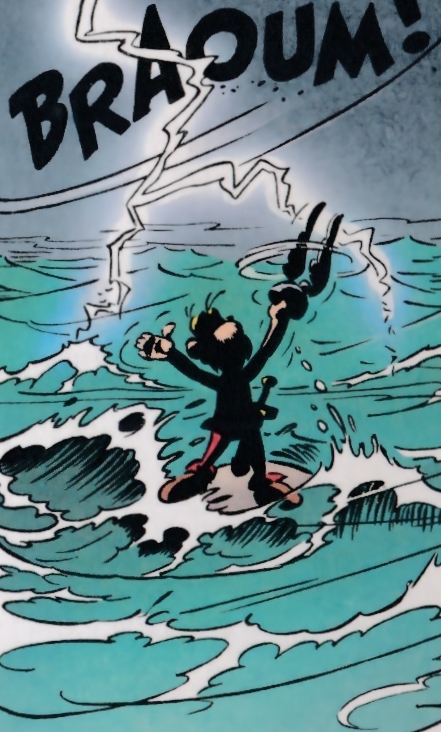
That makes the dolphin rescue in Asterix and the Actress particularly interesting. Uderzo was familiar with the literary and cultural world of antiquity. Throughout the Asterix albums, ancient history, mythology, literature, and popular traditions are repeatedly transformed into comic material. Against that background, it is reasonable to read Uderzo’s illustrative choices and the dolphin rescue in the context of this older tradition of extraordinary dolphin stories. Asterix’s rescue may look like a random comic solution, but the basic idea is surprisingly ancient: a human being in serious trouble at sea is saved through an extraordinary encounter with a dolphin. Whether Uderzo had a particular ancient text open in front of him when creating the scene cannot be established from the album itself, but the resemblance to the ancient tradition is striking—and paradoxography gives us a useful name for the kind of literature in which such stories flourished.
Asterix on the Water: A Subtle Echo of the New Testament
There is another intriguing detail in the same sequence. Before the dolphin comes to Asterix’s aid, the pirates see him standing on a rock surrounded by water. From their perspective, the sight is so unexpected that Redbeard believes he is seeing a ghost. This scene invites comparison with one of the best-known episodes in the New Testament. In Matthew 14:22–33 and Mark 6:45–52, the disciples see Jesus appearing on the water during a storm and become frightened because they think they are seeing a ghost. The textual connection is particularly notable in the original French text: Redbeard cries out, “Un spectre !” which aligns perfectly with the standard French biblical translation of the disciples crying out, “C’est un fantôme !”
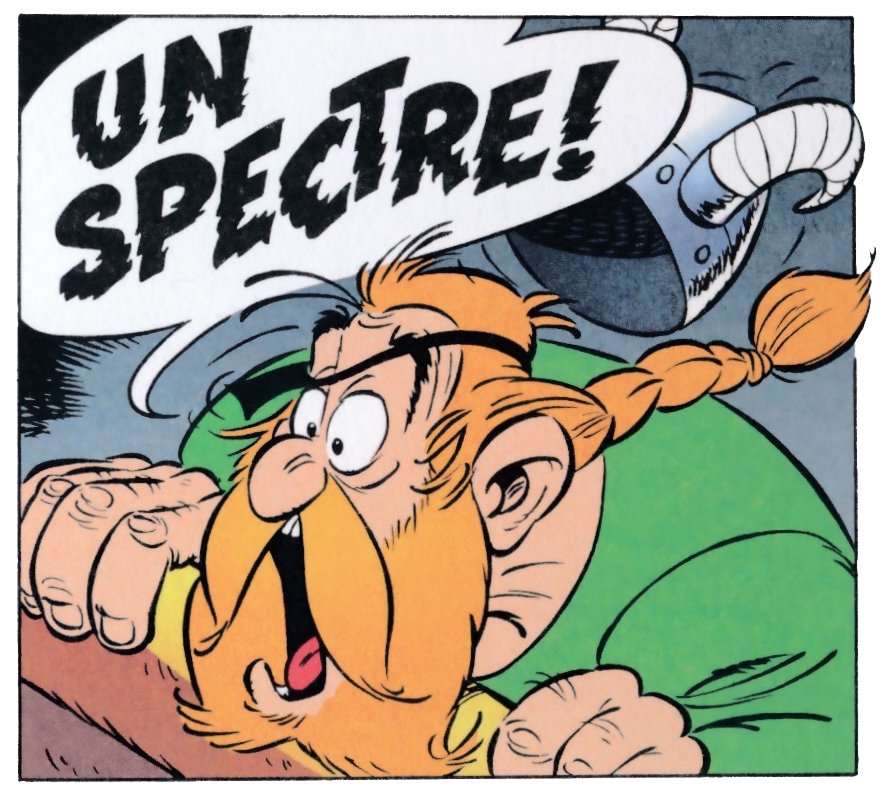
The parallel is not exact. Asterix is standing on a rock rather than literally walking across the water, and frightened pirates are hardly the same as Jesus’ disciples. Nevertheless, the basic visual joke is remarkably similar: people at sea see a familiar figure apparently appearing in an impossible situation and initially interpret what they see as a supernatural apparition. It is therefore possible to read the pirate scene as a playful echo of the Gospel story. That interpretation should remain an interpretation rather than a documented statement of Uderzo’s intention, but it fits a broader characteristic of Asterix: ancient material is often transformed so thoroughly into comedy that the original reference can become easy to overlook.
From Dolphin to Paradoxography
This is what makes the dolphin rescue more interesting than it initially appears. The scene does not need to be narratively realistic to have an ancient literary ancestry. Long before Uderzo, writers were fascinated by stories that sounded extraordinary: men riding dolphins, musicians being rescued from the sea, animals behaving in remarkable ways, and natural phenomena that seemed to defy expectation. The ancient world had a literary category for collecting such things: paradoxography.
Once you know the word, the dolphin rescue in Asterix and the Actress looks slightly different. Instead of seeing only a convenient cartoon escape, we can also recognize an ancient storytelling pattern: the sudden appearance of something extraordinary at precisely the moment when ordinary solutions have failed. That does not mean that every improbable event in Asterix should be labelled paradoxography, nor does it prove that Uderzo consciously copied Antigonus of Carystus. But Uderzo’s familiarity with classical literature makes the comparison far more than a random coincidence. The dolphins therefore provide an amusing gateway into a forgotten part of ancient literary culture. What looks like a bizarre comic invention turns out to have a surprisingly long ancestry—and that ancestry has a name: paradoxography, the ancient art of writing about things that astonish.


When Albert Uderzo published Asterix and the Actress (Astérix et Latraviata) in 2001, one of the album’s strangest moments came near the end of the story. Asterix finds himself stranded at sea, apparently without any way to escape. Then, in wonderfully improbable Asterix fashion, dolphins come to his rescue. At first glance, the scene can seem like a convenient deus ex machina. Many fans criticized this sequence, feeling it lacked the grounded narrative buildup typical of earlier Goscinny-era albums. Why dolphins? Why should they suddenly appear and save Asterix? There is, however, a much older tradition of stories about extraordinary encounters between humans and animals. The ancient Greeks even had a name for literature devoted to such remarkable stories: paradoxography.
What is Paradoxography in Ancient Greek Literature?
The word paradoxography comes from the Greek paradoxon, meaning something unexpected, extraordinary, or contrary to ordinary expectation, and graphein, meaning “to write.” Paradoxographical works collected accounts of remarkable things: strange natural phenomena, unusual animals, extraordinary customs, and events that seemed to challenge what people normally considered possible.
The genre became particularly prominent in the Hellenistic period, where writers such as Antigonus of Carystus compiled collections of paradoxa, bringing together reports of things that astonished their readers. These were not necessarily “miracles” in the later religious sense. The fascination was precisely that something unusual had happened and was worth recording. A strange animal, an unusual natural phenomenon, or an astonishing human experience could become a paradoxon simply because it was extraordinary, and dolphins provided some particularly memorable examples.
The Motif of the Dolphin Rescue in Ancient Texts
Antigonus of Carystus’s Historiae Mirabiles (“Wondrous Histories”) contains stories of remarkable encounters between humans and animals, including an account in which a man rides on the back of a dolphin. This is not an isolated curiosity in ancient literature. Dolphins repeatedly appear in Greek and Roman stories as unusually intelligent animals with a remarkable affinity for human beings. The famous story of Arion, preserved by Herodotus, tells of a musician who was thrown into the sea and carried safely to shore by a dolphin. To a modern reader, these stories can sound like fantasy. To ancient writers interested in paradoxa, however, precisely this kind of extraordinary event was worth collecting and discussing.
That makes the dolphin rescue in Asterix and the Actress particularly interesting. Uderzo was familiar with the literary and cultural world of antiquity. Throughout the Asterix albums, ancient history, mythology, literature, and popular traditions are repeatedly transformed into comic material. Against that background, it is reasonable to read Uderzo’s illustrative choices and the dolphin rescue in the context of this older tradition of extraordinary dolphin stories. Asterix’s rescue may look like a random comic solution, but the basic idea is surprisingly ancient: a human being in serious trouble at sea is saved through an extraordinary encounter with a dolphin. Whether Uderzo had a particular ancient text open in front of him when creating the scene cannot be established from the album itself, but the resemblance to the ancient tradition is striking—and paradoxography gives us a useful name for the kind of literature in which such stories flourished.
Asterix on the Water: A Subtle Echo of the New Testament
There is another intriguing detail in the same sequence. Before the dolphin comes to Asterix’s aid, the pirates see him standing on a rock surrounded by water. From their perspective, the sight is so unexpected that Redbeard believes he is seeing a ghost. This scene invites comparison with one of the best-known episodes in the New Testament. In Matthew 14:22–33 and Mark 6:45–52, the disciples see Jesus appearing on the water during a storm and become frightened because they think they are seeing a ghost. The textual connection is particularly notable in the original French text: Redbeard cries out, “Un spectre !” which aligns perfectly with the standard French biblical translation of the disciples crying out, “C’est un fantôme !”
The parallel is not exact. Asterix is standing on a rock rather than literally walking across the water, and frightened pirates are hardly the same as Jesus’ disciples. Nevertheless, the basic visual joke is remarkably similar: people at sea see a familiar figure apparently appearing in an impossible situation and initially interpret what they see as a supernatural apparition. It is therefore possible to read the pirate scene as a playful echo of the Gospel story. That interpretation should remain an interpretation rather than a documented statement of Uderzo’s intention, but it fits a broader characteristic of Asterix: ancient material is often transformed so thoroughly into comedy that the original reference can become easy to overlook.
From Dolphin to Paradoxography
This is what makes the dolphin rescue more interesting than it initially appears. The scene does not need to be narratively realistic to have an ancient literary ancestry. Long before Uderzo, writers were fascinated by stories that sounded extraordinary: men riding dolphins, musicians being rescued from the sea, animals behaving in remarkable ways, and natural phenomena that seemed to defy expectation. The ancient world had a literary category for collecting such things: paradoxography.
Once you know the word, the dolphin rescue in Asterix and the Actress looks slightly different. Instead of seeing only a convenient cartoon escape, we can also recognize an ancient storytelling pattern: the sudden appearance of something extraordinary at precisely the moment when ordinary solutions have failed. That does not mean that every improbable event in Asterix should be labelled paradoxography, nor does it prove that Uderzo consciously copied Antigonus of Carystus. But Uderzo’s familiarity with classical literature makes the comparison far more than a random coincidence. The dolphins therefore provide an amusing gateway into a forgotten part of ancient literary culture. What looks like a bizarre comic invention turns out to have a surprisingly long ancestry—and that ancestry has a name: paradoxography, the ancient art of writing about things that astonish.