For decades, Assurancetourix (Cacofonix in English) has been portrayed as the village’s worst musician: tied up, gagged, and ridiculed during feasts. But a closer look at his performances in the original French albums reveals a creative artist—one who skillfully parodies folk, classical, and contemporary songs. Perhaps he was misunderstood rather than terrible.
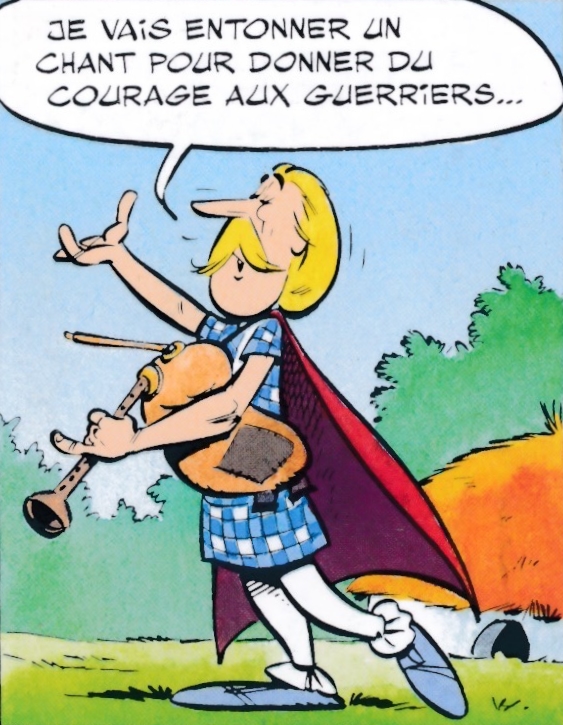
A Bard Sometimes Respected
- In Astérix le Gaulois, villagers danced along to his instrumental, showing he could competently play the lyre—and even bagpipes later—suggesting his voice, not his musicianship, was problematic.
- In Le Combat des chefs, the aged Getafix—suffering from amnesia—laughs and appears to enjoy Cacofonix’s performance, indicating that his unconventional style could resonate with open ears .
- In Astérix et les Normands, Justforkix encourages him to sing, suggesting that youth might have appreciated his artistic voice.
These glimpses hint that Cacofonix’s performances were avant-garde rather than outright bad.
Song Table: Lyrics, Albums, and Parodies
| Album (FR) | Page | Lyrics (FR) | Parody / Source | Details / Notes |
|---|---|---|---|---|
| Astérix le Gladiateur | 6 | « Ils ont des casques ailés, vive les Celtes » | Parody of Ils ont des chapeaux ronds (Breton folk) | Traditional Breton song, mocking regional stereotypes |
| 7 | « Massilia de mes amours » | Rossignol de mes amours – Luis Mariano (1950) | Popular operetta aria by the Spanish tenor | |
| 12 | « Il était une petite galère… ohé ohé » | Il était un petit navire(Traditional) | French children’s sea shanty | |
| 37 | « Menhir montant, mais oui madame » | Ménilmontant – Charles Trenet (1938) | Parody with wordplay on “menhir” and Trenet’s Parisian neighborhood | |
| 37 | « C’est le petit vin blanc qu’on boit… » | Ah! Le petit vin blanc – Jean Dréjac (1943) | Classic French guinguette-style song | |
| 41 | « Salut, ô mon dernier latin » | Aria from Faust – “Salut, ô mon dernier matin” | From Faust by Gounod, sung by Valentin | |
| 42 | « Jolie fleur de pa pa pa… » | Jolie fleur de papillon – Annie Cordy (1955) | Belgian singer/actress, comedic song | |
| Le Combat des chefs | 13 | « Nuits latines, nuits câlines… » | Tune from 1920s cabaret song by Ernest Dumont | Possibly Nuits d’Orient, phrasing matches Dumont style |
| Astérix et les Normands | 8 | « Le folklore armoricain » | Le folklore américain – Sheila (1965) | French yé-yé hit with regional twist |
| 36 | « Un milia passuum à pied… » | Un kilomètre à pied… (French marching song) | Children’s chant, taught in schools | |
| 42 | « J’aime la Gaule, la cervoise… les femmes… » | “J’aime la Gaule, la cervoise, Toutatis et les femmes, les femmes, les femmes qui ont les yeux bleus…” | Aparody of Charles Trenet’s song Un rien me fait chanter. | |
| 42 | « Ça balance ! Ça balance ! Oh, oui ! » | 1960s yé-yé style parody | Referencing artists like France Gall or Sheila | |
| 43 | « Ma mère m’a dit… fais-toi tresser les cheveux » | Parody of children’s rhyme Ma mère m’a dit | Appears in schoolyard rhymes | |
| 46 | « Et tout ça, ça fait d’excellents Gaulois… » | Tribute-style finale | Structurally reminiscent of “Tout ça, ça fait d’excellents Français” (1940s) | |
| Astérix en Hispanie | 20 | « Je suis un petit garçon… » | Rhyme structure of Petit garçon – Graeme Allwright (1967) | Evokes innocence in parody of French lullaby structure |
| 20 | « J’vous ai apporté des sanglieeeeers… » | « Je vous ai apporté des bonbons / Parce que les fleurs, c’est périssable » from “Les Bonbons” by Jacques Brel – 1964 | The caricatured Belgian pronunciation (“ça est tellement bon”) mimics Brel’s accent and comedic tone. | |
| Le Domaine des dieux | 40 | « J’aimeu les forêts… dirladada… » | Darla dirladada – Dalida (1970) | Greek folk rhythm adapted by French singer Dalida |
| Le Devin | 33 | « Ô matrone bleue… » | Mamy Blue by Hubert Giraud – 1970 | Originally composed as an instrumental while stuck in traffic in Paris, Mamy Blue was quickly turned into a vocal hit. |
| Le Cadeau de César | 21 | « Ô marcassins… vous m’donnez faim. » | When the Saints Go Marching Inparody | Gospel tune reworded humorously |
| Astérix chez Rahàzade | 6 | « Petit génie Ariel… » | Echo of Petit Papa Noël – Tino Rossi (1946) | Satirical twist on France’s classic holiday song |
| 7 | « Toute la pluie… tombe sur moi » | Possibly Raindrops Keep Fallin’ on My Head – B.J. Thomas (1969) | Licensed inspiration suspected | |
| 18 | « Ah! Je ris de revoir Cybèle… » | Faust aria pastiche | Dramatic soprano parody, not a direct quote | |
| 20 | « La mer… qu’on voit danser… » | La Mer – Charles Trenet (1946) | Direct lyrical parody | |
| 46–47 | « aïm sïnguïn in ze rèïnnn… » | Singin’ in the Rain (1952) | Written phonetically in “Celtic accent” | |
| La Rose et le Glaive | 19 | “Je suis seul, ce soiiiiir” | Seule ce soir – Jean Casanova & Rose Noël (1941) | A wartime ballad written from the perspective of a woman, Cacofonix however reservers that role. |
| Astérix et la Rentrée gauloise | 17 | « J’aime la Gaule… » | See Astérix et les Normands page 42 | |
| Le Ciel lui tombe sur la tête | 13 | « Si j’avais un marteau » | French version of If I Had a Hammer – Claude François (1963) | Pete Seeger/Trini Lopez original; French by Cloclo |
| 47 | « Crac! Boum! Huuuu! » | “Air connu” placeholder for popular tune | Imitates cliché chanson phrases | |
| L’Iris blanc | 20 | « Glaive lève‑toi et danse à Gergovie » | Parody of Ève lève-toi – Julie Pietri (1986) | 1980s French synth-pop hit |
| 20 | « Besoin d’Orion, envie de Troie » | Besoin de rien, envie de toi – Peter & Sloane (1984) | Romantic duo hit | |
| 21 | « On s’était dit rendez-vous dans Byzance » | Place des Grands Hommes – Patrick Bruel (1989) | 1980s chanson à texte | |
| 21 | « Légionnaire particulier… » | Partenaire particulier – Partenaire Particulier (1985) | Cold-wave style; literal parody of band name | |
| 21 | « Alésia boire un p’tit coup… » | Viens boire un p’tit coup à la maison – Licence IV (1986) | Drinking song with Gaulish pun |
You can find the UK English version right here.
Le Menhir d’Or: The Bard’s Spotlight
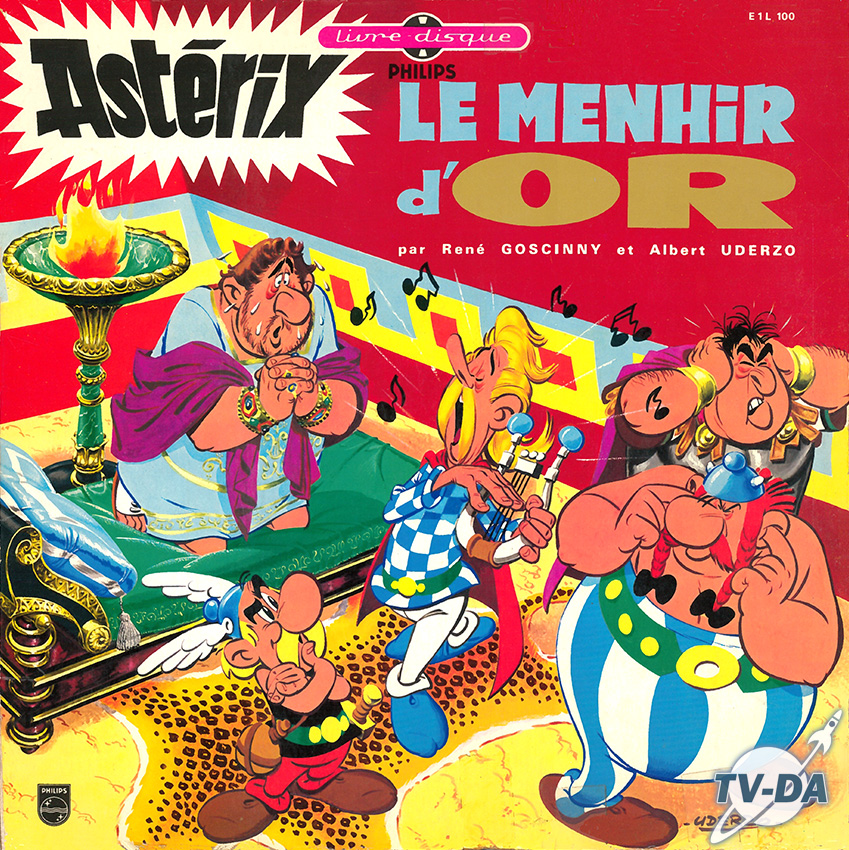
Le Menhir d’Or was released in 1967 as a 33‑RPM livre‑disque, a parody of an Eurovision‑style bard contest. Cacofonix steals the spotlight with “Menhir montant” (a play on Charles Trenet’s “Ménilmontant”), while other bard characters parody hits like “Le Folklore armoricain” (Sheila, 1965), “Si j’avais un dolmen” (Claude François), and “Massilia de mes amours” (1939).
The vinyl disappeared quickly but was republished on October 21, 2020 as a 48‑page illustrated album with restored Uderzo artwork, plus downloadable audio tracks. Reviewers praised its charm: “a true spotlight on Assurancetourix”. A Reddit thread adds:
“Bard Cacofonix’s hour of glory… a Celtic ‘The Voice’… presenting ‘Menhir Montant’… a parody of Charles Trénet” (Reddit).
You can also explore audio excerpts like this one featuring Menhir montant:
Listen to “Le Menhir d’Or” (1967 audio)
Why It Matters
Cacofonix isn’t just comic relief—he’s an early cultural remixer. His repertoire spans folk rhythms, classical arias, nursery rhymes, and pop parodies. The revival of Le Menhir d’Or places the bard where he belongs: center stage. He wasn’t tone-deaf—he was imaginative. From comedic snippets to full performances, Cacofonix’s songs deserved more than just gag endings. They hint at genuine creative audacity.
What did he sound like?
The movie Le Domaine des Dieux from 2014 tried to answer that question.
(1) The first album in which we learn that Cacofonix’s singing makes it rain.


For decades, Assurancetourix (Cacofonix in English) has been portrayed as the village’s worst musician: tied up, gagged, and ridiculed during feasts. But a closer look at his performances in the original French albums reveals a creative artist—one who skillfully parodies folk, classical, and contemporary songs. Perhaps he was misunderstood rather than terrible.
A Bard Sometimes Respected
- In Astérix le Gaulois, villagers danced along to his instrumental, showing he could competently play the lyre—and even bagpipes later—suggesting his voice, not his musicianship, was problematic.
- In Le Combat des chefs, the aged Getafix—suffering from amnesia—laughs and appears to enjoy Cacofonix’s performance, indicating that his unconventional style could resonate with open ears .
- In Astérix et les Normands, Justforkix encourages him to sing, suggesting that youth might have appreciated his artistic voice.
These glimpses hint that Cacofonix’s performances were avant-garde rather than outright bad.
Song Table: Lyrics, Albums, and Parodies
| Album (FR) | Page | Lyrics (FR) | Parody / Source | Details / Notes |
|---|---|---|---|---|
| Astérix le Gladiateur | 6 | « Ils ont des casques ailés, vive les Celtes » | Parody of Ils ont des chapeaux ronds (Breton folk) | Traditional Breton song, mocking regional stereotypes |
| 7 | « Massilia de mes amours » | Rossignol de mes amours – Luis Mariano (1950) | Popular operetta aria by the Spanish tenor | |
| 12 | « Il était une petite galère… ohé ohé » | Il était un petit navire(Traditional) | French children’s sea shanty | |
| 37 | « Menhir montant, mais oui madame » | Ménilmontant – Charles Trenet (1938) | Parody with wordplay on “menhir” and Trenet’s Parisian neighborhood | |
| 37 | « C’est le petit vin blanc qu’on boit… » | Ah! Le petit vin blanc – Jean Dréjac (1943) | Classic French guinguette-style song | |
| 41 | « Salut, ô mon dernier latin » | Aria from Faust – “Salut, ô mon dernier matin” | From Faust by Gounod, sung by Valentin | |
| 42 | « Jolie fleur de pa pa pa… » | Jolie fleur de papillon – Annie Cordy (1955) | Belgian singer/actress, comedic song | |
| Le Combat des chefs | 13 | « Nuits latines, nuits câlines… » | Tune from 1920s cabaret song by Ernest Dumont | Possibly Nuits d’Orient, phrasing matches Dumont style |
| Astérix et les Normands | 8 | « Le folklore armoricain » | Le folklore américain – Sheila (1965) | French yé-yé hit with regional twist |
| 36 | « Un milia passuum à pied… » | Un kilomètre à pied… (French marching song) | Children’s chant, taught in schools | |
| 42 | « J’aime la Gaule, la cervoise… les femmes… » | “J’aime la Gaule, la cervoise, Toutatis et les femmes, les femmes, les femmes qui ont les yeux bleus…” | Aparody of Charles Trenet’s song Un rien me fait chanter. | |
| 42 | « Ça balance ! Ça balance ! Oh, oui ! » | 1960s yé-yé style parody | Referencing artists like France Gall or Sheila | |
| 43 | « Ma mère m’a dit… fais-toi tresser les cheveux » | Parody of children’s rhyme Ma mère m’a dit | Appears in schoolyard rhymes | |
| 46 | « Et tout ça, ça fait d’excellents Gaulois… » | Tribute-style finale | Structurally reminiscent of “Tout ça, ça fait d’excellents Français” (1940s) | |
| Astérix en Hispanie | 20 | « Je suis un petit garçon… » | Rhyme structure of Petit garçon – Graeme Allwright (1967) | Evokes innocence in parody of French lullaby structure |
| 20 | « J’vous ai apporté des sanglieeeeers… » | « Je vous ai apporté des bonbons / Parce que les fleurs, c’est périssable » from “Les Bonbons” by Jacques Brel – 1964 | The caricatured Belgian pronunciation (“ça est tellement bon”) mimics Brel’s accent and comedic tone. | |
| Le Domaine des dieux | 40 | « J’aimeu les forêts… dirladada… » | Darla dirladada – Dalida (1970) | Greek folk rhythm adapted by French singer Dalida |
| Le Devin | 33 | « Ô matrone bleue… » | Mamy Blue by Hubert Giraud – 1970 | Originally composed as an instrumental while stuck in traffic in Paris, Mamy Blue was quickly turned into a vocal hit. |
| Le Cadeau de César | 21 | « Ô marcassins… vous m’donnez faim. » | When the Saints Go Marching Inparody | Gospel tune reworded humorously |
| Astérix chez Rahàzade | 6 | « Petit génie Ariel… » | Echo of Petit Papa Noël – Tino Rossi (1946) | Satirical twist on France’s classic holiday song |
| 7 | « Toute la pluie… tombe sur moi » | Possibly Raindrops Keep Fallin’ on My Head – B.J. Thomas (1969) | Licensed inspiration suspected | |
| 18 | « Ah! Je ris de revoir Cybèle… » | Faust aria pastiche | Dramatic soprano parody, not a direct quote | |
| 20 | « La mer… qu’on voit danser… » | La Mer – Charles Trenet (1946) | Direct lyrical parody | |
| 46–47 | « aïm sïnguïn in ze rèïnnn… » | Singin’ in the Rain (1952) | Written phonetically in “Celtic accent” | |
| La Rose et le Glaive | 19 | “Je suis seul, ce soiiiiir” | Seule ce soir – Jean Casanova & Rose Noël (1941) | A wartime ballad written from the perspective of a woman, Cacofonix however reservers that role. |
| Astérix et la Rentrée gauloise | 17 | « J’aime la Gaule… » | See Astérix et les Normands page 42 | |
| Le Ciel lui tombe sur la tête | 13 | « Si j’avais un marteau » | French version of If I Had a Hammer – Claude François (1963) | Pete Seeger/Trini Lopez original; French by Cloclo |
| 47 | « Crac! Boum! Huuuu! » | “Air connu” placeholder for popular tune | Imitates cliché chanson phrases | |
| L’Iris blanc | 20 | « Glaive lève‑toi et danse à Gergovie » | Parody of Ève lève-toi – Julie Pietri (1986) | 1980s French synth-pop hit |
| 20 | « Besoin d’Orion, envie de Troie » | Besoin de rien, envie de toi – Peter & Sloane (1984) | Romantic duo hit | |
| 21 | « On s’était dit rendez-vous dans Byzance » | Place des Grands Hommes – Patrick Bruel (1989) | 1980s chanson à texte | |
| 21 | « Légionnaire particulier… » | Partenaire particulier – Partenaire Particulier (1985) | Cold-wave style; literal parody of band name | |
| 21 | « Alésia boire un p’tit coup… » | Viens boire un p’tit coup à la maison – Licence IV (1986) | Drinking song with Gaulish pun |
You can find the UK English version right here.
Le Menhir d’Or: The Bard’s Spotlight
Le Menhir d’Or was released in 1967 as a 33‑RPM livre‑disque, a parody of an Eurovision‑style bard contest. Cacofonix steals the spotlight with “Menhir montant” (a play on Charles Trenet’s “Ménilmontant”), while other bard characters parody hits like “Le Folklore armoricain” (Sheila, 1965), “Si j’avais un dolmen” (Claude François), and “Massilia de mes amours” (1939).
The vinyl disappeared quickly but was republished on October 21, 2020 as a 48‑page illustrated album with restored Uderzo artwork, plus downloadable audio tracks. Reviewers praised its charm: “a true spotlight on Assurancetourix”. A Reddit thread adds:
“Bard Cacofonix’s hour of glory… a Celtic ‘The Voice’… presenting ‘Menhir Montant’… a parody of Charles Trénet” (Reddit).
You can also explore audio excerpts like this one featuring Menhir montant:
Listen to “Le Menhir d’Or” (1967 audio)
Why It Matters
Cacofonix isn’t just comic relief—he’s an early cultural remixer. His repertoire spans folk rhythms, classical arias, nursery rhymes, and pop parodies. The revival of Le Menhir d’Or places the bard where he belongs: center stage. He wasn’t tone-deaf—he was imaginative. From comedic snippets to full performances, Cacofonix’s songs deserved more than just gag endings. They hint at genuine creative audacity.
What did he sound like?
The movie Le Domaine des Dieux from 2014 tried to answer that question.
(1) The first album in which we learn that Cacofonix’s singing makes it rain.